India’s first launch of 2016

The competition heats up: India today successfully completed its first launch in 2016, placing in orbit the fifth of what will be a seven satellite constellation of home-built navigational satellites.

It was India’s 50th orbital launch, and another success for their smaller PSLV rocket. The article is especially worth reading as it includes a nice history of the country’s rocket program.

0 comments

Tuesday’s Batchelor podcast

Below the fold is the podcast of my appearance on the John Batchelor Show today, Tuesday. It was fun comparing the recent successes of private space compared to the big space programs of the U.S., Russia, and China. I also made reference to this essay I wrote after watching Elon Musk first announce in 2011 his plans to vertically land the first stage of his Falcon 9 rocket. Took him only five years to do it.
» Read more

1 comment

The Falcon 9 first stage almost landing

I can’t resist. I have to post that video here of the Falcon 9 first stage landing and then falling over from Sunday. You can see it below the fold. It is incredibly impressive, because it shows that the stage actually did succeed in landing, though a failure of some kind afterward caused it to tip over. The company says it was the failure of one landing leg, but if you watch the video you can see that the angle of fall is between two legs, which suggests that the cause was more complicated.

Nonetheless, don’t be surprised if by the end of 2016 SpaceX is successfully landing its first stages on every launch.
» Read more

16 comments

Russia names next manned spaceship “Federation”

They might not be close to building it, but the Russian government has decided that the name they will use for their next generation manned spaceship to replace Soyuz will be “Federation.”

“Federation is a perfect name for the series of new Russian spacecraft. Russia is a federation of 85 constituent entities and each of them will be able to give its name for one of the spaceships,” the corporation [Energia] said [in a press release].

Don’t bet on this spaceship appearing in the near future. In fact, don’t bet on it having this name either. Remember how in the 2000s they were going to build “Clipper”? That never happened either. With a shrinking economy and the consolidation of their entire aerospace industry into a single government entity I expect Russia’s space industry to have a great deal of problems building anything new in the coming years.

1 comment

Falcon 9 launches NASA satellite, first stage landing fails

The competition heats up: SpaceX successfully put its first NASA/NOAA science satellite in orbit today, though its attempt to land the Falcon 9 first stage on a barge failed when one landing leg broke and the stage tipped over.

The first stage however was still recovered as it fell sideways on the barge. The link above includes a picture, which shows that stage lying on its side. The engines might be recoverable, but certainly they have enough material from the stage to do tests and learn a great deal more about how it tolerates the stresses of launch. Commenter Frank provides a link to a video that shows the stage falling over and exploding, something the images I had seen previously had not shown. They might have more material to test, but hardly as intact as I had first thought.

Nonetheless, they have now successfully test fired the engines from last month’s recovered first stage.

The 156-foot first stage booster that carried out that successful landing was taken to the company’s hangar at Launch Complex 39A at NASA’s Kennedy Space Center in Florida and partially inspected. It was later taken back to Launch Complex 40 and hoisted upright via a crane. On Jan. 15, a static fire was conducted. “Data looks good overall,” Musk said in a tweet, but noted Engine No. 9—one of the outer engines—showed thrust fluctuations. He said that there may have been some debris ingestion, but the engine data looks OK and that they would borescope later that night. There has been no word on how that inspection went.

That all nine engines functioned is a very good sign, even if one had issues.

8 comments

Spacewalk cut short due to spacesuit water leak

Today’s spacewalk at ISS to repair a failed voltage regulator of the station’s power system has been cut short because a water bubble had appeared inside one of the astronaut’s spacesuit.

The astronauts are presently in the airlock about to remove their spacesuits, so it appears they are not in danger. However, this problem is the return of the earlier water leaks inside NASA’s spacesuits, something that the agency had thought it had solved last year. If it has returned, this is of serious concern, since it suggests that they have not yet pinpointed the chronic cause of the problem.

It should be noted that the astronauts had successfully replaced the voltage regulator prior to the premature conclusion of their spacewalk. They had had other less critical tasks on their schedule which they had to forego because of the leak.

2 comments

Russia trims its 10-year space plan

The competition cools: Due to budget pressures, Russia has once more cut what it plans to do in its as yet not finalized 10-year space plan.

Not only do they expect to fly fewer satellites during the plan, they appear to either have dropped or are significantly curtailing their plans for their own space station after they pull out of ISS in 2024.

The corporation has also lost some of the original ambitious projects, including creation of two autonomous modules (transformable and power generating ones, ordered by the Russian Academy of Sciences), meant for the creation of a Russian orbital station. The project is absent from the latest version of the program. A transformable module was to be created in 2020-2025 and its launch was scheduled for 2025. Its service life was estimated at five years and design and manufacturing costs, 12.3 billion rubles.

In addition, it appears they are cutting back their plans for planetary research.

0 comments

SpaceX, Orbital ATK, and Sierra Nevada awarded contracts to ISS

The competition heats up: NASA has decided to award contracts to all three competitors, Orbital ATK, SpaceX, and Sierra Nevada, in the second round of cargo contracts to ISS.

Or as Yogi Berra once said, “When you come to a fork, take it.”

The main winners appear to be Orbital and SpaceX, with Sierra Nevada coming in later. Details at this moment remain vague, so stay tuned.

10 comments

Bush, Cruz, Carson, and Sanders on space policy

This article takes a look at the positions on space policy of four candidates for President.

Not surprisingly, there is not much substance to what these candidates have said. They mostly mouth positive platitudes about space, and often indicate by those platitudes a general lack of knowledge about the subject.

What is more important to consider is their overall political philosophies combined with legislative actions they have actually done. Cruz for example is clearly in favor of reducing the cost and size of government. He has also made it clear by his actions in the Senate that he considers space an important national priority. These facts tell me that, should he become president he will likely move to end SLS while shifting resources to private space, since it costs a lot less and the government (and nation) will get more for its money.

Sanders meanwhile has consistently voted for a smaller space program in all his years in the Senate. As a socialist and a liberal who sides with the Democrats routinely, he, like them, has generally opposed spending any money on NASA or space, generally arguing that the money would be better spend solving problems on Earth. While he might mouth support for NASA now, I would expect him to try to kill it once in office.

0 comments

Orbital ATK and SpaceX win Air Force contracts

The competition heats up: The Air Force has awarded Orbital ATK and SpaceX contracts to develop new rocket engines to help end the U.S.’s reliance on Russian rocket engines.

The Orbital contract is initially worth $47 million, with the company committed to spend $31 million of its own money., according to the Defense Department’s daily digest of major contract awards. Eventually the government could pay the company $180 million. SpaceX’s contract meanwhile was for $33.6 million initially for the development of its new Raptor upper stage engine, with a total government payment to be $61 million.

And that’s not all. Later today NASA will announce the winners in its second ISS cargo contract. The competitors are SpaceX, Orbital ATK, and Sierra Nevada. I am hoping the latter two win, since that would allow the construction of a fourth American spacecraft, Sierra Nevada’s Dream Chaser, capable of lifting cargo and crew into space.

2 comments

Juno becomes most distant solar-powered mission

Scheduled to enter orbit around Jupiter in July 2016, the American space probe Juno has now broken the record as the most distant solar-powered interplanetary spacecraft ever to operate.

The previous record had been held by Rosetta. In the past most missions beyond Mars used nuclear-generated power plants, since the amount of sunlight is insufficient. However, improvements to the efficiency of solar power, combined with a lack of nuclear fuel in the U.S., has made it possible to fly missions using solar power farther from the sun.

0 comments

That space junk was from Lunar Prospector

A research team at JPL has concluded that the unidentified piece of space junk that had been in lunar space but crashed to Earth in November was likely the engine module used by the 1998 Lunar Prospector mission.

The junk’s identity is by no means certain, but the “leading candidate” is the translunar injection module of Lunar Prospector, says Paul Chodas, an asteroid tracker at NASA’s Jet Propulsion Laboratory in Pasadena, California. The module nudged the probe out of Earth orbit and then detached from the main spacecraft, which orbited the Moon for 19 months before it was deliberately slammed into the lunar south pole in July 1999.

Speculation about the source of the debris, known as WT1190F, ran rampant even before it plummeted through the atmosphere on 13 November. The only artificial object to make an uncontrolled re-entry at a precisely predicted place and moment, it presented a unique chance to witness such an event in real time. Researchers took advantage of the opportunity, monitoring the debris from a chartered jet as well as from ground-based observatories.

0 comments

Water behavior on Comet 67P/C-G

A new paper based on accumulated data from Rosetta has given scientists a better understanding of the behavior of water ice on Comet 67P/C-G, including the process by which it escapes and is also covered by dust on the surface.

Although water vapour is the main gas seen flowing from comet 67P/Churyumov–Gerasimenko, the great majority of ice is believed to come from under the comet’s crust, and very few examples of exposed water ice have been found on the surface. However, a detailed analysis by Rosetta’s VIRTIS infrared instrument reveals the composition of the comet’s topmost layer: it is primarily coated in a dark, dry and organic-rich material but with a small amount of water ice mixed in.

In the latest study, which focuses on scans between September and November 2014, the team confirms that two areas several tens of metres across in the Imhotep region that appear as bright patches in visible light, do indeed include a significant amount of water ice. The ice is associated with cliff walls and debris falls, and was at an average temperature of about –120ºC at the time.

Note that many media sources today are falsely reporting the “discovery” of water by Rosetta on the comet. This is ridiculous, as water has been detected there for years. To suggest that “discovery” indicates a remarkable level of stupidity and ignorance by these news organizations about science. Either they think their readers are dumb, or they themselves don’t know anything.

Unfortunately, I worry that the answer is both.

2 comments

The Falcon has landed

SpaceX has produced a short video that recaps its last launch and the successful landing of its first stage. I have embedded it below, because it is worth seeing again as the company is preparing to do it again this weekend. It is also worth watching again to see the joyous celebration of everyone watching at the moment, all of whom know deep down that they have just witnessed a significant event in the history of the human race.

4 comments

SLS still has no mission

At a meeting at the Kennedy Space Center on Monday, outlining the status of the Orion/SLS program, managers admitted that the program still lacks funding for any missions past its initial 2018 unmanned test flight.

Internally, a huge amount of work is continuing to take place on providing SLS with Design Reference Missions (DRMs). However, those are only for planning purposes and the outlook continues to change, resulting in uncertainty. Numerous factors are to blame, with funding once again mentioned as an issue during the KSC meeting – citing SLS is “lacking booked missions at this time due to tight funding.”

In other words, Congress has not provided NASA any funding for any real SLS missions. I also don’t expect Congress to ever do so, since the cost per launch ranges from $3 to $14 billion, depending on how you calculate the numbers. This is in comparison to the estimated per launch cost of about $100 to $150 million for a Falcon Heavy launch, capable of putting in orbit about two-thirds that of SLS. Even a stupid Congressmen can read these numbers and figure out that they will get a lot more bang per buck dumping SLS for Falcon Heavy.

3 comments

Former Virgin Galactic employee battles company in court

A former employee of Virgin Galactic, in a arbitration dispute, has accused the company of lying about its spacecraft’s safety and performance.

Virgin Galactic’s former vice president of propulsion, Thomas Markusic, has accused Richard Branson’s space company of lying about the safety and performance of its SpaceShipTwo suborbital tourism vehicle. “Dr. Markusic was forced to separate from VG [Virgin Galactic] because the company was defrauding the public about the ability of the vehicles to reach space and was utilizing rocket engine technologies that have a high probability of causing catastrophic failure and loss of life,” according to the document. “VG directed Dr. Markusic to lie to customers about the performance and safety of the company’s hybrid rocket technology,” the document continues. “VG asserts that Dr. Markusic secretly plotted to start his own rocket company and exploited his position at VG; whereas, in reality, Dr. Markusic’s conscience forced him to to leave.”

Read the whole thing. It appears Markusic left Virgin Galactic to form his own company, and in doing so might have violated an anti-competition clause in his contract, resulting in the arbitration dispute. At the same time, his accusations ring true, considering these rumors had been flying about at the time and have since been more or less confirmed.

1 comment

Crater close-ups from Dawn

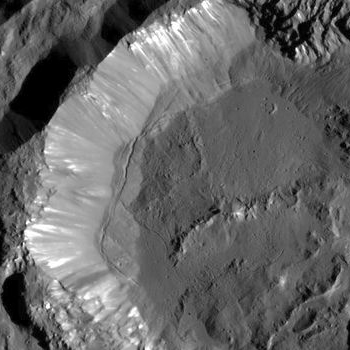
Kupalo Crater on Ceres

The Dawn science team today released a set of close-up images of several craters on Ceres, showing a number of geological features similar but different than features seen in lunar craters.

The image on the right, of Kupalo Crater, shows the same kind of bright material on the rim that is seen on the floor of Occator Crater as two bright areas. The bright material is now believed to be a salt deposit leeched from beneath the surface. Other craters showed extensive fractures in their floor as well as lobes and scarps.

0 comments
1 614 615 616 617 618 798