Second Google Lunar X-Prize launch contract confirmed

The competition heats up: The Google Lunar X-Prize has now confirmed two launch contracts for sending a privately financed and built rover to the Moon by 2017.

Moon Express is now the second company to have a launch contract for their lunar lander spacecraft verified by the X Prize Foundation. An Israeli team, SpaceIL, had its contract to launch a lander on a SpaceX Falcon 9 verified by the foundation in October. SpaceIL will be one of the primary payloads on a launch purchased in September by Spaceflight Industries that will carry about 20 other spacecraft. That initial launch contract verification allowed the foundation to formally extend the competition’s deadline to the end of 2017. Teams have until the end of 2016 to submit their own launch contracts in order to continue in the competition.

Sixteen teams remain in the competition, announced in September 2007, to land a privately-developed spacecraft on the moon, travel at least 500 meters across its surface, and return high-resolution videos and other data. Some teams are cooperating with others for launch arrangements.
2 comments

French Mars’ instrument repair looks good

The head of France’s space agency announced today that repairs to their instrument for NASA’s InSight Mars lander will be completed in time to ship the instrument to the U.S. in time for the scheduled March launch.

Briefing reporters here at the COP21 United Nations Climate Change Conference, Jean-Yves Le Gall said the leak, which compromised the required high-precision vacuum chamber carrying InSight sensors, was caused by a defective weld that is applied to close off the tank.

The leak’s cause has been identified and a new weld performed, Le Gall said. Tests to confirm the new weld’s integrity are underway and, assuming no problems, will be completed in time to ship the instrument to the United States in the first week of January. It will then be integrated into the InSight lander in preparation for the March launch.

0 comments

Success at last for Akatsuki

Five years after the Japanese Venus probe Akatsuki’s main engines failed while trying to put it into orbit, the spacecraft today fired its attitude thrusters and was successfully inserted into orbit.

This is a singular achievement by the Japanese engineers running the mission. They improvised a plan using the thrusters, which were designed to adjust the spacecraft orientation, not its course, and were able to get Akatsuki in an solar orbit that brought it back to Venus.

0 comments

Russia has another launch failure

In the heat of competition: Russia today confirmed that its Saturday launch of a military satellite failed when the satellite did not separate from the Soyuz rocket’s upper stage.

For most of the weekend Russian news sources were claiming that the satellite had been inserted into its proper orbit. One source however had correctly noted the failure. Because of the contradiction I had held off posting on this. Now that the failure is confirmed, it reveals again what seem to be chronic quality control problems within the Russian aerospace industry. They fix problem one place and another pops up somewhere else.

0 comments

New spectacular images of Pluto

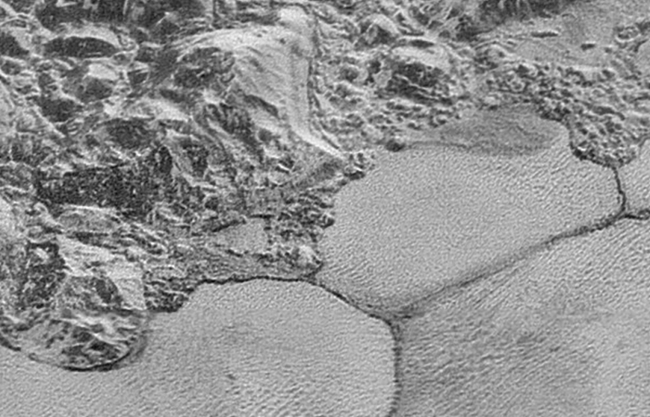
Pluto's mountainous shoreline

Many cool images! The New Horizons science team has today released new images from the spacecraft’s close fly-by of Pluto.

These latest pictures are part of a sequence taken near New Horizons’ closest approach to Pluto, with resolutions of about 250-280 feet (77-85 meters) per pixel – revealing features less than half the size of a city block on the diverse surface of the distant planet. In these new images, New Horizons captured a wide variety of spectacular, cratered, mountainous and glacial terrains.

I have cropped and lowered the resolution of the image above to fit it here. Make sure you click on the link to see it and the other images. As they note,

In this highest-resolution image from NASA’s New Horizons spacecraft, great blocks of Pluto’s water-ice crust appear jammed together in the informally named al-Idrisi mountains. Some mountain sides appear coated in dark material, while other sides are bright. Several sheer faces appear to show crustal layering, perhaps related to the layers seen in some of Pluto’s crater walls. Other materials appear crushed between the mountains, as if these great blocks of water ice, some standing as much as 1.5 miles high, were jostled back and forth. The mountains end abruptly at the shoreline of the informally named Sputnik Planum, where the soft, nitrogen-rich ices of the plain form a nearly level surface, broken only by the fine trace work of striking, cellular boundaries and the textured surface of the plain’s ices (which is possibly related to sunlight-driven ice sublimation).

Today’s release also includes a short animation of a faint distant Kuiper Belt object, assembled by four images taken by New Horizons. The images don’t show much more than a streak of light, but the feat of imaging this object by a spacecraft billions of miles away in this manner is breath-taking.

1 comment

India wins contract to launch private weather satellites

The competition heats up: The first two satellites in the first private weather satellite constellation will be launched on India’s PSLV rocket.

With 12 satellites on orbit, PlanetiQ will collect approximately 34,000 “occultations” per day, evenly distributed around the globe with high-density sampling over both land and water. Each occultation is a vertical profile of atmospheric data with very high vertical resolution, comprised of measurements less than every 200 meters from the Earth’s surface up into the ionosphere. The data is similar to that collected by weather balloons, but more accurate, more frequent and on a global scale.

“The world today lacks sufficient data to feed into weather models, especially the detailed vertical data that is critical to storm prediction. That’s why we see inaccurate or ambiguous forecasts for storms like Hurricane Joaquin, which can put numerous lives at risk and cost businesses millions of dollars due to inadequate preparation or risk management measures,” McCormick said. “Capturing the detailed vertical structure of the atmosphere from pole to pole, especially over the currently under-sampled oceans, is the missing link to improving forecasts of high-impact weather.”

This project is a win-win for aerospace. Not only will this weather constellation help shift ownership of weather satellites from government to private ownership, the company’s decision to use India’s PSLV rocket increases the competition in the launch industry.

0 comments

LRO finds lunar impact site for Apollo rocket stage

Lunar Reconnaissance Orbiter has located the impact site for the Apollo 16 rocket booster that, like four other boosters, had been deliberately crashed on the surface so the Apollo seismometers could use the vibrations to study the Moon’s interior.

The other impact sites had been found already, but Apollo 16 was harder to pin down because contact with the booster had ended prematurely so its location was less well known.

0 comments

Oblique view of Ceres’s bright spots

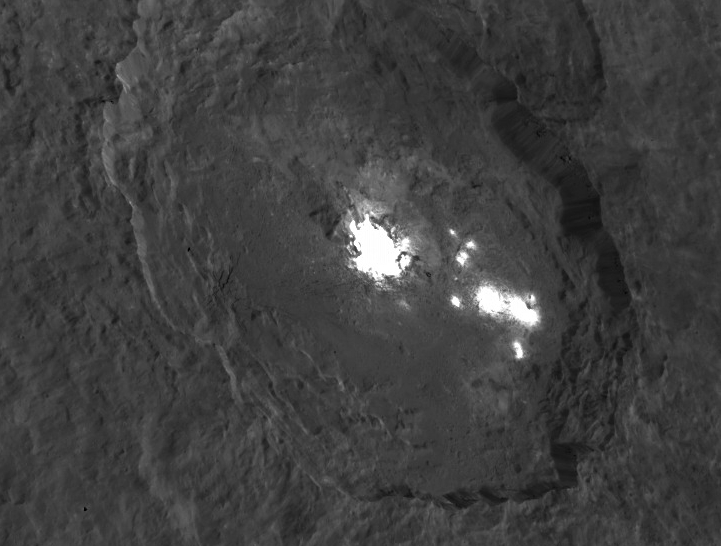
Occator Crater on Ceres

Cool image time! The image above is a newly released image of Occator Crater on Ceres, the location of the dwarf planet’s double bright spots, taken by Dawn in October.

I have cropped the image to focus on the crater and the bright spots. Unlike most previous images, this one is taken from an angle to bring out the topography, which also confirms what other data had shown, that the bright spots are not on top of any peaks. If anything, they appear to be located at low spots in the crater, as that previous data had suggested.

Though the spots are not really very bright, they are very bright relative to the dark surface of Ceres. This is why it is difficult to get a good image of them. Either you have to over-expose the spots to see the surface details around them, or under-expose the surface around them to see some detail in the spots. This image tries to find a middle ground.

Eventually they will move Dawn in very close to try to get higher resolution images of the spots alone. At that time we might finally be able to get a better understanding of what causes them.

0 comments

Lisa Pathfinder lifts off

Lisa Pathfinder, an experimental probe to test the technologies for measuring gravity waves in space, was successfully launched today by Arianespace’s Vega rocket.

At its core is a pair of free-floating, identical 46 mm gold–platinum cubes separated by 38 cm, which will be isolated from all external and internal forces acting on them except one: gravity. “LISA Pathfinder will put these test masses in the best free-fall ever produced in space and monitor their relative positions to unprecedented precision,” says Karsten Danzmann, who also is the Co-Principal Investigator for the LISA Pathfinder Technology Package, the scientific heart of the satellite. “This will lay the foundations for future gravitational-wave observatories in space such as eLISA.”

It is important to point out that this probe will not measure gravity waves. It doesn’t have the sensitivity to do it. Instead it is testing the engineering, as described above, for building a later probe that will have sensitivity. To gain that sensitivity the floating cubes must be much farther apart, and likely will require several independent satellites flying in formation.

0 comments

Next Falcon 9 first stage to touch down on land?

The competition heats up: SpaceX is considering an attempt to land its Falcon 9 first stage on land in its next launch in two weeks.

Carol Scott, who works technical integration for SpaceX within NASA’s Commercial Crew Program, told reporters here at the Cape Canaveral Air Force Station today that SpaceX’s first attempt at a land-based rocket landing may be coming sooner than the public expects. “You know how they want to fly the stage back, right? Their plan is to land it out here on the Cape [Canaveral] side,” Scott told reporters.

The company declined to comment on Scott’s remarks, which are vague enough to leave them plenty of wiggle room. Not that it matters. Even if they attempt the next first stage landing on a barge, a landing on land will soon follow. It is only a matter of time.

0 comments

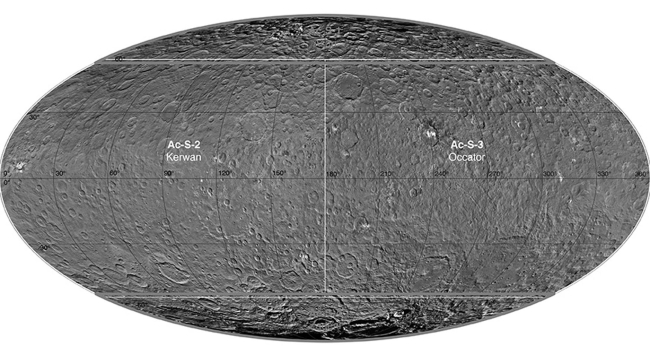
The first Ceres atlas

Ceres's first atlas

Using data during Dawn’s first orbit of Ceres German scientists have compiled a global atlas of the dwarf planet.

The images used for this are the wide angle survey images, which won’t show the smallest objects because they were taken from about 2,700 miles above the surface. Nonetheless, this atlas gives scientists a baseline for studying the giant asteroid.

1 comment
1 617 618 619 620 621 798