ULA prepares Atlas 5 for its third October launch

The competition heats up: ULA will attempt its third Atlas 5 launch in October, launching a new GPS satellite for the Air Force on October 30.

In the past ULA never packed its launches in this tightly. I suspect they are now doing so because of the competition from SpaceX. They need to show their customers, both commercial and the government, that they are a reliable launch provider. Launching three Atlas 5s in one month is one way to do it.

0 comments

SpaceX Dragonfly test vehicle arrives in Texas

The competition heats up: Dragonfly, SpaceX’s test capsule for testing vertical rocket landings, has arrived at their facility in McGregor, Texas.

DragonFly will be attached to a large crane, ahead of a series of test firings of its SuperDraco thrusters to set the stage towards the eventual goal of propulsive landings. The first test is set to take place in the next few weeks to kick start around two years of incremental testing.

Similar in concept to Grasshopper, Dragonfly is not an actual Dragon capsule, but a testbed for figuring out how to do vertical landings with a capsule, using thrusters.

0 comments

SpaceX switches payloads for next launch

The competition heats up: SpaceX has rearranged the payloads for its next two launches, delaying the SES-9 geosynchronous communications satellite launch until December to instead launch 11 Orbcomm low-orbit satellites in November.

Using the upgraded Falcon 9, this switch will give them more fuel to try a vertical landing of the first stage on this first launch. They will then try again on the second launch.

0 comments

Fractures on Enceladus’s north pole

Enceladus's North Pole

The Cassini science team has released the first image from Wednesday’s flyby of the Saturn moon Enceladus.

Scientists expected the north polar region of Enceladus to be heavily cratered, based on low-resolution images from the Voyager mission, but the new high-resolution Cassini images show a landscape of stark contrasts. “The northern regions are crisscrossed by a spidery network of gossamer-thin cracks that slice through the craters,” said Paul Helfenstein, a member of the Cassini imaging team at Cornell University, Ithaca, New York. “These thin cracks are ubiquitous on Enceladus, and now we see that they extend across the northern terrains as well.”

To see more you can browse the raw images here.

The next flyby later this month will be especially interesting as they will dip to within 30 miles of the surface.

0 comments

More evidence of giant flash floods on Mars

Mangala Valles

A newly released image from ESA’s Mars Express orbiter shows that catastrophic flooding — caused by ice melted from volcanic activity — created the Mangala Valles channels on Mars.

The perspective image on the right shows the topography of the region, with low points indicated in blue and high points by red. The channel along the right side of the image is Mangala Valles itself, though you can also see additional flood channels to the left of it passing around and through a large crater whose floor now stands above the surrounding terrain caused by the erosion of the rim plus the deposit of sediment inside the crater during the flooding.

I have a soft spot for Mangala Valles. When it was first photographed by the first orbiter missions to Mars in the early 1970s I was struck by its river-like appearance and striking topography. I therefore placed my Martian colony here in one of my efforts at science fiction writing. I figured it a good location for colonization, as there would likely be water and, by roofing over the deep canyon, a colony could be built relatively easily.

Better locations on Mars have since been found, but the location still intrigues me.

2 comments

Smallsat rocket launchers get NASA contracts

The competition heats up: NASA this week awarded contracts ranging from $4.7 to $6.9 million to three different smallsat launch companies.

The companies are Firefly Space Systems, Rocket Lab USA, and Virgin Galactic. The second is the company that just won the contract to put a privately-built lunar rover on the moon (part of the Google Lunar X-Prize).

In the past, cubesats and other small satellites could only afford to be secondary payloads on much larger rockets. Thus, they were at the mercy of the needs of the primary payload, often resulting in significant unplanned delays before launch. This in turn acted to discourage the development of smallsats. Now, with these private launch companies designed to service them exclusively the smallsat industry should start to boom.

Note also the low cost of these contracts. The small size of cubesats and the launchers designed for them means everything about them costs much less. Putting an unmanned probe into space is thus much more affordable.


4 comments

Antares failure wipes out Aerojet’s 2nd quarter profits

The settlement between Orbital ATK and Aerojet Rocketdyne over the failure of an Aerojet Russian engine that failed during an Antares launch has wiped out Aerojet’s entire second quarter profit.

The Rancho Cordova rocket engine maker reported a $38.1 million quarterly loss Tuesday, largely the result of a spectacular launchpad explosion last October that forced Aerojet to pay a hefty settlement to a key customer and prompted the end of a profitable supply contract. Aerojet, which has embarked on a cost-cutting program, said the third-quarter loss came to 62 cents a share. It compared to a year-ago loss of $9.9 million, or 18 cents a share.

The company’s stock has also been declining, probably linked to its loss of business to Blue Origin.

0 comments

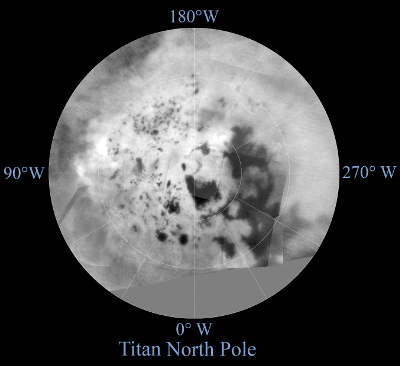
New global maps of Titan

Titan's North Pole

The Cassini science team has released new maps of Titan, including new maps of both poles, assembled from images taken during the 100 flybys that the spacecraft has made of the moon since it arrived in orbit around Saturn.

The scale is rough, just less than a mile at best, and there is no topographic information because the thick atmosphere allows for no strong sunlight or shadows. The images show differences in surface brightness, which does tell us where Titan’s dark methane lakes are.

This is likely the best we will get of Titan for decades, until another spacecraft is sent there.

0 comments

Putin delays first launch from Vostochny

During an inspection tour of Russia’s new Vostochny spaceport, Vladimir Putin announced that the first launch should be delayed from December to the spring of 2016.

“We do not need any drumbeating reports, we need high-quality results,” Putin said. “So let us agree: you finish the work related to water supply and wastewater disposal. It is necessary to prepare spaceships for launches. And be ready to carry out the first launches in 2016, somewhere in the spring.” “If you do that before Cosmonautics Day, that will be fine,” the president added.

Cosmonautics Day is the anniversary of Yuri Gagarin’s first spaceflight, April 12, so this is the new deadline Putin is setting. He doesn’t mention anything about the launch assembly building supposedly built to the wrong size.

0 comments

Cassini’s last flybys of Enceladus

As Cassini approaches the end of its decade-long mission at Saturn it will begin its last series of flybys of the moon Enceladus starting October 14.

Images will arrive a day or two afterward. The last two flybys will take place in late October and then in December, with the second October flyby getting closest, only 30 miles from the surface.

Beginning next year they will shift the spacecraft’s orbit so that it can get a better look at Saturn’s poles during its last two years. In that orbit flybys of the moons cannot be done.

0 comments

Neiman Marcus sells suborbital space tickets

The competition heats up: Flights on Worldview high altitude balloon will be offered through the Neiman Marcus Christmas catalog.

World View, the commercial balloon spaceflight company, has been included in the Neiman Marcus Christmas Book as one of ten elite Fantasy Gifts. The annual Christmas Book will include an exclusive World View package available only to ten Neiman Marcus customers. This package features the rare opportunity to be a part of a World View test flight with a behind-the-scenes invitation while enjoying luxurious accommodations at the Miraval Resort in Tucson, Ariz. Each package also includes a private tour of Biosphere 2 with original crew member and World View CEO, Jane Poynter, along with a ticket to be one of the first to see Earth from the company’s luxury pressurized capsule.

0 comments

ULA picks Vulcan launchpads

The competition heats up: ULA has picked the two launchpads it will use for its new Vulcan rocket.

United Launch Alliance’s next-generation Vulcan rocket will lift off from the company’s existing Atlas 5 launch facilities in Florida and California, according to the company’s Vulcan program manager. The launch pads at Cape Canaveral and Vandenberg Air Force Base will require modifications to accommodate the Vulcan booster, which is wider than the Atlas 5 rocket’s existing first stage, said Mark Peller, ULA’s Vulcan program manager, at the International Symposium for Personal and Commercial Spaceflight in Las Cruces, New Mexico.

This decision mainly outlines how ULA hopes to eventually reduce the number of launchpads it must maintain, and thus reduce its costs.

0 comments

Pentagon refuses ULA Russian engine waiver

The Pentagon has denied ULA its request for a waiver to allow it to use more Russian engines in its Atlas 5 rocket than allowed by Congress.

It appears the Defense Department is in no hurry to give ULA any slack in its dependence on Russian engines, and instead seems to agree with Congress that the company should stop complaining and get around to replacing those engines as fast as possible.

0 comments

Next New Shepard test flight expected before December

The competition heats up: Blue Origins has revealed that the next test flight of its suborbital New Shepard capsule and launch rocket will take place before the end of 2015.

They also noted that they will not be selling any tickets for suborbital flights for at least two more years, until they are satisfied that the test flights have proven the system. This is a far cry from other suborbital companies like Virgin Galactic and XCOR, who have made big promises to garner ticket sales, and have yet to deliver. Jeff Bezos’s company has instead decided to deliver first, and then sell tickets.

In the end, we shall see who wins the race to put the first tourists into space. What is certain in all this however is that Virgin Galactic has squandered the ten-year headstart it had when it started out in 2004.

In related news, Virgin Galactic says that construction of its second SpaceShipTwo ship is progressing well.

0 comments
1 621 622 623 624 625 798