3D image of Comet 67P/C-G

Do you own red-blue 3-D glasses? Get them out and go to this link. Rosetta scientists have created a 3-D image of Comet 67P/C-G, including the jets of material shooting out from its surface.

[C]reating a 3d anaglyph of dynamic events like this is notoriously difficult: often the jets are too faint or their duration is too short to find two high-quality images taken several minutes apart that are suitable to pair together to create this type of view. However, the OSIRIS team got lucky with this particular event, capturing two images separated by about two-and-a-half minutes.

The image shows a bright, collimated jet embedded in a broader emission structure. The three dimensional perspective also reveals the conical shape of the jet and that the collimated feature is emitted towards the observer.


0 comments

Russian lunar mission delayed again

The Russian Luna-Glob has been delayed again, partly due to embargoes imposed by the Ukraine war, and partly due to a lack of money.

The article notes that Russia’s participation in the European ExoMars project has left little resources for this lunar mission, causing delays. It also notes the possibility that the second mission in ExoMars, scheduled for 2018, might be delayed as well. (The first ExoMars mission is scheduled to launch next year.)

All-in-all, this story indicates to me that the Russians continue to have serious underlying financial and management problems throughout their society. Having lost faith in capitalism, after 20 years of not really doing it right, they have returned to a soviet-style big government top-down approach. I doubt it will solve their problems.

0 comments

More confirmation from Curiosity of past lakes in Gale Crater

New data from Curiosity has now provided further confirmation that the deeper sedimentary layers seen in Gale Crater were likely formed far in the past by flowing water.

“Paradoxically, where there is a mountain today there was once a basin, and it was sometimes filled with water,” said John Grotzinger, the former project scientist for Mars Science Laboratory at the California Institute of Technology in Pasadena, and lead author of the new report. “We see evidence of about 250 feet (75 meters) of sedimentary fill, and based on mapping data from NASA’s Mars Reconnaissance Orbiter and images from Curiosity’s camera, it appears that the water-transported sedimentary deposition could have extended at least 500 to 650 feet (150 to 200) meters above the crater floor.”

Furthermore, the total thickness of sedimentary deposits in Gale Crater that indicate interaction with water could extend higher still, perhaps up to one-half mile (800 meters) above the crater floor.

Above 800 meters, Mount Sharp shows no evidence of hydrated strata, and that is the bulk of what forms Mount Sharp. Grotzinger suggests that perhaps this later segment of the crater’s history may have been dominated by dry, wind-driven deposits, as was once imagined for the lower part explored by Curiosity.

This was always the reason to go and climb Mount Sharp. As Curiosity heads uphill it begins to map out the geological history of Mars, first as a wet place with liquid water, then as a dry place in which the water is gone.

0 comments

Ice and blue skies on Pluto

New data downloaded from New Horizons has confirmed the presence of ice on the planet’s surface, as well as suggesting that the planet’s sky might actually be colored blue.

The haze particles themselves are likely gray or red, but the way they scatter blue light has gotten the attention of the New Horizons science team. “That striking blue tint tells us about the size and composition of the haze particles,” said science team researcher Carly Howett, also of SwRI. “A blue sky often results from scattering of sunlight by very small particles. On Earth, those particles are very tiny nitrogen molecules. On Pluto they appear to be larger — but still relatively small — soot-like particles we call tholins.”

Scientists believe the tholin particles form high in the atmosphere, where ultraviolet sunlight breaks apart and ionizes nitrogen and methane molecules and allows them to react with each other to form more and more complex negatively and positively charged ions. When they recombine, they form very complex macromolecules, a process first found to occur in the upper atmosphere of Saturn’s moon Titan. The more complex molecules continue to combine and grow until they become small particles; volatile gases condense and coat their surfaces with ice frost before they have time to fall through the atmosphere to the surface, where they add to Pluto’s red coloring.

0 comments

Cygnus grabs March Atlas 5 launch slot

The competition heats up: Taking advantage of delays in prepping a NOAA weather satellite, Orbital ATK has grabbed a March launch slot on the Atlas 5 for its Cygnus capsule.

Originally Orbital was going to launch on an Atlas 5 in December and then late in 2016 (based on Atlas 5 launch manifest availability), with the Antares launching a Cygnus in-between. By taking this March Atlas 5 launch, they can push the Antares return-to-flight launch back, thus giving themselves more time to install and test its new Russian first stage engines.

0 comments

Second Atlas 5 launch in only six days

The competition heats up: Only six days after its previous launch, a ULA Atlas 5 today successfully launched an American surveillance satellite.

This was the shortest time yet between Atlas 5 launches. While the most likely reason for the quick turnaround was centered on the needs of the satellites, I also suspect the increased competition for launch services has prodded ULA to demonstrate improved capabilities.

1 comment

Sierra Nevada touts new work on Dream Chaser

The competition heats up: As part of the normal lobbying that companies due prior the awarding of a government contract, Sierra Nevada today put out a press release describing the work they are doing to prepare both their Dream Chaser engineering test article (ETA) for glide tests and their Dream Chaser orbital vehicle for flight tests.

The announcement describes how they plan to do the next ETA glide test early in 2016, followed by orbital test flights of the orbital vehicle. Of course, that plan depends entirely on whether NASA picks them as one of the two companies for the second round of contracts to provide cargo to ISS.

The release however does include a nice picture of the ETA, which looks completely ship-shape following the failure at landing of one of its landing wheels during the first glide test. They have since replaced those wheels, which came from an airplane and were not the intending wheels for the actual spacecraft.

1 comment

China launches first commercial Earth-observation satellite

The competition heats up: China today successfully launched its first Earth-observation satellite for providing commercial images to the public.

A Long March 2C rocket launched the Jilin 1 satellite constellation, which consists of a primary high definition optical satellite, as well as two Lingqiao video satellites and a fourth, LQSat, to test space technology. Xuan Ming, from the Chang Guang Satellite Technology Co., Ltd, earlier told Xinhua the satellites will focus on providing images to commercial clients, while helping with harvest assessment, geological disaster prevention and resource surveys. Jilin-1 is reported to be capable of very high definition images, boasting a resolution of 0.72m with a pan-chromatic camera and a 4m resolution multi-spectral camera.

The article also provides a short but nice summary of China’s space plans for 2016, including its first manned mission since 2013.

0 comments

Another Google Lunar X-Prize contestant announces launch contract

The competition heats up: Another Google Lunar X-Prize team, SpaceIL, has announced the signing of a launch contract, this time as a secondary payload on a Falcon 9 launch in the latter half of 2017.

Their press release says they are the first to produce an actual contract to the contest, which only means the Moon Express contract hasn’t yet been delivered.

This two launch contracts suggest that the competition for the X-Prize will get interesting in 2017. As a secondary payload, SpaceIL will not be able to schedule its launch. And while Moon Express, as a primary payload on smallsat rocket, can schedule its launch, it is depending on a new untried rocket, Electron, being developed by a new untried rocket company, Rocket Labs.

And since SpaceIL is an Israeli company, be prepared for some Muslim and leftwing heads to explode should it win the X-Prize. How dare they oppress those Palestinians by getting their rover to the Moon first!

0 comments

An avalanche on Mars, as it happens

Avalanche on Mars

Cool image time! In their routine monitoring for avalanches at the layered deposits at the Martian north pole, the Mars Reconnaissance Orbiter science team captured the avalanche on the right, as it happened.

This picture managed to capture a small avalanche in progress, right in the color strip. … The small white cloud in front of the brick red cliff is likely carbon dioxide frost dislodged from the layers above, caught in the act of cascading down the cliff. It is larger than it looks, more than 20 meters across, and (based on previous examples) it will likely kick up clouds of dust when it hits the ground.

They note that avalanches in this area of Mars are common in the spring when things are warming, and have been documented previously, but possibly not so dramatically.

4 comments

Guess where?

Pluto lake

I found the image on the right while trolling about on the various raw image sites for NASA’s planetary missions. No press release yet, and maybe there never will be one. I do know the scientists involved in this particular mission are right now drooling over the details available in the full resolution image, which I have cropped and reduced to fit on the right. Take a look and you will drool as well.

Want to know where this is? I bet you have already guessed, but if you need help, click on the “read more” link below, where I have also added some comments.
» Read more

0 comments

Facebook to provide internet access to Africa

The competition heats up: Using an Israeli communications satellite built by the European satellite company Eutelsat and slated to be launched by SpaceX in 2016, Facebook will provide internet service to the African continent.

Under a partnership announced Monday, Facebook and European satellite operator Eutelsat will buy all of the broadband capacity on the AMOS-6 satellite owned by Israeli company Spacecom. The mission has no confirmed launch date, with SpaceX still recovering from a Falcon 9 launch failure in June, but the partners expect the satellite to begin service in the second half of 2016, according to a press release.

What I like about this is the number of companies involved, all trying to make money, with Facebook the newcomer to the space industry. And the more the merrier, I say!

0 comments

A list of all smallsat launch rockets

Doug Messier has compiled a very interesting table showing all the known smallsat launch vehicles presently under construction or in operation.

Most of the operational rockets, such as Orbital ATK’s Minotaur, have turned out to be too expensive for their small payloads, and have not been very profitable. The new generation of rockets, however, have the chance of success, as they are all working to reduce the cost significantly. Keep your eye especially on Rocket Labs (which just signed a contract with Moon Express), Swiss Space Systems, Firefly Space Systems, and (dare I say it?) Virgin Galactic.

1 comment

France considers developing reusable first stage

The competition heats up: Two French government aerospace agencies have announced that they are researching the development of a reusable first stage.

It is very unclear how this research will be applied, since Europe’s replacement for the Ariane 5 is being built by Airbus Safran and they have made it clear that they only intend to recover their rocket’s engines, not the entire first stage.

0 comments

ULA completes its 100th successful launch

The competition heats up: In a rare private commercial launch, ULA’s Atlas 5 rocket put a Mexican communications satellite in orbit on Friday, the 100th successful launch for the company.

The company still faces the same problems it did before this launch: It is running out of Russian engines for the Atlas 5, Congress is not willing to give them permission to use more, and the cost competition from SpaceX is not going to let up.

0 comments

Moon Express buys launch contract

The competition heats up: The leading private effort to win the Google Lunar X-Prize, Moon Express, has signed a contract with the smallsat launch company Rocket Labs for three launches.

Mountain View, California-based Moon Express plans to use the launches to send to the moon new, smaller versions of its MX-1 lunar lander. Two of the launches will take place in 2017, with a third to be scheduled. All three will use Rocket Lab’s Electron small launch vehicle, whose first flight is scheduled for no earlier than late 2015 from New Zealand. – See more at: http://spacenews.com/moon-express-buys-rocket-lab-launches-for-lunar-missions/#sthash.J1hEuCp3.dpuf

Rather than piggyback on the major launch of big payload, which would deny them any control over launch dates, they have signed with a new and as yet unproved small rocket company. The result? Not only do we have the chance of getting our first privately built lander on the Moon, the contract jumpstarts a new rocket company designed to put small payloads into space.

0 comments

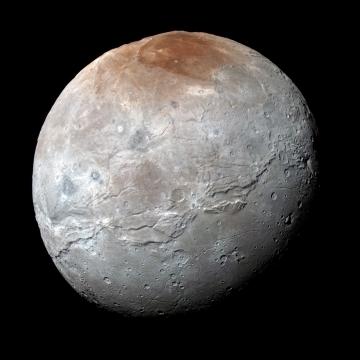
Charon in color

Charon

The New Horizons science team has released new high resolution images of Pluto’s moon Charon, including the global enhanced color view on the right.

High-resolution images of the Pluto-facing hemisphere of Charon, taken by New Horizons as the spacecraft sped through the Pluto system on July 14, and transmitted to Earth on Sept. 21, reveal details of a belt of fractures and canyons just north of the moon’s equator. This great canyon system stretches across the entire face of Charon, more than a thousand miles, and probably around onto Charon’s far side. Four times as long as the Grand Canyon, and twice as deep in places, these faults and canyons indicate a titanic geological upheaval in Charon’s past. “It looks like the entire crust of Charon has been split open,” said John Spencer, deputy lead for GGI at the Southwest Research Institute in Boulder, Colorado. “In respect to its size relative to Charon, this feature is much like the vast Valles Marineris canyon system on Mars.”

The team has also discovered that the plains south of the canyon, informally referred to as Vulcan Planum, have fewer large craters than the regions to the north, indicating that they are noticeably younger. The smoothness of the plains, as well as their grooves and faint ridges, are clear signs of wide-scale resurfacing.

In many ways these images remind me of an upside-down Mars, with the smooth lower plains in the south instead of the north. Obviously, the causes on Charon are going to be significantly different than those on Mars.

0 comments

A new map of Ceres

The Dawn science team has released several new false color maps of Ceres, showing the dwarf planet’s topographic and compositional differences.

They have also assigned names to many of the features that Dawn has discovered, including Ysolo Mons for that large peak near the north pole.

0 comments
1 622 623 624 625 626 798