Juno flight plan at Jupiter revised

In preparation for its arrival in orbit around Jupiter in about a year, engineers for the unmanned probe Juno have revised their planned orbital maneuvers.

Following a detailed analysis by the Juno team, NASA recently approved changes to the mission’s flight plan at Jupiter. Instead of taking 11 days to orbit the planet, Juno will now complete one revolution every 14 days. The difference in orbit period will be accomplished by having Juno execute a slightly shorter engine burn than originally planned.

The revised cadence will allow Juno to build maps of the planet’s magnetic and gravity fields in a way that will provide a global look at the planet earlier in the mission than the original plan. Over successive orbits, Juno will build a virtual web around Jupiter, making its gravity and magnetic field maps as it passes over different longitudes from north to south. The original plan would have required 15 orbits to map these forces globally, with 15 more orbits filling in gaps to make the map complete. In the revised plan, Juno will get very basic mapping coverage in just eight orbits. A new level of detail will be added with each successive doubling of the number, at 16 and 32 orbits.

The change will extend the official mission from 15 to 20 months, though I expect that even this will be extended if the spacecraft’s fuel holds out.


0 comments

NASA names its astronauts for the first Dragon and CST-100 flights

The competition heats up: NASA today named the four government astronauts that will fly on the first manned demo flights to ISS of SpaceX’s Dragon and Boeing’s CST-100.

Bob Behnken, Eric Boe, Doug Hurley and Sunita Williams are veteran test pilots who have flown on the shuttle and the International Space Station. ….

NASA said the four astronauts will train with both companies and have not yet been assigned to flights. Two-person crews will fly the first test flights by each capsule, after they have completed an orbital test flight without people on board. Company proposals anticipate an all-NASA crew flying SpaceX’s Dragon test flight, with Boeing’s CST-100 carrying a split NASA-Boeing crew. Boeing has not yet identified its astronaut.

5 comments

New radio communications from Philae

On July 9 Philae successfully transmitted data to Rosetta for the first time in more than two weeks.

Although the connection failed repeatedly after that, it remained completely stable for those 12 minutes. “This sign of life from Philae proves to us that at least one of the lander’s communication units remains operational and receives our commands,” said Koen Geurts, a member of the lander control team at DLR Cologne.

The mood had been mixed over the last few days; Philae had not communicated with the team in the DLR Lander Control Center (LCC) since 24 June 2015. After an initial test command to turn on the power to CONSERT on 5 July 2015, the lander did not respond. Philae’s team began to wonder if the lander had survived on Comet 67P/Churyumov-Gerasimenko.

The intermittent nature of Philae’s attempts at communication are puzzling. Normally, they either would have communications or they would not. For good communications to break off like this repeatedly is puzzling. It is almost as if there is a loose wire causing communications to go on and off, which seems an unlikely explanation for this problem.

2 comments

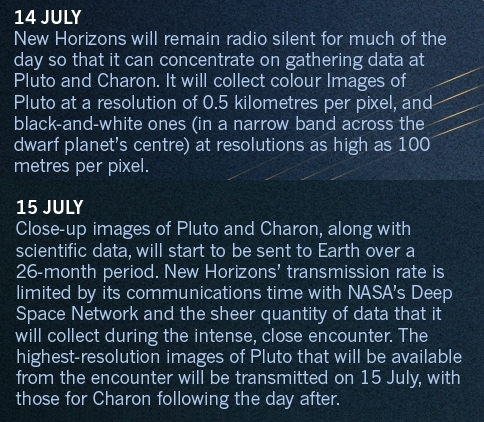
New image of Pluto and Charon

Pluto and Charon

The New Horizons science team today released a new image showing both Pluto and Charon, and not unexpectedly, they are very different from each other.

A high-contrast array of bright and dark features covers Pluto’s surface, while on Charon, only a dark polar region interrupts a generally more uniform light gray terrain. The reddish materials that color Pluto are absent on Charon. Pluto has a significant atmosphere; Charon does not. On Pluto, exotic ices like frozen nitrogen, methane, and carbon monoxide have been found, while Charon’s surface is made of frozen water and ammonia compounds. The interior of Pluto is mostly rock, while Charon contains equal measures of rock and water ice. “These two objects have been together for billions of years, in the same orbit, but they are totally different,” said Principal Investigator Alan Stern of the Southwest Research Institute (SwRI), Boulder, Colorado.

For a half century, since the first probes left Earth to visit other worlds, the one consistent axiom we have learned from every mission is that no two objects are going to be alike, and that every object out there is going to be incredibly unique. Pluto and Charon, in finishing the human race’s first inventory of the solar system, prove this axiom once again.

2 comments

Some results from SpaceX’s Dragon launchpad abort test

SpaceX has revealed some of the results from their Dragon launchpad abort test in May, which may explain why they have delayed the launch abort test until next year.

SpaceX engineers are evaluating the results of the May 6 pad abort test, in which the prototype Crew Dragon rocketed away from Cape Canaveral’s Complex 40 launch pad, reached an altitude of nearly one mile, and splashed down under parachutes just offshore in the Atlantic Ocean. Officials said data from the test showed a slight underperformance of the SuperDraco jetpack, and capsule did not reach the top speed and altitude targeted by engineers. But the test was successful by NASA’s standards, and the space agency awarded SpaceX a $30 million milestone payment after data reviews. [emphasis mine]

The article says that the delay is to make sure they are doing a launch abort test with the capsule design they intend to use, rather than an earlier design. I wonder if they also have decided they need more time to tweak their designs after this first test, and thus don’t want to use the capsule they had original planned to use since it has an older design.

Instead, the plan is to use the actual capsule after it has flown to ISS in their unmanned demo test flight of the manned capsule. They will not only be using their in-flight design for the test, this will give them extra time to study the results from the first test and revise the SuperDraco engines.

0 comments

Watch Opportunity’s full journey on Mars, in 8 minutes

The science team for the Mars rover Opportunity have released an 8-minute movie compiled from the rover’s hazard-avoidance cameras. Enjoy!

One comment: There is a long stretch of territory south of Albuquerque, New Mexico called Jornada de Muerto, which means “Journey of Death” in English. It gets its name from its lack of water or life. This video makes that stretch of land look like a water park, strongly highlighting the utter barrenness of the Martian surface.

2 comments

Best image yet of Pluto

Pluto

Very cool image time! The New Horizons science team today released [link fixed] their best image yet of Pluto, taken on July 7 immediately following the spacecraft’s recovery from safe mode.

This view is centered roughly on the area that will be seen close-up during New Horizons’ July 14 closest approach. This side of Pluto is dominated by three broad regions of varying brightness. Most prominent are an elongated dark feature at the equator, informally known as “the whale,” and a large heart-shaped bright area measuring some 1,200 miles (2,000 kilometers) across on the right. Above those features is a polar region that is intermediate in brightness.

For the first time these features look like actual surface areas on a planet, not fuzzy blobs. We are still seeing Pluto like we saw all planets prior to the space age, but at least now we know what we are looking at.

6 comments

A New Horizons map of Pluto

New Horizons map of Pluto

Cool image time! The New Horizons science team today released their best global map of Pluto, as seen so far.

The center of the map shows the area that New Horizons will see close-up during the fly-by.

The elongated dark area informally known as “the whale,” along the equator on the left side of the map, is one of the darkest regions visible to New Horizons. It measures some 1,860 miles (3,000 kilometers) in length. Directly to the right of the whale’s “snout” is the brightest region visible on the planet, which is roughly 990 miles (1,600 kilometers) across. This may be a region where relatively fresh deposits of frost—perhaps including frozen methane, nitrogen and/or carbon monoxide—form a bright coating.

Continuing to the right, along the equator, we see the four mysterious dark spots that have so intrigued the world, each of which is hundreds of miles across. Meanwhile, the whale’s “tail,” at the left end of the dark feature, cradles a bright donut-shaped feature about 200 miles (350 kilometers) across. At first glance it resembles circular features seen elsewhere in the solar system, from impact craters to volcanoes. But scientists are holding off on making any interpretation of this and other features on Pluto until more detailed images are in hand.

Some of these features will not be resolved much clearer than this, as Pluto’s day is six Earth days long, and will thus not be visible any longer to the spacecraft during its last week approach. In addition, much of the southern hemisphere will also not be imaged at all, as the planet’s inclination puts much of that hemisphere out of view entirely.

Nonetheless, we will see a great deal that has never been seen before. Stay tuned!

1 comment

Musk makes first extended public comments since Falcon 9 failure

In the heat of competition: Elon Musk on Tuesday made his first detailed public comments about the Falcon 9 accident, the on-going investigation, and the aftermath.

Musk hopes to release more details on the failure by the end of this week after further data analysis and engineering reviews. “At this point, the only thing that’s really clear was there was some kind of over-pressure event in the upper stage liquid oxygen tank, but the exact cause and sequence of events, there’s still no clear theory that fits with all the data,” Musk said. “So we have to determine if some of the data is a measurement error of some kind, or if there’s actually a theory that matches what appear to be conflicting data points.”

He also had no word on when launches would resume.

0 comments

New Horizons team proposes cool names for Charon and Pluto features

In anticipation of their discovering many previously unseen features on both Pluto and Charon, the New Horizons science team released today a proposed list of names, including “Kirk”, “Spock”, and many other fictional science fiction characters.

Many of these suggestions were proposed by the public. Personally, I prefer the part of their proposal where they suggest naming features after real people, like Lewis Carroll and Arthur Clarke.

0 comments

Great Britain space agency calls for an increased space effort

The competition heats up: The United Kingdom’s space agency has issued its proposed future strategy, focusing on a renewed involvement with ISS and the European Space Agency.

Following a public consultation and lengthy discussions across government, the new strategy, published today, concludes that continued involvement in the ISS and other programs via ESA membership is the best way to involve U.K. scientists and industry in human spaceflight. The document says the government will consider bilateral projects with other space agencies but fears always being the junior partner since the United Kingdom has no launchers or space stations. It does not think that the commercial launch industry is sufficiently mature for the United Kingdom to buy services commercially. The report also states: “The Agency will also consider its role in human exploration missions beyond Earth orbit, especially where this complements science and technology goals for robotic exploration.”

I wonder if the newly elected conservative British government agrees with this strategy. It appears to me that it was researched and written prior to the election.

1 comment

Dawn recovers from safe mode

Spot 1

Beginning on June 30 Dawn experienced an as yet unexplained “anomaly” that put it into safe mode for several days.

According to JPL, engineers have uploaded “configuration changes” that solved the problem, and the spacecraft has returned to normal operations, continuing its second mapping orbit of Ceres. From this position they are gathering wide angle images of the entire planet, from which they will construct a detailed global map to be used as a baseline during later more detailed close-up orbits. For example, they released this very nice image today of what is called “Spot 1”, shown on the right. I have cropped it to focus on the spot itself. Looks almost like scattered snow on the surface, doesn’t it?

1 comment

All A-OK with New Horizons

Engineers have pinpointed the issue — “a hard-to-detect timing flaw in the spacecraft command sequence” — that caused New Horizons to enter safe mode on Saturday.

Since they do not plan to upload any similar commands before the July 14th fly-by, they do not expect a repeat of this problem. Full science operations are expected to resume on July 7.

3 comments

Obamacare continues to cause health insurance premiums to skyrocket

Finding out what’s in it: Health insurance companies are now requesting (and getting) rate increases from 23 to 54 percent due to the increased costs imposed by Obamacare.

Blue Cross and Blue Shield plans — market leaders in many states — are seeking rate increases that average 23 percent in Illinois, 25 percent in North Carolina, 31 percent in Oklahoma, 36 percent in Tennessee and 54 percent in Minnesota, according to documents posted online by the federal government and state insurance commissioners and interviews with insurance executives.

The Oregon insurance commissioner, Laura N. Cali, has just approved 2016 rate increases for companies that cover more than 220,000 people. Moda Health Plan, which has the largest enrollment in the state, received a 25 percent increase, and the second-largest plan, LifeWise, received a 33 percent increase.

At the same time, many insurance companies are merging or leaving the market because of the law makes profitability impossible.

Obviously, we must all then vote for Democrats so they can use their brilliance (demostrated so clearly with Obamacare) to solve this problem by nationalizing healthcare.

12 comments

New Horizons temporarily loses contact with Earth

Engineers lost contact with New Horizons for an hour and twenty-one minutes on Saturday.

Engineers have since begun talking with the probe again, but NASA says it will take up to several days to get New Horizons back to normal. In the meantime, the US$700-million spacecraft is not recording science data. It is just 11 million kilometres from Pluto, and closing in fast.

Communication issues are exacerbated by the fact that it takes four and a half hours to send a signal, traveling at light speed, across the nearly 4.8 billion kilometres to the spacecraft — and four and a half hours back. In that elapsed time, the Earth has rotated so much that mission controllers must switch from one to another of the three deep-space antennas that communicate with spacecraft: in Goldstone, California; Canberra; and Madrid.

0 comments

Dragon/Falcon 9 launch abort test moved from Vandenberg to Kennedy

Instead of using the Air Force’s Vandenberg launch complex in California, NASA and SpaceX have shifted their plans for the final launch abort test of the manned version of Dragon capsule to the Kennedy Space Center in Florida.

The date for the test has not been finalized, but it appears it will be delayed until after the next Dragon flight to ISS, itself delayed following the Falcon 9 failure on Sunday. The test will also be delayed until after the completion of the unmanned demo flight to ISS of the manned version of Dragon. SpaceX will then refurbish that demo capsule and re-use it for the launch abort test.

Update: I have rewritten the paragraph above, correcting my first version, which had mistakenly said that a refurbished cargo version of Dragon would be used for the launch abort test. My very knowledgeable readers noted the error and set me straight.

4 comments

Progress successfully launched into orbit

Supplies for ISS! The Russians today successfully launched a Progress freighter into orbit to bring cargo to ISS.

After three failures since October from three different cargo systems (Cygnus, Progress, and Dragon), this success is somewhat of a relief for both the astronauts on board ISS and the managers of the station. It gives everyone some breathing room until both Cygnus and Dragon fly again.

1 comment

The jets on Comet 67P/C-G come from its sinkholes

More on the comet sinkholes! New data from Rosetta has now confirmed that some of the plumes or jets that the spacecraft has seen emanating from Comet 67P/C-G come directly from the sinkholes that they have discovered on the nucleus.

In a study reported today in the science journal Nature, 18 quasi-circular pits have been identified in the northern hemisphere of the comet, some of which are the source of continuing activity. The pits are a few tens to a few hundreds of metres in diameter and extend up to 210 m below the surface to a smooth dust-covered floor. Material is seen to be streaming from the most active pits. “We see jets arising from the fractured areas of the walls inside the pits. These fractures mean that volatiles trapped under the surface can be warmed more easily and subsequently escape into space,” says Jean-Baptiste Vincent from the Max Planck Institute for Solar System Research, lead author of the study.

0 comments
1 631 632 633 634 635 798