
The mysterious dark streaks on Vesta
In a preprint paper published today at the Los Alamos astro-ph website, scientists have taken a detailed look at the mysterious dark streaks seen by Dawn on the surface of the asteroid Vesta and have concluded that the material comes from impacts, not from volcanic activity.
The scientists also concluded that
the majority of the spectra of [dark material] are similar to carbonaceous chondrite meteorites mixed with materials indigenous to Vesta.
Carbonaceous chondrite meteorites are considered to be the most primeval material in the solar system. This means that Vesta has the potential to give scientists a convenient laboratory for studying that primeval material and the early formation of the solar system. Ideally, the best way to do this would of course be to go there.
The scientists also theorize that much of this material was brought to Vesta by a single large impact.
Our modeling efforts using impact crater scaling laws and numerical models of ejecta re-accretion suggest the delivery and emplacement of this [dark material] on Vesta during the formation of the ~400 km Veneneia basin by a low-velocity (<2 km/sec) carbonaceous impactor.
The Veneneia basin is one of the largest impact basins on Vesta and is thought to be about two billion years old.
Later impacts further distributed the dark material about the surface of Vesta, while also burying much of this material.
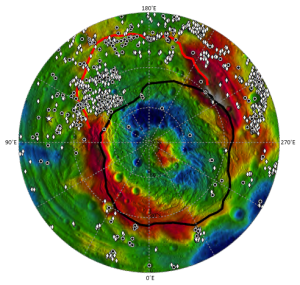
The image above shows the global distribution of geologic features associated with the dark material. Blue corresponds to lowest elevation and red the highest. Dark material is indicated by the white and black spots, with the black spots cases where the dark material is associated with craters. The black line indicates the approximate outline of the rim of the Rheasilvia basin, the largest such impact basin on Vesta and thought to be about one billion years old, while the broken red line indicates the rim of the older Veneneia basin.
As you can see, the dark material seems to cluster around the rim of the Veneneia basin. It mostly disappears inside the Rheasilvia Basin, which was created by an impact after Veneneia and wiped it away. The only evidence of dark material in the Rheasilvia Basin are newer crater impacts, which would have is drilled into the surface and exposed older material.
You can download and read the full paper here. [pdf]

On Christmas Eve 1968 three Americans became the first humans to visit another world. What they did to celebrate was unexpected and profound, and will be remembered throughout all human history. Genesis: the Story of Apollo 8, Robert Zimmerman's classic history of humanity's first journey to another world, tells that story, and it is now available as both an ebook and an audiobook, both with a foreword by Valerie Anders and a new introduction by Robert Zimmerman.
The print edition can be purchased at Amazon or from any other book seller. If you want an autographed copy the price is $60 for the hardback and $45 for the paperback, plus $8 shipping for each. Go here for purchasing details. The ebook is available everywhere for $5.99 (before discount) at amazon, or direct from my ebook publisher, ebookit. If you buy it from ebookit you don't support the big tech companies and the author gets a bigger cut much sooner.
The audiobook is also available at all these vendors, and is also free with a 30-day trial membership to Audible.
"Not simply about one mission, [Genesis] is also the history of America's quest for the moon... Zimmerman has done a masterful job of tying disparate events together into a solid account of one of America's greatest human triumphs."--San Antonio Express-News