
Curiosity’s exploration of boxwork on Mount Sharp
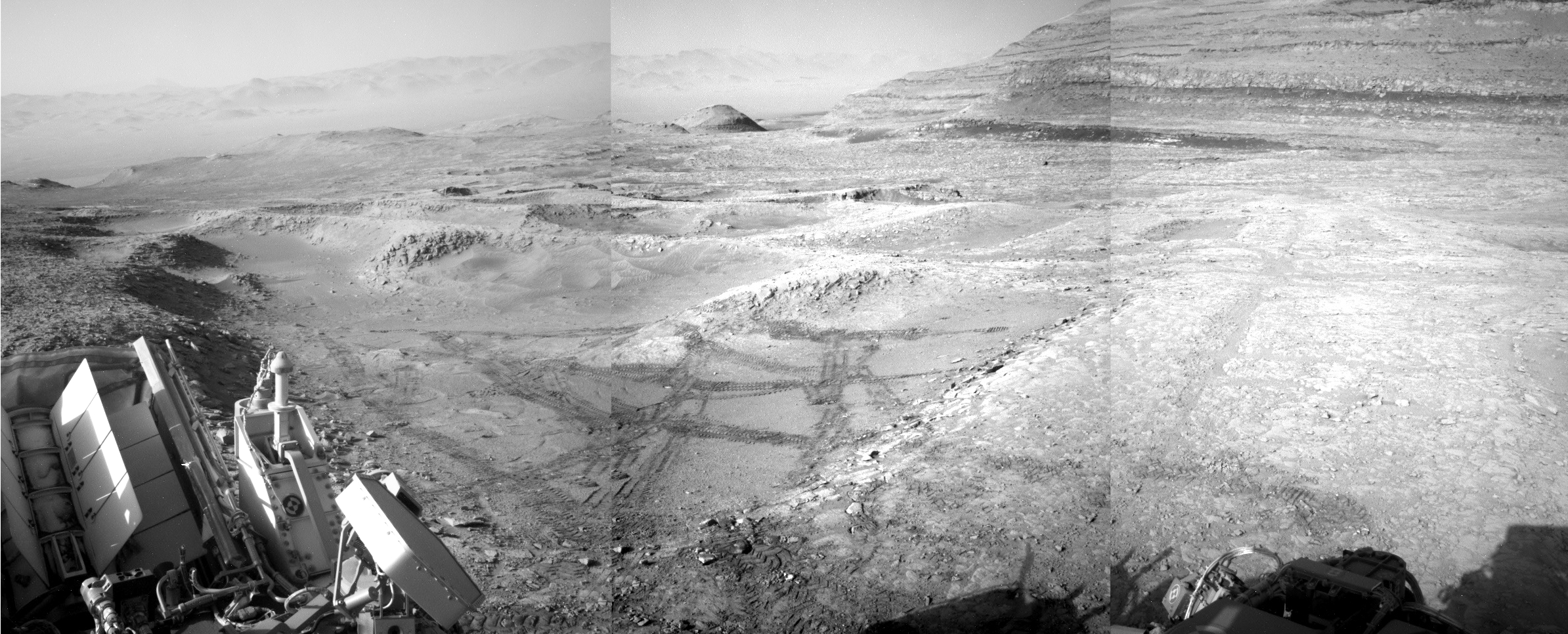
Click for high resolution panorama. For original images, go here, here, and here.


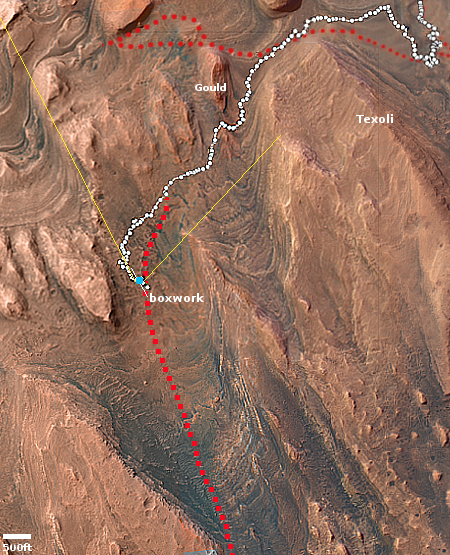
Click for interactive map.
Cool image time! The panorama above was created from three photographs taken on December 18, 2025 (here, here, and here) by the right navigation camera on the Mars rover Curiosity.
The view is north, looking down the flanks of Mount Sharp and across the floor of Gale Crater to its rim about 20 to 30 miles away. In comparing this view with a similar one taken in July, it is obvious that the Martian atmosphere has become far dustier during the last six months. The rim and the mountains beyond are hardly visible now through the haze.
The blue dot on the overview map to the right marks Curiosity’s present position. The yellow lines indicate roughly the area covered by this panorama. The while dotted line indicates the rover’s travels, while the red dotted line its planned routes.
As you can see by both the rover’s tracks in the panorama above and the white dotted line in the overview, Curiosity has been traversing back and forth across the boxwork formation of criss-crossing ridges for more than half a year, as the science team attempts to decipher what caused these ridges and hollows. They have also done some drilling in this effort.
The science team has been getting close to the day it will move on, resuming Curiosity’s climb of Mount Sharp, but they keep finding things amidst this boxwork that requires additional study. For example, consider this from yesterday’s update:
The weekend drive starting from the “Nevado Sajama” drill site brought Curiosity back into the “Monte Grande” boxwork hollow. We’ve been in this hollow before for the “Valle de la Luna” drill campaign, but now that the team has seen the results from both the “Valle de la Luna” and “Nevado Sajama” drilled samples, we’ve decided that there’s more work to do here.
Overall science goals here included analysis of the other well-exposed bedrock block in Monte Grande to improve our statistics on the composition of the bedrock in the hollows, and also high-resolution imaging and compositional analysis of portions of the walls of the hollow, other than those that had been covered during the Valle de la Luna campaign. These are part of a systematic mini-campaign to map a transect over the hollow-to-ridge structure from top to bottom at this site.
The post-drive imaging revealed a surprise — Valle de la Luna’s neighboring block was covered with polygons! As it turned out, the rover’s position during our previous visit for the Valle de la Luna drill campaign happened to have stood in the way of imaging of the polygonal features on this block so this was our first good look at them. We have seen broadly similar polygonal patterns in various strata in Gale Crater before — recently in the layered sulfate units (for instance, during Sols 4532-4533 and Sols 4370-4371) but we hadn’t seen them in the bottom of a boxwork hollow. [emphasis mine]
So don’t expect Curiosity to start climbing just yet.

On Christmas Eve 1968 three Americans became the first humans to visit another world. What they did to celebrate was unexpected and profound, and will be remembered throughout all human history. Genesis: the Story of Apollo 8, Robert Zimmerman's classic history of humanity's first journey to another world, tells that story, and it is now available as both an ebook and an audiobook, both with a foreword by Valerie Anders and a new introduction by Robert Zimmerman.
The print edition can be purchased at Amazon or from any other book seller. If you want an autographed copy the price is $60 for the hardback and $45 for the paperback, plus $8 shipping for each. Go here for purchasing details. The ebook is available everywhere for $5.99 (before discount) at amazon, or direct from my ebook publisher, ebookit. If you buy it from ebookit you don't support the big tech companies and the author gets a bigger cut much sooner.
The audiobook is also available at all these vendors, and is also free with a 30-day trial membership to Audible.
"Not simply about one mission, [Genesis] is also the history of America's quest for the moon... Zimmerman has done a masterful job of tying disparate events together into a solid account of one of America's greatest human triumphs."--San Antonio Express-News
The higher Curiosity gets on Mount Sharp, the more amazing its imagery gets. And now we get polygons!
I hope it’s got a lot of miles left on its odometer.
I’d just like somebody to do a PhotoShop showing Marvin the Martian standing with his hands on his hips in the distance, perturbed because somebody put caterpillar tracks all through his rock garden…
In the near distance of the panorama are a couple of outcrops, one of which the tracks of the rover go up to. From this distance it looks like breccia, but did they assess what those were?