
New gullies on Mars?

Click for original image.
Cool image time! The picture to the right, cropped and reduced to post here, was taken on November 6, 2025 by the high resolution camera on Mars Reconnaissance Orbiter (MRO).
The science team labels this image “Fresh-Looking Gullies.” It was clearly taken to study the gullies flowing down the north interior crater wall of this 4.4 mile-wide unnamed crater, about 1,500 feet deep.
What causes these gullies remains an open question. They are found in many places in the Martian mid-latitudes. When first discovered scientists thought they might be related to the sublimation of underground ice. More recent research suggests they are formed by the seasonal dry ice frost cycle that in the high latitudes has carbon dioxide condense to fall as snow in autumn and then sublimate away in the spring.
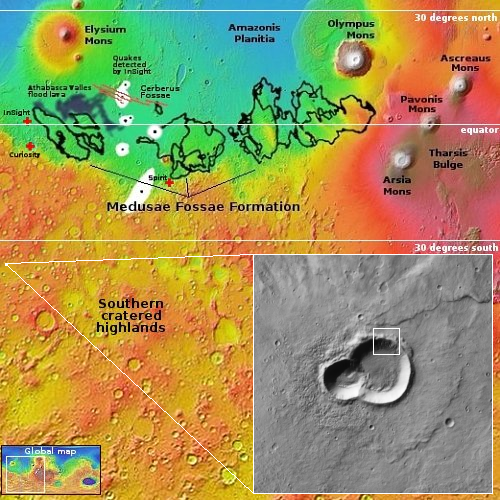
The white dot marks the location, in the mid-latitudes of the Martian southern cratered highlands. In the inset the white rectangle indicates the area covered by the picture above.
As this crater wall faces south and it is in the southern hemisphere, this wall will get less sunlight overall. As a result, it is very likely that dry ice frost could gather on its slopes in the winter, and then sublimate away in the summer when the Sun is high enough in the sky to shine on these gullies. With each cycle, the coming and going of the dry ice would disturb the material on the slope, eventually causing some to fall. This is not unlike the erosion that occurs on Earth due to seasonal freeze-melt cycle.
As this crater is also at 35 degrees south latitude, there is likely near surface ice here as well. In fact, if you look at the inset, it appears the impact that created this crater produced a faint splash apron, suggestive of a slushy surface impregnated with ice. In addition, the floor of the crater appears to be filled with glacial material.

On Christmas Eve 1968 three Americans became the first humans to visit another world. What they did to celebrate was unexpected and profound, and will be remembered throughout all human history. Genesis: the Story of Apollo 8, Robert Zimmerman's classic history of humanity's first journey to another world, tells that story, and it is now available as both an ebook and an audiobook, both with a foreword by Valerie Anders and a new introduction by Robert Zimmerman.
The print edition can be purchased at Amazon or from any other book seller. If you want an autographed copy the price is $60 for the hardback and $45 for the paperback, plus $8 shipping for each. Go here for purchasing details. The ebook is available everywhere for $5.99 (before discount) at amazon, or direct from my ebook publisher, ebookit. If you buy it from ebookit you don't support the big tech companies and the author gets a bigger cut much sooner.
The audiobook is also available at all these vendors, and is also free with a 30-day trial membership to Audible.
"Not simply about one mission, [Genesis] is also the history of America's quest for the moon... Zimmerman has done a masterful job of tying disparate events together into a solid account of one of America's greatest human triumphs."--San Antonio Express-News
Another interesting feature of the picture are the runnels which appear to have gone from left to right at the bottom of the crater, appearing to come from the ends of the gully material.
I’d be hard-pressed to believe that those runnels are caused by freeze-thaw cycles since there doesn’t appear to be very much of a slope at that portion of the crater.
We’ve got to get some geologists (aresologists?) out there to actually look at this stuff and figure out what it is. If the US weren’t blowing half it’s budget on fraud we could actually afford it.
Blackwing1: It’s not fraud; it’s aid to oppressed peoples.