
Orbex failure occurred partly because UK government withheld promised funding
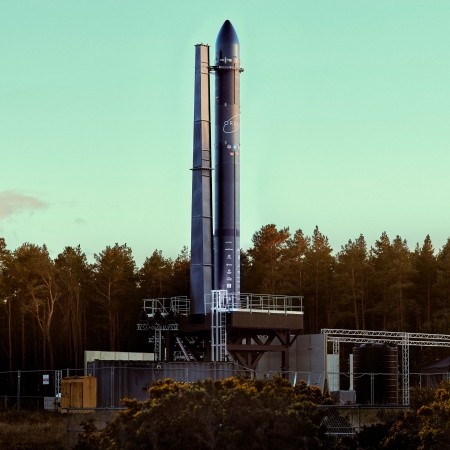
The prototype of Orbex’s never-launched Prime rocket,
on the launchpad in 2022
It appears the government of the United Kingdom contributed to the bankruptcy and sale of the British rocket startup Orbex in more than one way.
Orbex had hoped to do its first launch from the proposed Sutherland spaceport on the north coast of Scotland in 2022, but was blocked for four years because of red tape. First, the UK’s Civil Aviation Authority would not issue the spaceport and launch licenses. Second, local opposition delayed approvals as well. Those delays ate into the company’s resources, until it became entirely dependent on grants from the UK government (some through the European Space Agency) to keep it afloat.
Orbex’s problems were further compounded when it became clear in 2024 that the Sutherland spaceport would never get clearance. Orbex then switched to the Saxavord spaceport in the Shetland Islands, but this forced more delays because the company had no facilities there. It had already spent a fortune building everything for Sutherland.
A new report today says that it was finally forced to shut down and sell its assets to the French startup The Exploration Company because the UK government had withheld some of that promised funding.
News of the potential sale came just a month after a European Space Agency document confirmed that €112 million of €144 million UK government funding, earmarked for the European Launcher Challenge (ELC) scheme, was still “to be distributed”.
As a result, Orbex received just €34.9 million from the scheme – one-fifth of the €169 million awarded to each of its rivals by European governments.
That shortfall equates to about $160 million, a substantial amount of cash. While it is perfectly reasonable for the UK government to withheld these funds if it thinks the money would be badly spent, none of this government funding would not have been necessary at all if the UK government had simply issued the launch permits in a timely manner, allowing Orbex to launch and earn revenue.
As I noted early, congratulations to the United Kingdom, the place where rocket companies go to die! This is now the second such company killed by UK red tape and government incompetence, the first being Virgin Orbit.

On Christmas Eve 1968 three Americans became the first humans to visit another world. What they did to celebrate was unexpected and profound, and will be remembered throughout all human history. Genesis: the Story of Apollo 8, Robert Zimmerman's classic history of humanity's first journey to another world, tells that story, and it is now available as both an ebook and an audiobook, both with a foreword by Valerie Anders and a new introduction by Robert Zimmerman.
The print edition can be purchased at Amazon or from any other book seller. If you want an autographed copy the price is $60 for the hardback and $45 for the paperback, plus $8 shipping for each. Go here for purchasing details. The ebook is available everywhere for $5.99 (before discount) at amazon, or direct from my ebook publisher, ebookit. If you buy it from ebookit you don't support the big tech companies and the author gets a bigger cut much sooner.
The audiobook is also available at all these vendors, and is also free with a 30-day trial membership to Audible.
"Not simply about one mission, [Genesis] is also the history of America's quest for the moon... Zimmerman has done a masterful job of tying disparate events together into a solid account of one of America's greatest human triumphs."--San Antonio Express-News
I was once told that after WW2 the UK government, instead of having a light aircraft industry, decided to have a light aircraft bureaucracy instead.
Seems history repeats.
They’ve long traded away production for bureaucracy, and the powers that be, with the exception of Thatcher, don’t seem to mind the proliferation of slogans over the hard challenge of building. It’s a shame, the UK has renowned designers even now, but they’re handicapped or they simply leave.
Maggie hated Concorde too.
Brits just don’t care about aerospace any more.
Pride matters, Nate.
The F-111 may indeed have been a less costly option than TSR-2…but if you have no skin in the game…no pride in your own boffins….that can have a withering effect on capability.
Once the light in engineers eyes goes out from being told “no” one time too many–that’s it.
If TSR-2 had flown…that might have kept the embers red.
Ash is all is left to them now.
I strongly suspect the UK will never become a significant space power even if Farage and Reform eventually evict Starmer from 10 Downing Street and reverse all of the ruinous Labor and Conservative idiocies of the past few decades. I fear that ship has sailed and won’t be making any future port calls in Old Blighty.
I will say it again. Virgin Orbit was not going bust because of the UK. Now this is only from my memory, so there could be mistakes, but it should be good enough to get the point.
VO arrived at the end of August, getting the licence around the 10-12 of December, flew around one month later. So 3.5 month waiting time, the last month is on them not the government agencies.
This was the first licences given to an orbital rocket, so everybody knew that it would take a bit of time. And certain approvals can only be given after the Launch system arrived in England. In hindsight, it would have been amazing to get the licence after one month. But than wouldn’t have made any difference at all, VO was already in a death spiral.
But first a look at Australia. Gilmour Space arrived at the end of March ’24. They were getting their CAA-license end of February ’25. 11 months, let that sink in. And that wasn’t even the launch license, only the last important license before the launch license. Gilmour was then flying July 30.
So another six months. That’s the prime example of slow, not the UK. But why this VO go bust, while Gilmour is still around?
Biggest part, is that VO had over a Billion Dollar in funding. A lot was spent up to their first launch. Then they went public, and had to show their finances. Between 210-23x million losses year after year, while doing 1–2 flights per year. So basically the need 20+ flights just to break even. Sure the more rockets get build, the cheaper the cost per rocket, but the overall cost of would rise too if they build 20 rockets instead of 2.
Now the failures. Maybe if that least flight hadn’t failed, we would have seen flight number 7. But no one was willing to invest in this money burning machine. Even after dissolution no one was willing to take over. Firefly was able to come back, Astra was probably able to come back, but VO was simply not competitive.
A search for “Beck on Virgin Orbit”:
“That doesn’t faze Beck. The CEO recounted when Virgin Orbit, which invested around $1.2 billion in getting its first rocket into orbit, was expected to win the small launch race.
“That was $1.1 billion more than we spent,” Beck said.”
UK killed VO makes it sound, that they would still be around if the licence had been given 2.5 months earlier.
If VO was a heathy business those 3.5 months would have done nothing to them. The failure on the last flight would have done nothing to them.
From Wikipedia:
In August 2021 when the SPAC merger was announced, Virgin Orbit estimated it needed $420 million in cash, starting in the second half of 2021, to reach positive cash flow in 2024. When it went public in December 2021, after completing its SPAC merger, the company raised $228 million, less than half than the $483 million it expected to raise.
…
The company said it had about $300 million in active contracts, and expected its rocket launch business to grow to about 18 launches in 2023.
People were sceptical of VO, and going from 2 flights in 2022 to 18(!) in 2023 is a joke.
Agenor: Your timeline is faulty. Virgin Orbit signed a deal to launch from Cornwall in March 2022. The rocket company at that time was operational, so if it had had its permissions three months from then, it could have launched in the summer of 2022. In fact, the press release says exactly that.
Virgin Orbit officially announced it was ready to launch in October 2022, but couldn’t because it was waiting for license approvals. Over the next three months all the delays were related to CAA licensing. During that time the company began to run out of cash.
Had it launched in the fall as planned, Virgin Orbit might have been able to survive the launch failure, as it still had cash reserves. The failure in ’23 came too late.
The company might have had its own problems, but the CAA only made them worse.
Meanwhile, Orbex is dead because of licensing delays, Sutherland is dead because of licensing delays, Rocket Factory Augsburg seems delayed for what I suspect are licensing delays.
And above all, it appears no rocket startups are interested in launching out of Great Britain. I wonder why. Maybe they know more about this than you.
”Virgin Orbit officially announced it was ready to launch in October 2022, but couldn’t because it was waiting for license approvals. Over the next three months all the delays were related to CAA licensing.”
Virgin Orbit had other customers waiting to fly and the infrastructure in Mojave able to accommodate them. They could have submitted the paperwork to the CAA and continued to fly from Mojave while they waited for the paperwork to clear. They chose not to and chose instead to sit idle in the UK and wait. That’s on them.
”During that time the company began to run out of cash.”
The company started with a huge cash reserve and blew through it all because 90% of their employees were working on follow-on projects, not LauncherOne. LauncherOne wasn’t generating the cash flow to sustain itself, let alone fund other projects ten times larger. They didn’t downsize the company until they had less than a month’s worth of cash left, which wasn’t enough to save the company. That’s extreme mismanagement, and that’s on Virgin Orbit, not the UK government.
It was VO’s extreme mismanagement that did them in. The CAA may have pounded the last nail into the coffin, but VO was already dead.
Agenor wrote: “But first a look at Australia.”
That is the “So’s Yer Old Man Fallacy.” You compare one wrong with another wrong, and because the other wrong exists, you conclude that the first wrong is right. Logic and reality don’t work that way. Two wrongs are still wrong. Just because Australia has some delays does not make the United Kingdom’s delays right.
Comparing two companies is also a fallacy. Apples and oranges, different companies have different situations. Is Gilmour expanding, like Virgin Orbit was, or have they applied the lesson that Virgin Orbit could not apply due to its death? Their lesson, don’t expand too fast.
The reality is that the U.K. had declared that it wanted a space economy, but the reality is also that it continues to not do what it takes to develop that economy. Virgin Orbit fell for the lie and gave the U.K. the honor and public relations favor of launching their payload from their territory, allowing the government to cheer its own industry launching from its own territory. The U.K. rewarded them by delaying the approval for months and months, while the company continued to work on its expansion. As Robert stated, had they launched when they were ready, they had a chance to stop spending money on the expansion and survive the failure. Instead, the U.K. delays hurt the company very badly. At first they thought they may be able to survive anyway, which is why it is likely that an earlier launch could have been survivable., “healthy” or not.
_____________
mkent wrote: “They could have submitted the paperwork to the CAA and continued to fly from Mojave while they waited for the paperwork to clear.”
Not really. They would have had to move all their equipment back to Mojave and then back to Britain. Since the CAA kept making it sound as though the license was imminent, that would have been a waste of effort and resources. That’s on Britain.
It is OK and necessary to work on other projects. Peter Beck’s Rocket Lab does this and did this from its own early days. We all see their launch products, but they have many other services and manufacturing products available to spacefaring companies. We don’t usually see those. Virgin Orbit should have been OK doing the same, and that is what they were trying to do when the U.K. screwed them over for doing them a public relations favor. That’s on Britain.
Lesson: Don’t trust the U.K., where spaceflight is concerned.