
Hubble eyes the Egg Nebula
Click for original image.
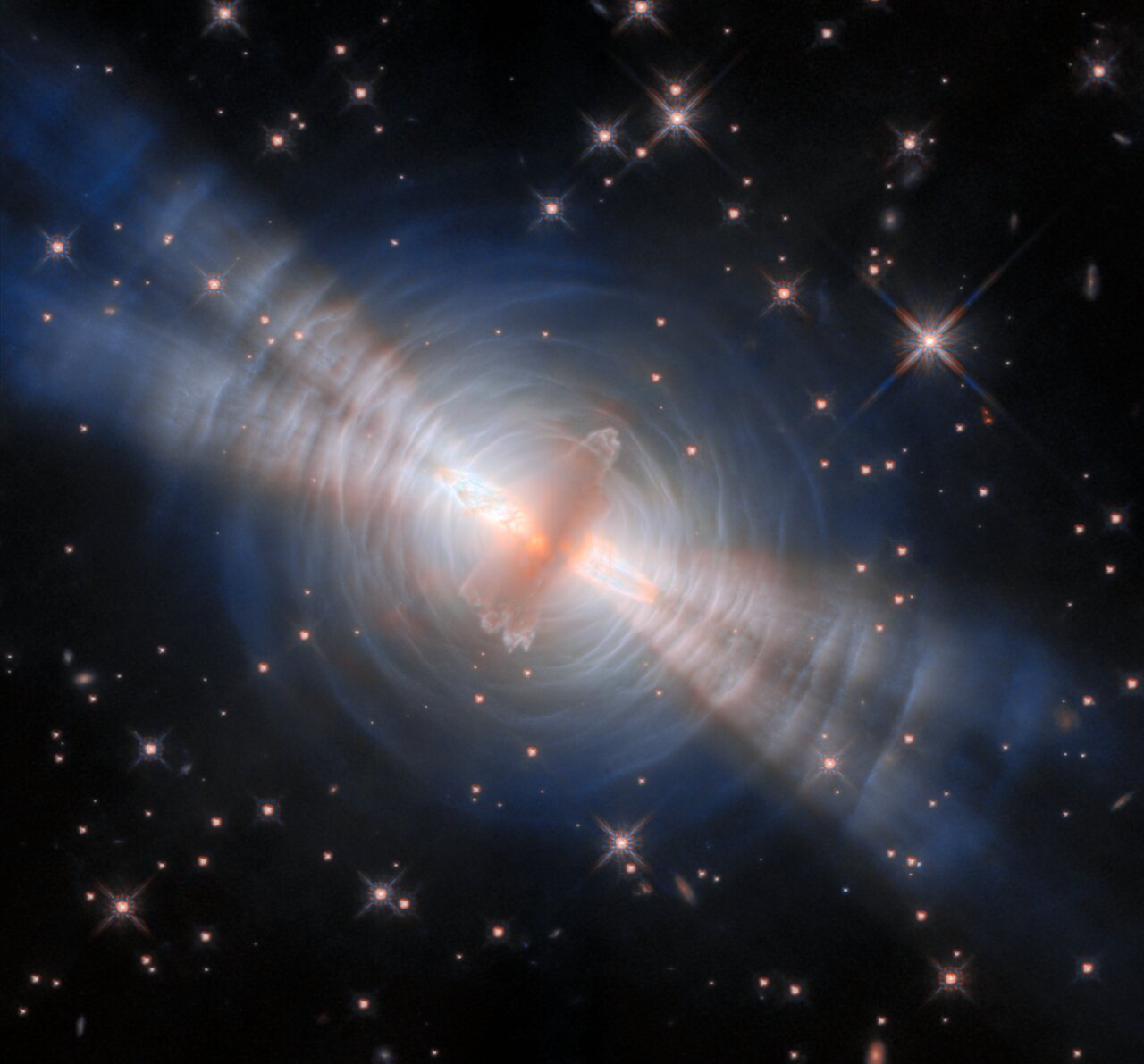
Cool image time! The picture to the right, reduced to post here, was taken by the Hubble Space Telescope as part of a study of “preplanetary nebula,” the initial stages of a planetary nebula that forms as some star types begin dying. From the caption:
Many preplanetary nebulae are relatively dim and hard to spot. They are made of layers of gas ejected by the star, but that star is not yet hot enough to ionise the gas and cause it to glow. The Egg Nebula is relatively unique, easily visible as a sparkling jewelled egg in space. Powerful beams of starlight blast out of the inner cloud, two a-side, giving a breathtaking illumination to this cosmic structure. Fast-moving outflows of hot molecular hydrogen also emerge from within the dust cloud, visible just at the base of the searchlight beams. These outflows glow with infrared light, which is shown in this image by orange highlights.
The central cloud of dust is surrounded by concentric rings, themselves made up from thin, faint arcs of gas. These were created by successive outbursts from the central star, which ejected a little more material from its outer surface every few hundred years. The beams of starlight are reflected by these layers of gas, creating an appearance like ripples on the surface of water. The way that gas molecules reflect and scatter light gives a bluish colour to the arcs. The reflected starlight reveals important details about the central star, which is impossible to view directly in its dusty shell.
Many planetary nebula get their spectacular shapes because they have a binary star system in their center, that act like the blades in a blender as they circle each other, mixing the materials the stars’ eject to form those shapes. Because of those surrounding shells, it is often impossible to determine with the nebula has a single central star, or a binary system.

On Christmas Eve 1968 three Americans became the first humans to visit another world. What they did to celebrate was unexpected and profound, and will be remembered throughout all human history. Genesis: the Story of Apollo 8, Robert Zimmerman's classic history of humanity's first journey to another world, tells that story, and it is now available as both an ebook and an audiobook, both with a foreword by Valerie Anders and a new introduction by Robert Zimmerman.
The print edition can be purchased at Amazon or from any other book seller. If you want an autographed copy the price is $60 for the hardback and $45 for the paperback, plus $8 shipping for each. Go here for purchasing details. The ebook is available everywhere for $5.99 (before discount) at amazon, or direct from my ebook publisher, ebookit. If you buy it from ebookit you don't support the big tech companies and the author gets a bigger cut much sooner.
The audiobook is also available at all these vendors, and is also free with a 30-day trial membership to Audible.
"Not simply about one mission, [Genesis] is also the history of America's quest for the moon... Zimmerman has done a masterful job of tying disparate events together into a solid account of one of America's greatest human triumphs."--San Antonio Express-News