
A sculptured Martian landscape

Click for original.
Cool image time! The picture to the right, cropped and sharpened to post here, was taken on December 4, 2025 by the high resolution camera on Mars Reconnaissance Orbiter (MRO).
The science team labels this landscape “olivine-rich plains”, which is a magnesium iron silicate mineral of some industrial value that is quite common on Earth. Its presence here suggests there could be other valuable minerals in this region.
I post the image because the landscape is so weird and beautiful. The orange color suggests these ridges are covered with dust, if not made of dust entirely. The small areas with a greenish tint that appear to mostly appear on north-facing cliffs could be frost, except this is in the southern hemisphere where north-facing cliffs get more sunlight. As it was autumn when this picture was taken frost is an unlikely explanation.
More likely the green indicates exposures of bedrock or coarser boulders.
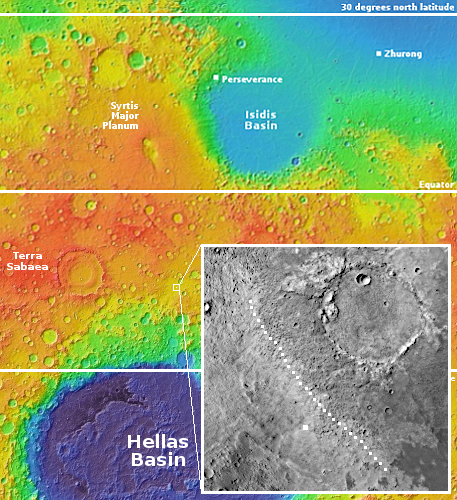
The white dot on the overview map to the right marks the location, in the Martian southern cratered highlands deep inside the equatorial tropics where no near surface ice is found. This is another reason the greenish areas are not frost.
The white dotted line in the inset indicates a ridgeline and the northeast border of this weird landscape, which forms a 10-mile-wide swath along that dotted line. Though this region looks like it is located in the ejecta of that nearby eroded nine-mile-wide crater to the northeast, the ridge suggests otherwise. Instead, it appears the splash apron of that crater hit against that ridge when the impact occurred.
What caused this strange lattice of ridges? If dust, wind could have shaped them, but that really doesn’t work, as ridges don’t appear to indicate any prevailing wind direction. I suspect instead these ridges are the result of some more internal geological process beyond my grade to understand. We might even be seeing the formation of giant surface crystals!

On Christmas Eve 1968 three Americans became the first humans to visit another world. What they did to celebrate was unexpected and profound, and will be remembered throughout all human history. Genesis: the Story of Apollo 8, Robert Zimmerman's classic history of humanity's first journey to another world, tells that story, and it is now available as both an ebook and an audiobook, both with a foreword by Valerie Anders and a new introduction by Robert Zimmerman.
The print edition can be purchased at Amazon or from any other book seller. If you want an autographed copy the price is $60 for the hardback and $45 for the paperback, plus $8 shipping for each. Go here for purchasing details. The ebook is available everywhere for $5.99 (before discount) at amazon, or direct from my ebook publisher, ebookit. If you buy it from ebookit you don't support the big tech companies and the author gets a bigger cut much sooner.
The audiobook is also available at all these vendors, and is also free with a 30-day trial membership to Audible.
"Not simply about one mission, [Genesis] is also the history of America's quest for the moon... Zimmerman has done a masterful job of tying disparate events together into a solid account of one of America's greatest human triumphs."--San Antonio Express-News
Robert, I am reeeeeeeally lookin forward to next December. I believe you meant to type December 2025 for this Cool Image.
Thanks again for all you do!
Ronaldus Magnus: Fixed. Thank you.
Nice.
Thanks Bob.