
“A new empire has sprung into existence, and there is a new thing under the sun.”
The words I quote in the headline above were spoken during a sermon by Pastor Manasseh Cutler on August 24, 1788 at the just established settlement of Marietta, Ohio, founded only six months previously by a small group of New England pioneers, with the goal of beginning the settlement of the American west now available following the end of the war of independence against Great Britain.
It may be emphatically said that a new empire has sprung into existence, and there is a new thing under the sun. By the Constitution now established in the United States, religious as well as civil liberty is secured.
Some serious Christians may possibly tremble for the Ark, and think the Christian religion in danger when divested of the patronage of civil power. They may fear inroads from licentiousness and infidelity, on the one hand, and from sectaries and party divisions on the other.
But we can dismiss our fears, when we consider the truth can never be a real hazard, where there is a sufficiency of light and knowledge, and full liberty to vindicate it.
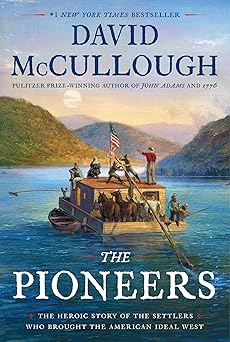
Cutler’s words come from David McCullough’s 2019 history, The Pioneers, describing the effort of Cutler and a small group of New Englanders to re-create a new New England in the wilderness north of the Ohio river.
Not surprisingly, McCullough’s book is quite readable, as are all his works. What made it a revelation to me is that it revealed an aspect of this early American settlement of the west that I had been ignorant of. It wasn’t just any old Americans moving west to found new communities. At the beginning it was specifically the descendants of the Pilgrims and Puritans in New England, actually organizing consciously to repeat the same thing as their ancestors, sending a group of God-fearing religious families west to build a new city on a hill, for the future of America and for their children.
Cutler himself had been crucial in lobbying Congress to establish the laws necessary to allow these first first settlers to buy land and begin settlement. He and a group of former revolutionary soldiers from New England had worked up a plan, and sent Cutler to New York and Philadelphia to convince Congress to pass the Northwest Ordinance of 1787, establishing the legal framework for settling the vast territories now open to American north and west of the Ohio river. Cutler himself wrote much of that bill, making sure it included articles requiring freedom of religion and no slavery.
In the early spring of 1788 the first group of twenty-two settlers arrived, and within a very short time they had established a town and community. By the time Cutler arrived in the late summer, the colony was so well established that families were arriving to build their own farms.
McCullough outlines this history most clearly, focusing on the specific individuals in this community who came with few skills and ended up becoming noted artists, architects, doctors, farmers, and politicians. And while Marietta would never become a major city, it certainly prospered as it laid the groundwork for the larger settlements that soon sprung up along the Ohio and in the interior.
Its founders however succeeded magnificently in one aspect much more important than size or wealth: They made sure that the same concepts that established the New England colonies would be sustained in this new western world: family, freedom, and moral commitment. Ohio and the states to the north and west all became free states, preventing the spread of slavery and making sure the north was strong enough to win the Civil War and end slavery forever.
For the next two centuries that groundwork sustained the United States, taking it through that civil war that ended slavery forever to make it a world power that freed Europe twice from power-hungry tyrants while becoming the most prosperous nation ever in the history of the human race. It became so prosperous it could send men to the Moon and back, and hardly blink an eye.
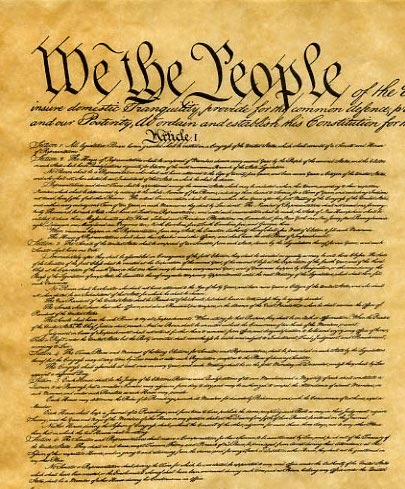
The Constitution: The framework for rebuilding America
Reading Cutler’s quote today (at the beginning of the second quarter of the 21st century), I fear the fears he dismissed so calmly are finally coming true. Today America is torn by sectarian factional warfare, and the Judeo-Christian beliefs that founded it are no longer dominant. Worse, licentiousness and infidelity have become culturally supreme. It might have taken more that two centuries, but it now appears that a large percentage of Americans not only no longer believe in the basic values of the Bible and western civilization, they are fundamentally hostile to it.
Can we recover our nation and culture? I think we can, but only if we are bluntly honest about our failures now, and are boldly willing to face the hideousness required to force change. It will not be a pretty thing to push back against the ugliness of our time, of the many people who now believe it perfectly okay to invade a church during Sunday services, to attack and even kill anyone who disagrees with them. Such people cannot be reasoned with, and for reason and rationality to once again be dominant in America we will have to fight much harder than rational and reasonable people like to do.
But it must be done. Cutler and his generation knew the cost, fought the Revolutionary War to win their rights, and were willing to do what was necessary to maintain them. As Cutler noted in the quote above, they set their work in stone by writing the Constitution so that the rights of future generations would be protected. And by doing so they made it it possible to Americans to do great things for the next two centuries.
We can do no less, so that future generations will have that same chance. We need only use the tools that Cutler and his generation gave us.

On Christmas Eve 1968 three Americans became the first humans to visit another world. What they did to celebrate was unexpected and profound, and will be remembered throughout all human history. Genesis: the Story of Apollo 8, Robert Zimmerman's classic history of humanity's first journey to another world, tells that story, and it is now available as both an ebook and an audiobook, both with a foreword by Valerie Anders and a new introduction by Robert Zimmerman.
The print edition can be purchased at Amazon or from any other book seller. If you want an autographed copy the price is $60 for the hardback and $45 for the paperback, plus $8 shipping for each. Go here for purchasing details. The ebook is available everywhere for $5.99 (before discount) at amazon, or direct from my ebook publisher, ebookit. If you buy it from ebookit you don't support the big tech companies and the author gets a bigger cut much sooner.
The audiobook is also available at all these vendors, and is also free with a 30-day trial membership to Audible.
"Not simply about one mission, [Genesis] is also the history of America's quest for the moon... Zimmerman has done a masterful job of tying disparate events together into a solid account of one of America's greatest human triumphs."--San Antonio Express-News
But for an accidental circumstance that befell my family, I would have grown up in Marietta, Ohio. Throughout my childhood, “losing Marietta” was my parents’ constant refrain of regret for an unrealized dream. Then I moved far away, and somehow, I have never been to Marietta, Ohio!
I’ve been to Marietta.
Rugged individualism. For centuries we honored those qualities.
In one of his speeches, Billy Jeff Clinton warned about radical individualism. To the Left, anything other than adherence to the collective is “radical.”
When people asked me about my confidence in President Trump winning (all 3 times) I would talk about how bi-coastal the Left had become. Between 2010 and 2016, the Left lost about 1,500 State and Federal elections. In 2016 only 5 States had both a democrat legislature AND a democrat governor. Outside of the two coasts, most people just want to live their lives. They had to cheat in 2020. In hindsight, it provided America with four years of the Hussein/Biden Regime insanity. The Left started telling the truth about their intentions. Climate, Trans, DEI, etc. It was all on display. When huuuuge numbers of black and Hispanic men voted for President Trump, I would explain that those men can easily answer the question: What is a Woman? In Texas, there is a county on the Mexican border that is 90% Hispanic. They had not voted Republican for over 100 years. They voted for President Trump. They are on the front lines of the illegal invasion.
Today, outside of the liberal insanity of $4-5 per gallon gas prices, many people are living the Trump economy. They see the drop in prices.
I remember Martin Luther King explaining one of his nonviolent methods to overcoming racism. Television was more widespread, and he was going to use television to “show the rest of America” the evil demonstrated by the attacks on their peaceful marches. Today, we can see the Left’s attacks. Even when the rioters record their own video, it still shows their insanity. They are protecting murderers and rapists. Many of them hide their faces with masks.
Salena Zito recently said that only 12% of Americans are on X. AND, only a small percentage of that 12% are very active on X. Probably the very same people on other social media. Once again, most people just want to live their lives.
When President Trump would have these huuuuge rallies, there were not just thousands inside the venues. Very often, there were more people outside the venue. Like minded people joining together. During the New York trials, President Trump decided one day to go to Brooklyn for a rally. THOUSANDS gathered to show support. Some blacks were interviewed by the Drive-By Media, asking why is a black supporting Trump. Some of the answers were precious. “I’m an American” they would say.
So, yes these are trying times. Dennis Prager often says we are still the last best hope. We can overcome the Left, and President Trump is demonstrating how. He, his cabinet, his press secretary are calling out the useful idiots and true believers for the evil that they are.
PS – thanks for the book reviews. Keep them coming, please.
Religion was more of a part of people’s lives then….dour Lutherans the butt of most of the jokes on the Prairie Home Companion. Some became a bit too open, and you can see what a mess that made.
Anyone see school textbooks from up north?
David Rubenstein, John Chancellor and David McCullough all sounded just alike to me.
Roddy McDowell and Derrick Jacobi too.
“Rugged Individualism” which is a term that refers back to the white colonizing slave owners is now a dirtied up weaponized talking point of the “progressives”, just today it was thrown in my face as a form shame.
I did not work out well.
The term is now a dirty term because “You did not build anything on your own, the entire society is responsible for your individual success”. You know its the Bernie Sanders / Charles Schumer justification to turn the country into a Communist utopia, no private property and the “warmth of the collective” (Mamdani).
That was the general justification and tone of the intended insult.
Nothing exists in a vacuum, especially “progressive” commy idealism.
To Cotour,
You win a fight with the Left by using their terms, not yours.
If someone says ICE is racist, remind them Obama praised ICE:
https://m.youtube.com/watch?v=z83MEWRes48
Remind them of this:
https://en.wikipedia.org/wiki/2022_Los_Angeles_City_Council_scandal
—and this:
https://www.splcenter.org/resources/hatewatch/california-latino-gang-latest-accused-targeting-blacks/
-which explains Obama’s ICE defense, in that the sons of conquistadors killed far more blacks than the sons of the confederacy. Remind them that Barbary pirates enslaved Europeans.
If someone says ICE and Trump’s border policy is racist, you could say that Reagan’s blanket amnesty was both racist and anti-union…in that he wanted strike breakers, and to use Hispanics as a model minority against blacks—and how the safety net minorities here rely on fall apart if everyone south of the US walked north.
All the GOP got out of that was Anna Navarro, so—enjoy.
In 1973, Chavez, Mondale and Civil Rights pioneer Abernathy marched against use of undocumented labor by illegals—were they racist?
Anti-same sex Proposition 8 likely passed in California due to socially conservative latino working housekeepers underpaid by Harvey Milk and friends. Point out that California spends more on prisons than schools.
That is how you beat a lefty
Now—how you beat republicans is to remind them that Trump is just Gephardt—and if Trump is right—Reagan was wrong on tariffs…or vice versa.
They have to choose since they both cannot be right on trade at least.
The typical anti-government type can’t stand it when I mention that the USAF can withstand crashes better than Braniff due to economies of scale….and shouldn’t American space deserve that stability too?
they start sputtering nonsense about confiscated this, and market force that—just as predictably as a Marxist backed up in a corner will hiss “provocateur” when they start losing an argument too.
I don’t have a lot of friends as a centrist—so there is nothing holding me back from tweaking noses.
Related:
TRUMPS MAN PUTS THE STAKE IN THE HEART OF THE GLOBALIST AGENDA
https://www.sigma3ioc.com/post/trumps-man-puts-the-stake-in-the-heart-of-the-globalist-agenda
What was the most significant event at the WEF / Davos meeting? And it only took 2 minutes to lay out.
Howard Lutnick, U.S. Secretary of Commerce puts the stake in the heart of the WEF “In the future you will own nothing, and you will like it” Socialize the world and administer it under an authoritarian U.N. type world government which can only spell oppression and failure.
Howard Lutnick: https://youtu.be/JpHmuVZ-Pdg?si=DduTX4X_4TgI11-f
https://static.wixstatic.com/media/e691e8_21ec0a1384a24c5da48256fb10a37866~mv2.png/v1/fill/w_601,h_339,al_c,q_85,usm_0.66_1.00_0.01,enc_avif,quality_auto/e691e8_21ec0a1384a24c5da48256fb10a37866~mv2.png
As President Trump reorganizes and rebuilds the world that the RINO Republicans and the now radical Liberal Leftist Democrats destroyed with their weakness, he is making substantive MACRO power moves that will have positive generational effects for America and its allies. I have been waiting for these two minutes for several years now.
Freedom is not free, ensuring freedom requires strong, benevolent visionary American leadership.
LET THE RE FOUNDING OF AMERICA COMMENCE!
https://www.sigma3ioc.com/post/let-the-re-founding-of-america-commence
Are You Paying Attention yet America? JGL all rights reserved 1/20/26
https://static.wixstatic.com/media/e691e8_bc7641934f8149ee849e3096aa852f5e~mv2.png/v1/fill/w_640,h_800,al_c,q_90,enc_avif,quality_auto/e691e8_bc7641934f8149ee849e3096aa852f5e~mv2.png
JW:
I just calmly ask them to please explain what exactly it is that they say that they think. Why do you think that? Much like having an exchange with LeeS here on BTB. You see what that devolves into.
Now what usually happens after only a few exchanges, after they have cursed me or called me and the president a NAZI and or a Fascist, after they become so frustrated with actually trying to sound like they actually know what they are talking about over and above their insane preprogrammed emotions, they block me.
When I say “It did not go well”, I mean it did not go well for them.
I have found no competent Leftist, Liberal or Democrat EVER on ANY platform that is able to remain in a rational conversation and reasonably lay out what they think, what they think they understand, and back it up.
They do not exist.
They are a humorless lot.
Gutfeld replaced Gore Vidal in political wit
I miss PJ
Talking about Liberals and Leftists and their lack of humor.
https://youtube.com/shorts/7cCzocS7CeQ?si=MdMFIT2rnSsSEMrM
I have maintained that a sense of humor, is a marker of intelligence. Events the past five years have not given me reason to change that opinion.
Truth is that the people inside the borders of the not so much United States are more or less evenly divided and it gets more bitter every year. As Lincoln said, “A house divided cannot stand.” The question is what comes next after it falls. Way too many people on both sides want his solution.
Richard:
I wouldn’t say ‘falls’ so much as ‘reconfigured’. There are many on both sides of the Civil War II (yes, it is. See: Minneapolis) that do not want the house to stand. Americans, those of ideals, rather than ideology, may need to retrench, and focus on core competencies. Social welfare for all, isn’t one of them.
A historian who married into our extended family recounts the immigration of some Kelsies and Websters from Connecticut to the new settlement of Elyria, Ohio using their extant letters for most of the text. Fascinating reading. She then carries the narrative forward through a second volume to almost the present, using letters to tell the stories of migration to Wisconsin, the Civil War, and transitions from rural life to the urban.
All we are witnessed to today is the now driven to desperation the depraved and corrupted Democrat party who could never retain or further acquire political power and control if the multiple ways to cheat in elections that they have designed and installed did not exist.
Case in point: We are witness today to the Democrat operatives and radicals protecting the last Democrat administrations investment with other peoples confiscated tax money the millions flooded into the country that they encouraged and allowed.
They understand that if they do not have these numbers of illegals that they flooded into the country and people counted in districts even if they do not vote they can control / increase the number of Democrats in Congress.
Pure and simple, a desperate strategy of mutual destruction if they do not get their way.
And if not for the no nonsense Trump America focused administration they would have gotten exactly what they so desperately needed.
ONE DEMOCRAT PRESIDENT AWAY
https://www.sigma3ioc.com/post/america-one-democrat-president-away
Jeff Wright: where will these economies of scale come from? Who is going to pay for it? Why would the USSF pay for SLS launches versus flying on Vulcan, F9, or FH? They need reliability and affordability, and the SLS offers neither.
The key is to enforce non-partisanship as a requirement of colleges to get tax benefits. They are partisan, illegally.
Congress needs an amendment to clarify, objectively, what non-partisan means in practice.
The best idea so far is a quota of at least 30% Republican professors (hard) & 30% Dems. Only colleges with at least that many Reps & Dems, based on Congress, qualify as non-partisan.