Isaacman makes it official: Artemis-2 will fly manned around the Moon, despite Orion’s heat shield concerns
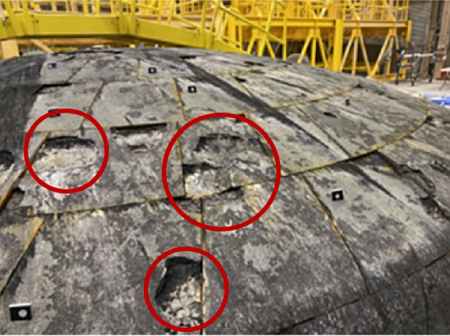
Damage to Orion heat shield caused during re-entry in 2022,
including “cavities resulting from the loss of large chunks”
In a tweet yesterday afternoon, NASA administration Isaacman essentially endorsed the decision of the NASA managers and engineers in its Artemis program who decided they could live with the engineering issues of Orion’s heat shield (as shown in the image to the right) and fly the upcoming Artemis-2 mission around the Moon carrying four astronauts with that same heat shield design.
Isaacman’s statement however suggests to me that he is not looking at this issue as closely as he should.
Human spaceflight will always involve uncertainty. NASA’s standard engineering process is to identify it early, bound the risk through rigorous analysis and testing, and apply operational mitigations that preserve margin and protect the crew. That process works best when concerns are raised early and debated transparently.
I appreciate the willingness of participants to engage on this subject, including former NASA astronaut Danny Olivas, whose perspective reflects how serious technical questions can be addressed through data, analysis, testing, and decisions grounded in the best engineering judgment available. [emphasis mine]
The highlighted sentence is fundamentally incorrect. Instead of recognizing that the unexpected damage to Orion’s heat shield after the 2022 Artemis-1 test flight around the moon made that heat shield unacceptable on the next flight, and immediately begin work on a new shield, NASA went dark, providing no information for two years. The agency realized that replacing the shield would cause a delay, and rather than fix the engineering it decided maintaining the Artemis program schedule was more important. Its subsequent actions since seem more designed to rationalize away the problem then deal with it, a conclusion that NASA’s own inspector general came to in 2024.
The agency’s lack of transparency was made very evident when Freedom of Information requests finally forced it to release the conclusions of its own engineering investigation, and it redacted every single word.. If Isaacman was so committed to transparency and truly believes NASA’s investigation was based on “the best engineering judgment available”, why doesn’t he release that report, unredacted? Has he even looked at it himself?
I and many others pray that the Orion crew comes home safe. Good engineering management however would never allow this mission to fly manned, considering the heat shield uncertainties as well as other issues (such as flying the capsule manned using an untested life support system). That NASA’s Artemis work force is willing to do this tells us the culture that killed the astronauts on Challenger and Columbia remains unchanged. They still put schedule above engineering, and are still willing to risk lives unnecessarily.
It also tells us that Isaacman appears unwilling to stand up to this culture and force it to change. If Orion comes home safe, that will only reinforce this unsafe culture, and future missions will thus be as unsafe and unreliable.

On Christmas Eve 1968 three Americans became the first humans to visit another world. What they did to celebrate was unexpected and profound, and will be remembered throughout all human history. Genesis: the Story of Apollo 8, Robert Zimmerman's classic history of humanity's first journey to another world, tells that story, and it is now available as both an ebook and an audiobook, both with a foreword by Valerie Anders and a new introduction by Robert Zimmerman.
The print edition can be purchased at Amazon or from any other book seller. If you want an autographed copy the price is $60 for the hardback and $45 for the paperback, plus $8 shipping for each. Go here for purchasing details. The ebook is available everywhere for $5.99 (before discount) at amazon, or direct from my ebook publisher, ebookit. If you buy it from ebookit you don't support the big tech companies and the author gets a bigger cut much sooner.
The audiobook is also available at all these vendors, and is also free with a 30-day trial membership to Audible.
"Not simply about one mission, [Genesis] is also the history of America's quest for the moon... Zimmerman has done a masterful job of tying disparate events together into a solid account of one of America's greatest human triumphs."--San Antonio Express-News
If the Artemis mission astronauts encounter disaster, then once again a board will convene. It will take years to draw the exact same conclusions as the Challenger and Columbia boards and NASA will STILL do absolutely nothing about it’s bureaucratic culture.
I, too, have concerns about this decision.
The cynical part of me wonders if this wasn’t just an effort on Isaacman’s part to buy himself some cover if the mission goes badly on EDL: Hey, I took over at the last minute, I had concerns enough to stage a special meeting on it, the entire org planted its flag on the solution and wouldn’t budge, I tried, it’s not my fault!
And it seems to be true that Isaacman kinda *is* handcuffed in a lot of ways. Because after all, as even Charlie Camarda would tell us, the problem is not just this heat shield or even just the decision to change the mission profile to accommodate its flaw. It’s an entire org culture, and that culture is the product of an entire organization. Changing it would not be easy even if you have the boss’s full backing, which Isaacman really does not. The White House and Congress both really, really want this mission to launch as soon as possible.
To take up another org culture issue at NASA, I mentioned a few weeks back Phil McAlister’s podcast interview with Space News. McAlister, the guy behind making Commercial Crew a success, was despondent that by the time he retired last year, there really wasn’t anyone else left at NASA with any appreciation for or understanding of commercial procurement — that’s how far backwards things went under the Biden Administration. This is the kind of thing which suggests to me that Isaacman will not get to change very much until he starts changing a lot of the people. He has to have allies and underlings committed to the new mission, whatever it ends up being.
Richard M: Your analysis is all true, except for one point. When a true leader takes over an organization badly in need of reform, he or she doesn’t allow himself to be conned by that organization. He pushes back hard, and if necessary begins firing people immediately.
Trump is a great example of this, both bad and good. In his first term he behaved just like Isaacman is doing now, believing the con jobs of the administrative state, and thus got conned badly. For example, there was no reason for him to have allowed the FBI and Department of Justice to be run by his enemies, but he was convinced by these corrupt apparatchiks that major change would be a mistake.
In his second term he arrived expecting more con jobs and instead ignored them and moved to slash and burn that administrative state — to great positive effect.
Isaacman is right now behaving like Trump 45. I think that is a mistake. I think if he made this argument to Trump, that he is being conned (like Trump was) and he needs clean house, Trump would let him. He isn’t doing this however, so don’t expect much from him.
Thus, I am not optimistic for NASA’s future, but that actually makes me very optimistic for America’s future in space. NASA will increasingly fail, while private space will increasingly take over and get it done.
What what it gets done will be increasingly spectacular.
Hi Bob,
“When a true leader takes over an organization badly in need of reform, he or she doesn’t allow himself to be conned by that organization. He pushes back hard, and if necessary begins firing people immediately.”
To be clear, I was not excusing, just explaining what I thought might be happening.
But it is worth asking just how far Trump is letting Isaacman’s writ run. Maybe the big reduction in headcount is all the White House really wanted out of NASA, and it has got that now already. Well, that and a Moon mission(s) to make Trump look good. Most of that White House space strategy paper was about *military* applications, and maybe that is a telling point….
But if that really is true, maybe Isaacman’s response should have been to just refuse the job.
Richard M: My impression of Trump is that he respects strong leaders of quality. Isaacman taking the job is the right thing to do, but once there he should be pushing hard. I suspect a smart argument to Trump would convince him.
If that gets him fired instead, then so what? Better to do what is right and be pushed out than stick around doing the wrong thing.
Somebody should ask the astronauts what they think.
Robert wrote: “The highlighted sentence is fundamentally wrong.”
I disagree. The process does work best when concerns are raised early and debated transparently, but sometimes “best” is still not good enough. As Robert noted, in this case the process was not applied early, at least not the transparency part, so it definitely did not work at its best. NASA thinks it was early, because they saw it early, but they came to poor conclusions — ones that do not assure crew safety, just assure project schedule. I think we see which priority NASA had, up to now, and what they mean by “best.”
“It also tells us that Isaacman appears unwilling to stand up to this culture and force it to change. If Orion comes home safe, that will only reinforce this unsafe culture, and future missions will thus be as unsafe and unreliable.”
Isaacman’s main problem is that during his nomination hearings he made promises to Congress, the people holding the reins of NASA’s funding. In addition, the president that nominated him also wants a manned lunar landing before he is out of office, which would also be in time for him to make a presidential phone call to the astronauts on the Moon. I don’t know that he wants to make the phone call, but that is my suspicion. Either way, schedule pressure from above is publicly visible and undeniable.
Issacman’s escape is a low chance of disaster. So, what are the chances of disaster? For Challenger, it was around 1/2, given the conditions (they had the same conditions the year before), or around 1/25 in general. For Columbia, it was around 1/100, depending upon when the foam insulation formula was changed to the version that shedded in chunks. For Orion, well, the empirical evidence is that it is 100% safe (one success out of one event).
Those aren’t so bad odds, if you are the manager in charge of only one mission. They weren’t the odds that had been advertised for the Space Shuttle when it was inaugurated, which is why everyone was willing to take that level of risk for the Space Shuttle. As Isaacman’s note said “Human spaceflight will always involve uncertainty,” a sentiment that can hide a multitude of safety sins.
But then again, the empirical evidence was the same, 100% safe, right up until Challenger and Columbia broke up in flight. If we ask the Orion crew, they are all for flying, so they are willing to take the odds, too. Besides, if they die in space, they aren’t the ones to face the inevitable Congressional hearings.
This is our space program, and we taxpayers and voters have some amount of responsibility, for we have elected the people who are in charge of the people who are in charge. We are paying for success, but we were not asked if we wanted schedule over safety. Judging from reactions to past disasters, I don’t think schedule is the priority for We the People.
The reason so many of us are concerned is that we are already aware of two potential serious risks that could be mitigated with just one more test flight. We know that new hardware is still higher risk than hardware that has been better tested and improved. It isn’t only America’s Starliner that shows us that; India’s improvements to its PSLV upper stage was insufficient to solve its problem, a couple of days ago. We really, really need one successful test mission before we put lives on the line, and Orion has not provided that for us.
That may be four reasons we are so concerned.
“That NASA’s Artemis work force is willing to do this tells us the culture that killed the astronauts on Challenger and Columbia remains unchanged.”
That is five reasons. NASA still has not applied the lesson learned from Challenger and Columbia. When will the culture become one of less risk taking rather than more risk taking? We know about this problem in advance of the flight, so if NASA is unwilling to fix it before flying astronauts, then NASA is unwilling to fix problems before flying astronauts.
We know what that leads to.
Which then leads to Congressional hearings, recriminations, enmity, ruined reputations and lost careers.
Fortunately, NASA’s track record is one disaster every couple of decades at the end of January or the beginning of February, and this is out of phase with that record, so we don’t have to be concerned with that. Oh, wait. Six.
But, Isaacman is doing what he promised Congress and what the president wants, and pleasing the boss(es) is important, and that concerns us, too.
Edward: You misunderstand my sentence, possibly because I wasn’t clear. I wasn’t saying that the idea of what Isaacman said was wrong, I was saying that his interpretation of what NASA has been doing is wrong. Transparency and immediate action are of course the right action. NASA in this case however has not been doing it at all, and Isaacman saying it has is intellectually dishonest.
I don’t want to play word games with Edward but I don’t agree with the statement:
“For Orion, well, the empirical evidence is that it is 100% safe (one success out of one event).”
I’d consider that data point to be a failure. It did not perform as designed. It was flawed. If it was successful there would have been no reason to change things.
This is nothing more than a repeat of NASA’s, “well we got away with it last time”. “Safety” attitude that Feynman pointed out after Challenger.
Nothings changed. Expect similar results.
And not to be morbid but I understand the entire reentry path is over water. The chances of recovering any debris if something happens is low. Therefore there will be no definitive root cause possible
Additionally, what is the risk of the capsule loosing integrity and taking on water after splashdown if it makes it in one piece?
This process is known in aviation as “normalization of deviance”. Dr Tony Kern, a USAF safety specialist coined the term. aka “we got away with it last time so it must be OK to do that”. As an aviator, Isaacman should be familiar with it.
You may find on the web a nice picture of a B-52 at high bank angle about to hit the ground (it was actually in an incipient spin – too slow at low altitude, pull around the turn, stall the wing, spin). The analysis was a sorry tale of risk taking that got away with it until it didn’t and a failure of leadership to nip this behavior in the bud.
I think Isaacman knows he’s taking a chance but that the odds favor him by flying this mission with crew. If it works he’s made his reputation and pleases the bosses, if it doesn’t he resigns but gets off the hook by being conned by the NASA “Deep State”.
He’s an astronaut. Would he fly it himself?
pawn,
“This is nothing more than a repeat of NASA’s, ‘well we got away with it last time’. ‘Safety’ attitude that Feynman pointed out after Challenger.”
I had intended that to be clear from context. Also, to be clear, and as I have said in other threads on this topic, past lessons learned are not being applied to the current mission(s).
“Therefore there will be no definitive root cause possible”
Several accident investigations occur from probes in deep space. Although definitive root causes from accidents resulting in loss of vehicle are uncommon, many conclusions are made, including a most probable root cause.
“Additionally, what is the risk of the capsule loosing integrity and taking on water after splashdown if it makes it in one piece?”
According to NASA, the base composite material survived an energetic test, so they think that the risk is extremely low that the capsule loses integrity and takes on water after splashdown.
The real risk is not well known or understood. At least not to we observers.
Mike Borgelt asked: “He’s an astronaut. Would he fly it himself?”
NASA astronauts rarely turn down assignments. Isaacman is not a NASA astronaut, so it is difficult to say how he would choose.
For Isaacman, as head of NASA, the odds are in his favor. For him, the reward is worth the risk. For the rest of us, we do not have bosses to please. We do pay the taxes and elect the bosses, so we have a stake in this decision. The reputation of our great nation is also at stake. We get bragging rights if it works, but we get angst and anger if it fails, ending in pointing fingers and demanding people lose their jobs — not our elected representatives, of course, because they are only responsible for their own actions of putting pressure on Isaacman to put schedule over safety or success. Our elected representatives will do the most important finger pointed, and not at themselves, so for them the risk is low and the reward is high.
Many of us, however, have not been sufficiently assured that the risk is low, that the risk is standard operating procedure. The reward is a repeat of a past mission, of glory past rather than glory future. No progress is being made, so what is the point? The risk is higher than with Apollo, which had a known working life-support system, and a known working heat shield. For us, the reward is not worth the risk.
Can we do anything about it? Not really. We the People elected the representatives and the president that have put pressure on Isaacman to remain on schedule, and we have no immediate recourse other than social media comments, letter writing campaigns, and commentary essays in well-respected journals. Maybe our peer pressure can make a difference.
No matter what, it is looking like Artemis II is go for launch, and no matter which way it goes, in about a month somebody is going to be saying, “I told you so.”