
Isaacman: SLS stands on very thin ice
Though NASA administration Jared Isaacman continues to support unequivocally NASA’s planned Artemis-2 ten-day manned mission around the Moon — presently targeting a March launch date — in a statement today on X he revealed that he also recognizes the serious limitations of the SLS rocket.
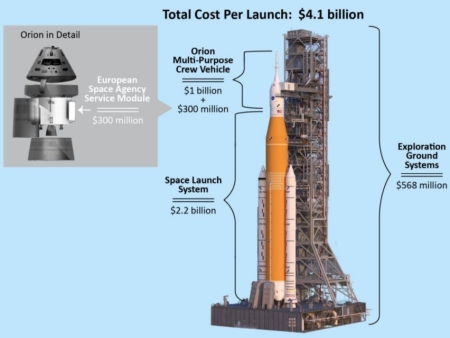
And it also takes two-plus years between launches
The Artemis vision began with President Trump, but the SLS architecture and its components long predate his administration, with much of the heritage clearly traced back to the Shuttle era. As I stated during my hearings, and will say again, this is the fastest path to return humans to the Moon and achieve our near-term objectives through at least Artemis V, but it is not the most economic path and certainly not the forever path.
The flight rate is the lowest of any NASA-designed vehicle, and that should be a topic of discussion. It is why we undertake wet dress rehearsals, Pre-FRR, and FRR, and why we will not press to launch until we are absolutely ready.
These comments were also in connection with the first wet dress rehearsal countdown that NASA performed with SLS/Orion in the past few days, a rehearsal that had to be terminated early because of fuel leaks. NASA now plans to do another wet dress rehearsal, requiring it to push back the Artemis-2 launch until March.
I think there is more going on here than meets the eye.
First of all, I think Isaacman is very aware that in the first launch of SLS in 2022, there were numerous delays due to similar problems. It took three wet dress rehearsals in April through June to finally allow the agency to commit to an August launch. In every case the problem was related to hydrogen fuel leaks or improper temperatures during fueling. Then the August launch was scrubbed twice because of more fuel leaks, forcing the agency to delay the launch again until November, when it was finally able to complete the countdown and launch.
I think Isaacman is telling us indirectly that he is going to demand a perfect dress rehearsal countdown before he will be willing to sign off on the actual launch. Based on SLS’s track record, it is therefore very likely that a launch this spring will not take place. Right now the launch has been delayed until March. If one or two dress rehearsals push it back into April and later, NASA will simply run out of time in this launch window.
Nor is this unlikely. There were five countdowns for Artemis-1 before it was finally able to launch, causing several months of delays. If this happens now, SLS won’t launch until later this year.
In other words, Isaacman is telling us by his statement today that he wants to make very clear to the public — and to the politicians in DC — the problems presented by SLS/Orion’s expensive and cumbersome design. During his nomination hearings he was forced by those politicians to commit to SLS/Orion and this Moon mission. He is now I think laying the groundwork to convince these Congress critters that a major change is essential, especially if they want to get their wish of creating a lunar base ahead of the Chinese. By forcing a perfect launch countdown and thus multiple delays — for entirely right reasons — he is going to force the politicians to reconsider SLS at last.
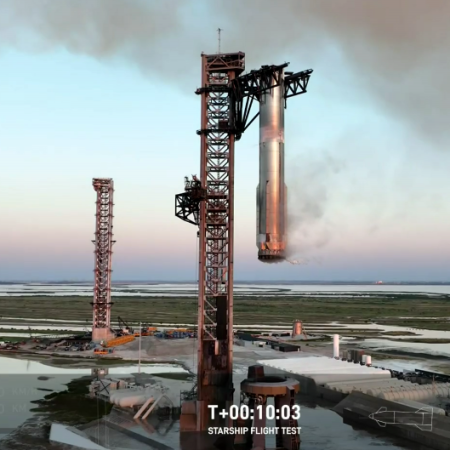
Superheavy after the October 2024 flight,
safely captured during the very first attempt
I am of course speculating, as I really have no idea what Isaacman is really thinking. I do know however that if SLS experiences multiple dress rehearsals with problems and gets delayed by months, this is exactly what is going to happen, even if Isaacman isn’t planning it.
The public is now paying close attention, and we have a NASA administrator who is not willing to sugarcoat these delays. That combination is going to make SLS look increasingly bad as it undergoes more likely “glitches” and delays, doing so in plain sight instead of limited to space geeks who pay attention.
And these delays will look even worse in comparison to Starship/Superheavy, which should launch itself at least twice or three times in the next six months, doing spectacular things and doing them regularly and almost routinely.

On Christmas Eve 1968 three Americans became the first humans to visit another world. What they did to celebrate was unexpected and profound, and will be remembered throughout all human history. Genesis: the Story of Apollo 8, Robert Zimmerman's classic history of humanity's first journey to another world, tells that story, and it is now available as both an ebook and an audiobook, both with a foreword by Valerie Anders and a new introduction by Robert Zimmerman.
The print edition can be purchased at Amazon or from any other book seller. If you want an autographed copy the price is $60 for the hardback and $45 for the paperback, plus $8 shipping for each. Go here for purchasing details. The ebook is available everywhere for $5.99 (before discount) at amazon, or direct from my ebook publisher, ebookit. If you buy it from ebookit you don't support the big tech companies and the author gets a bigger cut much sooner.
The audiobook is also available at all these vendors, and is also free with a 30-day trial membership to Audible.
"Not simply about one mission, [Genesis] is also the history of America's quest for the moon... Zimmerman has done a masterful job of tying disparate events together into a solid account of one of America's greatest human triumphs."--San Antonio Express-News
I am still not totally sure if this is what Jared is trying to do, but if he *is*….well, he faces an uphill climb, but this could not *hurt* as a strategy for trying to force both ends of Pennsylvania into a reconsideration of this entire architecture, if it really gets delayed that badly.
It would sure help, though, if in the meantime SpaceX manages one or two clean test flights of Starship, and Blue Origin’s coming launch of New Glenn is likewise hitch-free. You can’t beat something with nothing, and Congress needs fresh reassurances that there are some viable “somethings” out there as alternatives. But that seems to be what you are trying to say in that last paragraph (and the, uh, striking photo), Bob,
Richard M: Um, I actually say that directly, in the final sentences of the essay. :)
https://external-content.duckduckgo.com/iu/?u=https%3A%2F%2Fy.yarn.co%2F189b666f-20d9-4505-a8c8-598535ebdc42_text.gif&f=1&ipt=e765dc4cd97f595a7fac1ee4d4e79ad1eca5a91595e4dfe8ab58aef36b594f17
In the presser today, Amit Kshatriya agreed—firmly—that each SLS launch is an experimental, not an operational, affair. Things are changing at NASA.
Hi Bob,
I admit that I kind of skimmed past the last section of the essay as I was typing . . . then looked back up at that photo of the booster catch, went back and read the last paragraph, and decided that you really were making the point I was writing up already, but I wanted to finish off the post without rewriting the whole thing. But yes, you beat me to the punch. SpaceX and Blue Origin can really help their case for replacing SLS and Orion if they can deliver some successes over the next several months, if indeed Artemis II is delayed that long.
In the end, of course, they *are* going to win. But I think that, yes, they can plausibly accelerate the process if they have a good year in 2026.
Hello Patrick,
Yeah, I just got to that part. He did indeed!
Not sure he was entirely happy making the admission. But he did, it seems.
All: So NASA admits SLS is experimental, just like Starship/Superheavy!
Let’s compare these experimental programs:
Testing:
SLS: One launch followed by a manned flight.
Starship/Superheavy: So far eleven test flights plus a half dozen early flip maneuver tests with just Starship. No humans on board, and no present plans to put humans on board for quite a number of additional test flights.
Cost:
SLS: ranging above $60 billion.
Starshp/Superheavy: Estimated in the range of $12 billion.
Development time:
SLS: Now going on 22 years.
Starship/Superheavy: Now about a decade.
Which would you buy? As a taxpayer I continue to be outraged that our Congress and President keep wasting MY money on SLS.
Maybe I’m stating the obvious, but it looks to me like Isaacman could simply refuse to launch a manned SLS mission unless there were absolutely no non-optimal items, and hold SpaceX to the same standard. That allowed unmanned SpaceX launches to observe the rapid iteration approach, but does not allow SLS to get “ahead” by ignoring the fact that this flight is manned after much fewer flights than Starship will fly before it goes manned!
Not to mention that Starship could use Dragon as a ferry vehicle (perhaps both up and down) and avoid launching manned for an arbitrary amount of time… perhaps forever!
Re Our Host’s comment on testing:
Shuttle’s first flight in 1981 was manned.
As to Issacman’s message to congress, in the words of the artillery:
Shot, over.
Shot, out.
Splash, over.
Splash, out.
Cheers –
They don’t have to wait till March to attempt another WDR.
I am outraged that NASA is always the whipping boy of cost cutters..when entitlements and military adventurism cost Americans far more.
Casey Dreier’s June 17, 2019 article at THE SPACE REVIEW shows Artemis well below Apollo–a program worthy of tax dollars
Other Space Review articles deserving of remembrance
“Big Rockets for Big Science:” Nov. 6 2023
“Making Peace with the SLS:” Oct 29, 2018
Nuclear Thermal will be the best use for SLS.
See Greg Hullender’s appreciation for LH2 over ammonia at the NSF thread “New NASA/DOD Nuclear Propulsion Effort” (reply 82)
For those hung up about depots, see page 24 of the November 7, 2011 issue of AVIATION WEEK article “Fact Checking.”
Yup. By the time a human being actually climbs on board a crewed version of Starship (HLS or otherwise), it’s going to have a flight heritage of scores, even hundreds of actual, honest-to-gosh test flights.
Just as Falcon 9 did not first launch Doug and Bob on Demo 2 in May 2020 until it had already launched 84 times in its various blocks and versions. Doug and Bob could feel pretty darned confident that they were riding on a rocket that had really proven itself in flight.
I’m sure that the who built this SLS and the guys who are on the ground and mission controls for it worked their tails off, and did it with real integrity. It has a lot of systems and components with significant heritage. But the fact remains that this is a rocket that has only launched *once.*
Jeff Wright: nothing NASA does is really important. If you desire larger budgets for it, you have to persuade people that it is in their interests that NASA gets more, and on top of that, you need great leadership and a clear plan. For better or worse, a sufficient number of people are convinced of both the value of the military and of welfare that we spend a lot on them, and there is still constant wrangling over how much.
It doesn’t matter that the SLS and Orion are costing less than Apollo. What matters if is we’re getting our money’s worth for them. Your contention is that we are. Nearly everyone else here thinks otherwise. All of your mentioned articles are from a world dramatically different than our own-we didn’t have the launch capacity we have now, the prices, or the increasingly robust private sector. All of them need to be rewritten to account for the changes in the space industry, and honestly, you’re not going to get very far in persuading many to see your point of view. Our fundamentals are simply too different. Unless and until you can understand why people think differently from you, you’re going to struggle in vain.
Robert Zimmerman: it’s worse if you consider that the SSMEs were originally designed in the 70s, then flown in the 80s, given how propulsion is a significant challenge for any new launch vehicle. And, barely more time than the SLS/Orion programs have been absorbing billions per year for a single launch, SpaceX has launched over eleven thousand satellites, launched rockets nearly six hundred times, put dozens of people into orbit, sent payloads all over the solar system, and seen dozens of new companies spring up to take advantage, first of F9, and now of Starship. Dollar for dollar we get far more for taxpayer spending from SpaceX than we do of SLS or Orion, and that won’t ever change.
Hello Nate,
I agree with every word of your post. Well said.
Rand Simberg, on his blog, referred to the “subtle shade” Isaacman is throwing on SLS. I think it’s a lot more than “subtle.” Isaacman, I think, by explicitly stating that:
“As I stated during my hearings, and will say again, this is the fastest path to return humans to the Moon and achieve our near-term objectives through at least Artemis V, but it is not the most economic path and certainly not the forever path.”
is acknowledging the current political realities but also preparing the battlespace for what he expects to be a significant transition anent Earth-to-Moon logistics that he also expects will occur during his term of office.
Now, as Richard M and others here have said, the ball is pretty clearly in SpaceX’s and Blue’s courts. If either or both show sufficient moves in 2026, Isaacman is signaling that he is ready to back a transition that cuts out SLS entirely.
I wouldn’t put it past Jared to try to kill SLS even if NG or SS never flew.
If that happens, I could see SLS states voting to reduce funding for spaceflight such that there are no savings to go to other things.
Jeff Wright,
Both Starship and New Glenn have flown, though, so we don’t occupy your notional universe.
In terms of the politics of NASA funding, what NASA does will amount to a smaller and smaller fraction of the totality of what the US does in space – something Isaacman also acknowledged in his remarks. So “revenge” by “SLS states” isn’t going to significantly affect what remains of NASA’s remit once providing transport to and from the Moon has been removed from it. There are plenty of other “NASA states” to provide cover fire against any attempt to gut NASA by “SLS states.” As a practical matter, the only “SLS states” of consequence are Utah, Alabama and Louisiana. Against them, one can place the “SpaceX states” of Texas and Florida and the “Blue Origin state” of Washington.
SLS is going away at some point during the remainder of the current decade – almost certainly while Trump is still President. You need to find some way to deal with this inevitability. Hint: revenge fantasies will not suffice.
Perhaps Jeff really meant “never flew *again*.”
But that doesn’t make much more sense, since it’s impossible to imagine SpaceX and BO suddenly abandoning these vehicles suddenly without simultaneous megaton range nuclear strikes on both Boca Chica and the Cape while Musk and Bezos are on site. I mean, both Starship and New Glenn are literally scheduled for launches within the next six weeks.
P.S. I do think that Texas (JSC Mission Control) and Florida (KSC processing and launch operations) could count as “SLS states,” and I think their congressional delegations still show evidence of that mindset. But you’d still be right, Dick, that both states now employ more people and more material investment in Starship and New Glenn/Blue Moon development than they do SLS and Orion. And their congresscritters know that, too.
If Isaacman is delaying the launch of SLS, one rationale could be to take away the claim that SpaceX is the source of delay in getting back to the moon.
Jeff Wright: petty revenge aside, it would be worth ending the SLS program even if it meant NASA simply didn’t get that money at all. That’s not ideal, but it’s better than continuing to waste taxpayer money. The government has a responsibility to use the resources of the citizenry wisely, and if it can’t use them wisely, it’s better that they simply don’t have it.
Something that can actually launch a Moonship is not a waste. As long as you and yours continue to talk about Starship costing a fraction of SLS, I will remind you that Starship is the same fraction of readiness in taking humans Beyond Earth Orbit.
A great nation either funds spaceflight enough or it doesn’t.
Jeff Wright: do you recognize, and accept as legitimate, that while you view launching Orion to NRHO as intrinsically valuable, most people do not? As for Starship’s ability to take people BLEO, it will come soon enough. But it’s clear your goal isn’t to pursue truth, it’s to score points.
A great nation doesn’t build things like the SLS or Orion. It recognizes their waste, and chooses to invest its resources more wisely.
Savile: maybe, but he doesn’t need to arbitrarily restrict the SLS to demonstrate its weakness. It does that well on its own. There’s no real enthusiasm in Congress for flying more than 5-10 (and more likely only five) SLS missions. If Shelby were around he’d fund it in perpetuity, but thankfully he’s retired.
Nate P: I don’t think you realize yet that asking Jeff Wright a direct question is a waste of time. He does not respond to such things, as he is essentially a troll whose only purpose appears to be posting incoherent comments designed to irritate.
I have not banned him because (as commenter Edward has said), responding to his silliness helps people refine their arguments. In this context, it could be that Jeff Wright has done more to illustrate the failures of SLS and Orion than anyone else in the blogosphere. The hilarity of that is surely something to behold. :)
Richard M,
Granted that both TX and FL are also “SLS states” to some degree. By the same token, AL can also be counted as a “Blue Origin state.” I was simply pointing out that the Congressional calculus is changing and not in a direction that favors SLS.
Jeff Wright,
Thing is, Orion isn’t a Moonship. At best, it’s a limited-capability taxi that can only carry a crew out to where it can meet up with an actual Moonship. And it can’t even do that particularly close to the Moon. The analogy, I suppose, would be to a crew starting in Cheyenne, WY and going to Houston, but whose car ride can only get them to some deserted crossroads in the TX panhandle. Fortunately, there will be a tour bus waiting there that can take them to where they’re actually going.
Robert Zimmerman: I’m stubborn, and at least this way third parties who may be uninformed will have extra information when they decide who and what to support. I think Jeff suspects our motives and believes that anyone who is anti-SLS is anti-American, which is nonsense, but silliness is no bar to such belief.
Ken Kirtland made an important point about the consequences of SLS/Orion’s weaknesses just now, worth repeating:
“By the way, stuff like this 1 month delay for a WDR leak on SLS is why the HLS lander has the insanely tough requirement of being able to loiter at NRHO for at least 90 days BEFORE doing the landing + week stay + ascent. All with Cryo fuel.
As with everything, all difficult requirements got punted from Orion + SLS (the very reason we talk about stupid NRHO for example) to the lander, which we started a decade later and 1/10th the funding.”
https://x.com/i/status/2019120463583269018
As he says, it’s not just the extended loiter time that got shoved over to the HLS landers. It’s also the additional delta-v needed to go to and from Near Rectilinear Halo Orbit. And on top of all that, shoving power and life support over to a space station (Gateway).
It’s just such an awful architecture.
SLS / Orion is NOT an architecture. Richard M comments about the punting of requirements to “other – non-SLS things” demonstrates that fact.
At some point early in the Constellation program, the progenitors of SLS and Orion could be described as a conceptual or preliminary architecture. When Congress mandated effectively whatever we do in human spaceflight must use “SLS” however that was defined, it became a funding structure not a space exploration architecture. It went from being a lunar exploration architecture to a generic space exploration / asteroid mission architecture back to a lunar exploration architecture that looks significantly different than the first lunar architecture.
The only thing the current architecture is good at is burning money. The fact that it “could” burn even MORE money than it currently is doing, is hardly a point to recommend continuation.
I continue to hope that new space that is SpaceX, Blue Origin, Rocket Lab, Stoke Space can continue to lower the cost of human exploration so that that endeavor is not 100% dependent on pork rolling government expenditures.
Jeff Wright wrote: “Something that can actually launch a Moonship is not a waste.”
When it is too expensive, cannot launch often enough to be useful, and cannot even do better than go into a bizarre non-orbit of the Moon, it is a waste. The money could be better spent on other, more productive, projects. New Glenn and Starship should be able to get men and materiel onto the Moon’s surface, which is the goal. Jumping over the Moon, like the cow, and going into a non-orbit are not as useful as the true Moon Ship, Apollo-Saturn.
“A great nation either funds spaceflight enough or it doesn’t.”
Good comment. I now have a new favorite tautology.
_________
Robert Zimmerman wrote: “In this context, it could be that Jeff Wright has done more to illustrate the failures of SLS and Orion than anyone else in the blogosphere.”
Due to Jeff Wright’s comments, I have also lost a lot of respect for Marshall Spaceflight Center. Not for the workers but for the NASA management that those workers have to follow. It would be so much better if the talent, knowledge, and skills of the scientists, engineers, and technicians were put to good use rather than to support the increasingly obsolete SLS. It would be nice if the Lockheed Martin crews could also be put to use on commercial manned spacecraft that weren’t too heavy for the jobs at hand and without NASA interference on the heat shield.
Edward: yes. I think Jeff Wright doesn’t realize the damage he’s doing to MSFC’s reputation with his comments. The workforce isn’t much better; I’ve debated more than one, and nearly all of those are true believers in the SLS who resent the private sector.. One told me that his coworkers who had been there since Constellation were bitter they didn’t get to build Ares V.. Value to the taxpayer is a secondary consideration to getting their way.
Regarding the orbit, I could see a place for a true space station (one with artificial gravity and radiation shielding) that serves as a refinery or shipyard, much as in O’Neill’s proposal, but Gateway isn’t it, and I wouldn’t put such a station in NRHO.
If SLS/Orion was ended after this launch how much material and parts would be left over in the assembly areas?
“One told me that his coworkers who had been there since Constellation were bitter they didn’t get to build Ares V.”
Oh, I’ve heard that whine from MSFC peeps before, too, believe me.
“If SLS/Orion was ended after this launch how much material and parts would be left over in the assembly areas?”
Definitely a question for Phillip Sloss, who keeps track of all these things like a hawk — I mean, to the extent that NASA divulges anything at all about the hardware. I’d shoot him a query on either his X account, or his next Youtube video. He’s pretty good about answering.
I believe the core stage, ICPS, and SRB segments for Artemis III are mostly done, and the Orion is deep into processing now, largely complete. It gets sketchier after that, though. NASA released photos in December of the completed hydrogen tank for the Artemis IV core stage, but I don’t know where the rest of the hardware stands. The wild card is the Exploration Upper Stage, which Artemis IV will *need*, because there are no more ICPS stages for anything beyond Artemis III. The EUS Structural Test Article is supposed to be finished next year, but that is just a test article, obviously. This is something still in development, and because this is new SLS hardware and it is Boeing developing it, we should assume that delays are gonna happen.
I’m not quite sure about all the RS-25’s. They have enough reconditioned from the Shuttle to get them through Artemis IV. AJR is manufacturing new ones for the missions beyond that, and I have no idea how far along those are.
EDIT: the EUS Structural Test Article is supposed to be completed and ready for testing THIS year. I’m not sure exactly when; NASA is not exactly frequent in its updates.
So I guess no amount of arguments short of a fire will keep them from spending anything to get IV off the ground.
And it could take 3 more years, maybe even 5. And do nothing in the end.