
New Trump executive order today guarantees major changes coming to NASA’s Moon program

Change is coming to Artemis!
The White House today released a new executive order that has the typically grand title these type of orders usually have: “Ensuring American Space Superiority”. That it was released one day after Jared Isaacman was confirmed as NASA administrator by the Senate was no accident, as this executive order demands a lot of action by him, with a clear focus on reshaping and better structuring the entire manned exploration program of the space agency.
The order begins about outlining some basic goals. It demands that the U.S. return to the Moon by 2028, establish the “initial elements” a base there by 2030, and do so by “enhancing sustainability and cost-effectiveness of launch and exploration architectures, including enabling commercial launch services and prioritizing lunar exploration.” It also demands this commercial civilian exploration occur in the context of American security concerns.
Above all, the order demands that these goals focus on “growing a vibrant commercial space economy through the power of American free enterprise,” in order to attract “at least $50 billion of additional investment in American space markets by 2028, and increasing launch and reentry cadence through new and upgraded facilities, improved efficiency, and policy reforms.”
To achieve these goals, the order then outlines a number of actions required by the NASA administrator, the secretaries of Commerce, War, and State, as well as the Director of the Office of Management and Budget (OMB) and the Assistant to the President for Domestic Policy (APDP), all coordinated by the assistant to the President for Science and Technology (APST).
All of this is unsurprising. Much of it is not much different than the basic general space goals that every administration has touted for decades. Among this generality however was one very specific item, a demand to complete within 90 days the following review:
by the Secretary of Commerce and the Administrator of NASA, in consultation with the Director of OMB, of their respective major space acquisition programs to identify any such programs that are more than 30 percent behind schedule based on the program’s acquisition baseline, 30 percent over cost based on the program’s baseline, unable to meet any key performance parameters, or unaligned with the priorities in this order, along with a description of their planned mitigation or remediation efforts.
If that isn’t a very precise description of SLS and Orion, I don’t know what is. It appears this executive order is quite specifically laying the political groundwork for ending both, and to do so the Trump administration wants this report on hand to show both Congress and the public. Note too that the report isn’t simply supposed to identify these over-budget and behind schedule programs, but to outline the “planned mitigation or remediation efforts”, efforts that must work to “grow a vibrant commercial space economy through the power of American free enterprise.”
In other words, Trump wants Isaacman to work up a new Artemis program that he can present to Congress, no longer relying on a government-owned rocket (SLS). It is also likely that Isaacman and Trump discussed this entire strategy during their meetings leading up to Trump’s renomination of Isaacman.
What will that new plan entail? You can bet, based on the order’s focus on private enterprise, that it will involve SpaceX, with a strong dash of Blue Origin on the side. It will also include the many American startups planning the first launch of new rockets in 2026 (Rocket Lab, Relativity, Stoke Space) as well as others already established (Firefly and Northrop Grumman). That plan is also going to include the four commercial space station projects under development, as well as all the other peripheral industries involved.
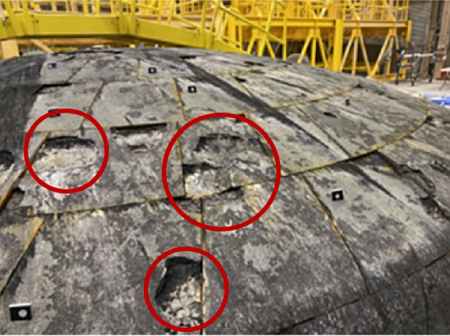
Damage to Orion heat shield caused during re-entry in 2022,
including “cavities resulting from the loss of large chunks”
And you can also bet it will outline the phasing out of SLS, Orion, and possibly Lunar Gateway, as quickly as possible. It might not cancel the already scheduled and funded next three Artemis SLS/Orion missions, but it is also very likely it will recommend that these programs be cancelled thereafter.
The deadline for the release of this report, 90 days from today or the middle of March, also suggests it is intended as a weapon for not only cancelling later SLS/Orion missions, but for forcing a change on the Artemis-2 mission, scheduled for the February-April 2026 time frame. That mission plans to fly four astronauts around the Moon, launched on SLS and flying inside an Orion capsule with a questionable heat shield (see the image to the right) and an untested environmental system. To fly such a manned mission with such questionable equipment is unconscionable, and appears to be another example of NASA putting scheduling ahead of good engineering and safety, as it did with Challenger and Columbia.
The deadline for this report suggests that Trump’s executive order today is precisely aimed at providing Isaacman the political clout he needs to pull those astronauts from that mission, for legitimate safety concerns. When he releases this report in March, he will do so with great fanfare, in a manner that will allow him to take such a politically charged action. All he needs to do is make sure Artemis-2 does not launch beforehand, a delay of only a matter of weeks.
Be prepared for political fireworks come March.

On Christmas Eve 1968 three Americans became the first humans to visit another world. What they did to celebrate was unexpected and profound, and will be remembered throughout all human history. Genesis: the Story of Apollo 8, Robert Zimmerman's classic history of humanity's first journey to another world, tells that story, and it is now available as both an ebook and an audiobook, both with a foreword by Valerie Anders and a new introduction by Robert Zimmerman.
The print edition can be purchased at Amazon or from any other book seller. If you want an autographed copy the price is $60 for the hardback and $45 for the paperback, plus $8 shipping for each. Go here for purchasing details. The ebook is available everywhere for $5.99 (before discount) at amazon, or direct from my ebook publisher, ebookit. If you buy it from ebookit you don't support the big tech companies and the author gets a bigger cut much sooner.
The audiobook is also available at all these vendors, and is also free with a 30-day trial membership to Audible.
"Not simply about one mission, [Genesis] is also the history of America's quest for the moon... Zimmerman has done a masterful job of tying disparate events together into a solid account of one of America's greatest human triumphs."--San Antonio Express-News
”If that isn’t a very precise description of SLS and Orion, I don’t know what is.”
SLS has been on budget and on schedule for years. Years ago it had some development issues that delayed first flight, but since then it has been hitting its milestones pretty much on target.
”…to identify any such programs that are more than 30 percent behind schedule based on the program’s acquisition baseline.”
That would be Starship. It was awarded a contract in 2021 with a schedule of making orbit in 2021, completing operational derivatives* for Starlink (Pez dispenser) and generic payload (chomper) deployment in 2021, developing tanker and fuel depot derivatives in 2022, landing an unmanned Starship on the moon in 2023, and performing the first manned landing in 2024. In fact, the entire rationale for giving SpaceX — and only SpaceX — the contract was that they were the only company who could meet that schedule.
None of that happened. 4-1/2 years later we are still waiting for Starship to make orbit. Six additional major derivatives still lie ahead after that. No one expects SpaceX to make even the 2028 date, or even come close to it.
With the EO reaffirming the 2028 goal and additional near-term landings after that, I don’t see either SLS or Orion going away anytime soon. I don’t see the Starship contract being cancelled either, BTW, just sidelined while work on an alternate is accelerated.
I expect that extra $50 billion will be used for 1) an alternate lander to make 2028 (which will become 2030 when all is said and done), 2) an alternate (commercial) capsule for Orion, 3) an alternate launch architecture involving depots and distributed launch allowing SLS to be phased out after 2030, 4) surface habitats and pressurized rovers, and 5) space nuclear power.
I think everyone who expects everything non-SpaceX to be cancelled and everything just handed over to SpaceX are going to be very disappointed. Again.
* Not technically part of the HLS contract but part of SpaceX’s development plan.
To mkent
I think Starship is doing pretty good. They are getting better, and better with launches. No landings, and reuse yet. But that will come. And after that, going from Earth, to LEO, it will be able to launch about three times a day, 20 times a week, 1,000 times a year.
SLS could never do that.
SLS on schdule? The Artemis I launch was supposed to occur in 2018 and did not happen until 2022. I would not call that on schedule. The Artemis II mission is nearly 5 years behind its original 2021 launch date. According to Space.com in 2020 the program was then 33% off the schedule and budget goals originally given to Congress. It would appear that RZ is correct in his assumption of what the target program is.
mkent, what alternate universe are you getting your information from or are you just a SpaceX hater?
BillB: mkent is correct on schedule and budget for SLS, if you make believe the schedule and numbers begin around 2021. Since then SLS has been holding its own somewhat as planned.
The problem is that the schedule and numbers don’t begin in 2021, as you most correctly note.
For a more complete accounting, see my 2017 policy paper, Capitalism in Space. (it’s a free download). At that time SLS and Orion were already insanely over budget and behind schedule, and little in the ensuing years has changed that.
Finally, note that the Trump executive order is very specific: It references the “baseline” budget and schedule. In other words, use the original promised numbers. Under that approach, SLS and Orion do not fare well at all.
This Just in. (Satire warning)
Like the Kennedy Center, President Trump has announced that the Kennedy Space Center will henceforth be know as the “Trump
Space Center,” and Starship will be renamed the “Trump Space Scepter.” Likewise, the Gulf of America, formerly known as the Gulf of Mexico, will now be called the Gulf of Trump.
Poor Susie Wiles *tries,* but apparently there is only so much that she can do. More seriously, there is the danger that all of the good that has been done — including what is discussed above — since last year’s election may be undone by the arrogance and tone deafness of a certain pig-headed Irishman who apparently does not care how many potential allies and supporters he alienates.
Quos deus vult perdere, prius dementat.
Ronald Reagan was an Irishman, too, but you could disagree with him and still like him. Likewise, he had a keen sense of humor, even after he had been shot. For me, the best analogy is that Trump is essentially the Batman elevated to a national level, doing the unpleasant but necessary things to clean up Gotham Nation that nobody else would dare to do* — the hero that we need, but not necessarily the one that we would want.
*And many of the Democrats seem to be every bit as twisted and evil as the Joker.
Okay, stipulate that SLS/Orion are now on a reasonable schedule. (Dismiss previous development history from your mind; it’s just water under the bridge, and besides, it’s painful.) What a New and Improved schedule it is! Three years between A1 and A2 (really sort of an unfair swipe, given they had to spend considerable time justifying putting the A2 crew on the same TPS that took a bit of a beatdown on A1) then a two-year wait for A3 BUT WE CAN BLAME SPACEX FOR THAT ONE, THE SLACKERS. Every one of those orange beauties tossed to the ocean floor or otherwise trashed, at $4.2B a pop. Sweet. What an amazing display of what our tax dollars can accomplish in the hands of our technocratic betters. Rejoice Therefore!
mkent,
An imaginative comment – particularly the parts about Starship’s alleged “schedule.”
“No one expects SpaceX to make even the 2028 date, or even come close to it.”
Well, I, for one, expect a manned Moon mission via HLS Starship by 2028. More to the point, so does SpaceX. SpaceX now has its own quite urgent reason to get to the Moon – AI data centers in space – and on a scale that makes the entire Artemis project look like a Boy Scout troop’s summer camp-out compared to the D-Day landings at Normandy.
And don’t waste any further time composing your wish list for that $50 billion mentioned in the EO. That isn’t a commitment to new government spending, it’s a goal for new private-sector space investment. The SpaceX IPO next year should cover well over half of that goal in one fell swoop.
Robert Zimmerman,
I hope Trump and Isaacman interpret those 30% margin numbers exactly as you surmise. SLS and Orion deserve to die with all deliberate speed. If this EO proves to be the axe needed to kill them, then good for Trump.
I didn’t put this item on my “greatest hits of the new EO” list in the other comment thread because, frankly, the things I did put there are, IMHO, of considerably more importance than the inevitable fate of SLS-Orion. I have long-since ceased to care very much about SLS-Orion or the details of the exact paths both will soon enough take to the graveyard. My remaining concerns anent those two unlovely lumps of metal now revolve entirely around no NASA astronauts dying unnecessarily aboard what Casey Handmer memorably – and correctly – labeled recently as “flaming garbage.”
The recent revelations regarding SpaceX’s plans for the Moon anent the goal of developing a massive infrastructure of AI data centers in space at flank speed now seems all but certain to guarantee both massive settlement and industrialization of that body over the long term with even the earliest aspects dwarfing the ambitions embodied in the Artemis program of record. SpaceX will do what is needful to address its goals and SLS-Orion will vanish of terminal irrelevance. The precise nature of that demise will be of interest mainly as entertainment, not because it will any longer have anything of consequence to do with America’s future in space.
Dick Eagleson wrote:
“My remaining concerns anent those two unlovely lumps of metal now revolve entirely around no NASA astronauts dying unnecessarily aboard what Casey Handmer memorably – and correctly – labeled recently as “flaming garbage.” ”
I’ll bet Trump is worried about that one as well. I know I am.
From the EO:
“…or unaligned with the priorities in this order, …”
I wonder if that includes science missions.
I wrote:
I wonder if that includes science missions.
I answer myself: probably not…not in this EO which seems to be oriented towards manned missions
More Coffee
mkent has a point, and I admit, it occurred to me, too. There is more than one possible target of such a requirement.
The only way to answer the intent of this point in the order is to determine who were the primary formators of the document. Because if it was people like Sean Duffy, Amit Kshatriya, Doug Cooke, Dan Dumbacher, Jim Bridenstine, or even certain senators we all know and love, then yeah, Starship HLS could be more rightly viewed as the target of this requirement.
If on the other hand, it was Isaacman or certain SpaceX-friendly peeps in the administration, then it would be more likely that Bob Zimmerman is correct.
What’s the answer? I haven’t seen anyone with an inside scoop yet on how this document came into being. Given the strong commercial tilt of other parts of the executive order, and the fact that Isaacman made such a point of being present at Trump’s signing of the order yesterday ( https://x.com/NASAAdmin/status/2001837809897013659 ), I *tend* to think Mr. Zimmerman is more likely to be correct, and SpaceX’s Starship HLS program will only get additional scrutiny at NASA HQ to the extent that Jared Isaacman thinks it is necessary to appear even-handed in his dealings on the Hill.
Yeah, I think mkent just misread that passage. That clearly has nothing to do with any appropriations request by NASA. And if it *was*, well…my gosh, even Bill Nelson could only squeeze $4 billion out of the Senate for the second HLS award to Blue Origin. The idea that you could get a $50 billion funding boost for NASA (even over multiple years!), short of an alien derelict or unobtanium being found on the Moon, well…
People need to understand just what a traditionally procured (cost-plus) “minimal” lunar lander would cost to develop and build. I do not have the link handy at the moment, but there was a discussion on X not long ago about this, and someone consulting with NASA had built a calculator for that, and it came out to roughly $25 billion. Which, by the way, is close to what Constellation’s Altair lander would cost based on its original projections if you factor in the 15 years of inflation since 2010. Personally, I think that’s gonna be on the low side.
Another point by mkent I would like to tickle:
But that’s not true. If you read the Source Selection Statement conclusion, it actually singles out cost, not schedule, as decisive: “My selection determination for SpaceX’s proposal is based upon the results of its evaluation considered in light of the Agency’s currently available and anticipated future funding for the Option A effort.” SpaceX also scored highest on technical and management criteria, too; but it remains the fact that SpaceX had the only bid that was (barely) within NASA’s available funding as appropriated by Congress. Blue Origin’s $6 billion proposal was *double* what NASA had available; Dynetics bid something close to $10 billion.
https://www.nasa.gov/wp-content/uploads/2019/04/option-a-source-selection-statement-final.pdf
Lueders says more in this vein in the statement: “SpaceX’s plans to self-fund and assume financial risk for over half of the development and test activities as an investment in its architecture, which it plans to utilize for numerous commercial applications, presents outstanding benefits to NASA. This contribution not only significantly reduces the cost to the Government (which is reflected in SpaceX’s lower price), but it also demonstrates a substantial commitment to the success of HLS public-private partnership commercial model and SpaceX’s commitment to commercializing technologies and abilities developed under the Option A contract.”
You can argue with the evaluation process by Kathy and her team. but we can’t mischaracterize it.
Richard M: Though of course this specific EO report is supposed to review all of NASA projects, when you weigh Isaacman’s background, the Trump effort to end SLS/Orion after the first manned lunar landing, the overall tone of the EO in favor of commercial space and private enterprise, and the overbudget and behind schedule of SLS and Orion, I think it is a poor analysis to think this EO report is aimed at anything but SLS and Orion.
There is also the politics and the dangers inherent in the Artemis-2 mission in the spring. This issue has to be dealt with, and I strongly believe Isaacman and Trump discussed it in those meetings. This EO seems perfectly designed to provide Trump and Isaacman the maneuvering room to take action.
That’s my analysis. I could be wrong, but I am confident if so I ain’t far off the mark.
Thanks, Bob. These are valid points. And I think (and hope!) you are right.
But just steelmanning mkent’s argument…it is *also* true that over the last several months that there has been a concerted pushback against SpaceX both on Capitol Hill, and within the Administration itself, even after Sergio Gor’s departure from the White House. Even the guy in charge of the explorations mission directorate at NASA (Kshatriya) has made it plain that he thinks the HLS award to SpaceX was a bad idea. So if nothing else, one wouldn’t be *surprised* if Isaacman got some prodding about whether this requirement is going to be used to prod SpaceX over Starship development delays by people who, you know, would love to see SpaceX prodded.
And SpaceX *has* had delays in Starship development. We all know it. The question is *why*. Starship is an astoundingly ambitious architecture and hiccups were likely going to be inevitable thanks to unknown failure modes and just the human errors from the friction of an organization moving at warp speed. Whereas the delays of SLS and Orion are clearly due to awful program management and perverse institutional incentives and rules. These are not the same sort of delays. And everyone needs to be confronted with that.
I kind of like the Gateway in Lunar NRHO. We could keep that as a station between lunar-rated shuttles and what has to get back to Earth orbit.
That’s the one link in the program as makes sense to me. We’ll probably need a sop to Congress and the Swamp, so that can be it.
P.S. I should probably nuance what I said about Kshatriya, who *in public* (when he speaks in public at all, which is rare) usually says the proper, good things about SpaceX and its progress. But he’s certainly from the more traditional EMD culture that Free et all are part of (albeit one senses that he’s more competent), and the scuttlebutt has been that he was less happy about the HLS award.
The people who really embraced SpaceX for these jobs in NASA senior management were Kathy Lueders and Phil McAlister. And they’re both retired from the agency now — not entirely voluntarily, it seems. It’s going to be interesting to see how Jared manages all that when he gets to work.
Much like our kind host, I have made it clear here that I think Gateway is just a terrible idea, and should be cancelled.
As an engineer I know once said, there’s probably an argument that having a docking port connected with 60kW in lunar orbit, even a dubious orbit, has some sort of value. Likewise, that near rectilnear halo orbit (NRHO) makes a pretty good place for a communications relay with the South Pole that always has line-of-sight with Earth. But we’re paying, at last count, $5.7 billion for these marginal things, and you could achieve both for far less than that through other, more appropriate (and commercially procured) vehicles.
For Starship and Blue Moon, though, the Gateway really makes no sense. They do not need it. The only vehicle that needs it is Orion. That, and the fact that it will employ a fair number of people at NASA in key congressional districts, are why it is being built.
The place to build your lunar station is on the surface of the Moon. That’s where the action is going to be, and that’s where everyone will want to be.
Richard M: That pushback however has NOT come from Jared Isaacman, who is the man who will write this report. It has mostly come from the anti-Musk left, with some stupid Republicans joining in for the PR.
Unfortunately, that cohort includes the guy who Trump hired as his acting NASA administrator!
Fortunately, he’s back haunting the Department of Transportation full-time again. But he did enough damage during his time at NASA.
MKent is absolutely correct
To Robert:
This notion that Starship is going to launch 20 times a week is hogwash. Even Falcon can’t do that.
Elon simply needs to forget Mars and put Starship money towards building more Falcons and more pads.
As far as building 100 ton-to-orbit SHLLVs–that should be left up to those who actually know how.
That’s a big reason why a lot of people went to work at SpaceX. What is he supposed to say? “I changed my mind.” Or: “Hah! I was just fooling.”
Well, that would rule out NASA then, wouldn’t it?
Robert Zimmerman & Richard M,
In general agreement with all speculations expressed here. We won’t have long to wait to see how correct we are. I think what, if anything, is done anent Artemis 2 will be the canary in the coal mine.
Jeff Wright,
Falcon 9 can’t launch 20 times per week because it needs a new 2nd stage for every launch and the production rate for those is only about three or four per week. But, with three pads in operation – and the minimum turnarounds on two of them closing in on 48 hours, Falcon 9 can easily launch three or four times per week – and has been doing so for some time. It will likely exceed four times per week in 2026 – as it has already been doing in the first two weeks of the current month.
So that’s only a factor of five over and above current F9 launch cadence for Starship to hit to do 20 launches per week. Production cadence for Starships won’t hit F9 second stage production cadence for awhile but, given that Starships will be reusable, that isn’t going to be necessary to reach 20 launches per week.
The goal with Starship is to do walk-arounds, then gas-and-go like airliners. That won’t happen right away either, but it won’t take long for the post-flight inspection and refurb process to shorten well below the comparable interval for F9 1st stages. SpaceX will likely be able to produce at least a Starship per week by the end of next year. By then, or very early in 2027 at the latest, it will also have five pads capable of Starship operations and could well be working on even more. Given the urgency of Elon’s AI data centers in space project, I think we will easily see 20 Starship launches a week by sometime in 2027. That number will probably be exceeded by the end of that year.
After that, Starship operations are going to look, more and more, like a remake of Gattaca.
SpaceX will perfect Starship and do so fairly soon. It will be a super-heavy-lift rocket system with operating economics and achievable launch cadence several orders of magnitude better than the throw-away monstrosity which is the best the schleppers at MSFC can do. The people “who actually know how” are all at Starbase, not Huntsville.
From the order:
Does this mean that the U.S. government suspects some nation(s) has already placed nuclear weapons in space?
______________
From mkent: “‘…to identify any such programs that are more than 30 percent behind schedule based on the program’s acquisition baseline.’
“That would be Starship.”
I don’t think that there should be much worry about Starship and the HLS contract. If SpaceX thinks that a Moonbase Alpha is important for its business plans, then they will make a lunar Starship, even without that contract. They may prefer a version that does not have to satisfy NASA’s requirements.
More important: the reports are that almost all of the budget has already been paid to SpaceX through the milestone payments, so there is very little money saved by cancelling the Lunar Starship contract, and if the lander is ready for use before any other lander, then NASA loses out. I’m not worried even in that case, because NASA could always rehire SpaceX’s Starship for lunar landings.
______________
Richard M wrote: “And SpaceX *has* had delays in Starship development. We all know it. The question is *why*. Starship is an astoundingly ambitious architecture and hiccups were likely going to be inevitable thanks to unknown failure modes and just the human errors from the friction of an organization moving at warp speed. Whereas the delays of SLS and Orion are clearly due to awful program management and perverse institutional incentives and rules. These are not the same sort of delays. And everyone needs to be confronted with that.”
Worse, SLS-Orion delays here not related to developing revolutionary new technologies, as most of the Starship delays were, but due to the goal being jobs rather than mission results. In that way, SLS-Orion is right on schedule, where many jobs still exist that otherwise would not.
It is only recently that Congress has expressed a genuine interest in a return to the Moon, one that could have been achieved years ago, if they had had that in mind. Instead, they put up with the delays, because delays were advantageous to their unstated jobs goal.
Starship is “delayed” (whatever that means in a development program) mainly because development of new technology does not happen in a straight line or to a schedule, especially ambitious technological advancement. Additional delays ocurred because several accident reports were slow-walked by government, even compared to an operational system.
_______________
Dick Eagleson wrote: “SpaceX will perfect Starship and do so fairly soon. It will be a super-heavy-lift rocket system with operating economics and achievable launch cadence several orders of magnitude better than the throw-away monstrosity which is the best the schleppers at MSFC can do. The people ‘who actually know how’ are all at Starbase, not Huntsville.”
I suspect that SpaceX will start operating a “good enough” version of the “Pez dispenser” soon, and once they develop their other needed versions (tankers, clamshell dispensers, cargo-Mars, manned-lunar, and manned-Mars) they will continue to make incremental improvements, as they did with Falcon 9. I expect SpaceX to eventually abandon further incremental development of Starship, as they did with Falcon, in order to concentrate on a new project for the coming decade, again as they did with Falcon.
My expectation is that SpaceX will continue trying to be the new “NASA,” leading the world in space exploration, development, and use. I also expect some other aspect of the space industry, such as manufacturing, to outstrip SpaceX by the end of next decade. I think that space is going to do for mankind something similar to what railroads did two centuries ago. I’m expecting many amazing advancements, like electricity brought to us, also two centuries ago (although electicity’s benefits came more slowly, similar to government space’s benefits).
Edward noted, “almost all of the budget has already been paid to SpaceX through the milestone payments [for the Starship lunar lander].”
This point makes mkent’s claim — that the target of this executive order will be SpaceX — invalid. SpaceX can’t go over budget by 30% because it has a fixed price contract, most of which has already been paid out. Moreover, its schedule at this moment isn’t behind by a significant amount, compared to SLS. Certainly not 30%.
Remember, the EO said these percentages are to be compared to the baseline of the project. That means the original budget number for SLS and Orion. Under that criteria, the budget overages are monstrous. For example, Lockheed Martin was awarded an $8.15 billion contract in 2006 to build Orion, and have the capsules ready for flight by 2013. NASA has now spent upwards of $22 billion on Orion since ’06, and gotten about six flight capsules, with a heat shield that is not trustworthy and a capsule environmental system that hasn’t yet flown. Only two have flown unmanned, but both were engineering tests that do not meet NASA’s normal man-rating for safety. And it is a dozen years past that 2013 due date.
To build SLS, NASA in 2014 awarded Boeing a $2.8 billion contract, with other contracts with Orbital ATK (now part of Northrop Grumman) and Pratt & Whitney (now Aerojet Rocketdyne) totaling about $4 billion.
That’s $7 billion to build the rocket, and have it ready by about 2018. NASA however has now spent upwards of $32 billion, and it is seven years past that original launch date.
Any sane businessman would long ago have canceled these contracts for non-performance, possibly suing the contractor to get his or her money back. NASA has blithely just kept forking over the dough, as if it grew on trees.
My source: Capitalism in Space
Edward,
If the US does not suspect some other nation of putting a nuke or two in space then it is asleep at the switch – and I don’t think either Trump or Hegseth are. Both the PRC and Russia have the ability to do so and the Russians have publicly threatened to do so. The US certainly needs to avail itself of the ability to detect such deployments and also to destroy them.
I agree about the “good enough” Pez dispenser Starship. We could see initial Starlink deployments from such a craft by the middle of next year. The height of the deployment door might change in order to accommodate Starlink sats with AI data center add-ons. That could also prove useful for deploying major elements of Golden Dome.
Starship will continue to be in an aggressive development mode for at least several more years yet, especially given all of the different variations that will be needed. By the early-to-mid-2030s, all versions of Starship will probably reach a point of design maturity comparable to today’s Falcons. Production processes will continue to be refined and operations tempo will continue to rise well beyond this point.
SpaceX has already roughly defined its next major push – or, rather, a second such to be pursued in parallel with Mars settlement. That will be the large-scale industrialization of the Moon pursuant to construction of giant AI data centers in space. SpaceX is not going to be outstripped by manufacturing, manufacturing will simply become an additional way in which SpaceX will continue to lead the industry.
“NASA has now spent upwards of $22 billion on Orion since ’06, and gotten about six flight capsules, with a heat shield that is not trustworthy and a capsule environmental system that hasn’t yet flown.”
It also does not have a docking port or docking software! That won’t be ready until Artemis III, and yes, it turns out NASA has to pay extra for that, too.
Richard M: Thank you for reminding me about the docking port. Very important information I need for something I am planning to write.
Hi Bob,
As I recall…yes, it is still there: Lockheed even did a lengthy press release, with video, on the docking system back in July:
https://www.lockheedmartin.com/en-us/news/features/2025/docking-orion.html
Missing: Any hint of schedule to completion or the cost of the docking system. I do not have a link handy, but I recall the minor flap that erupted in 2023 when it was first announced that LockMart had ended up billing NASA $2.3 billion or so for the system. Because amazingly, it somehow hadn’t been contracted yet. I mean, geez, if that is indeed the case, that’s almost as much as SpaceX’s entire HLS contract. It’s almost as much as SpaceX was awarded ($2.6 billion) for the Crew Dragon CCtCap contract in 2014.