
SpaceX launches 29 more Starlink satellites, sets new record for Falcon 9 reuse, dominates the world in rocketry
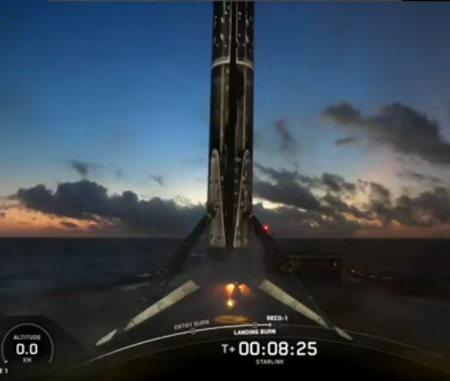
First stage after landing for the 32nd time
SpaceX today launched another 29 Starlink satellites, its Falcon 9 rocket lifting off from the Kennedy Space Center in Florida.
The first stage of its Falcon 9 rocket (B1067) flew for its 32nd time, a new record for a Falcon 9 first stage. As shown in the rankings below of the most reused launch vehicles, this stage is now just one flight from tying the space shuttle Atlantis:
39 Discovery space shuttle
33 Atlantis space shuttle
32 Falcon 9 booster B1067
30 Falcon 9 booster B1071
29 Falcon 9 booster B1063
28 Falcon 9 booster B1069
28 Columbia space shuttle
Nor will it be long before SpaceX’s fleet surpasses all the shuttles.
Meanwhile in the 2025 launch race SpaceX’s dominance is overwhelming, as shown by the leader board:
161 SpaceX (a new record)
77 China
15 Rocket Lab
15 Russia
To put some perspective on SpaceX’s dominance, it has completed more than twice as many launches as the nation of China, even though China has been trying to develop multiple launchers from many competing government-run or government-supervised entities. Even more amazing, SpaceX is beating the entire world combined, by a wide margin, 161 to 129.
In fact, even though China has two launches scheduled for today, one of which supposedly occurred a little over an hour ago but has yet been confirmed, neither launch will put much dent in SpaceX’s lead.
Furthermore, today’s launch of Starlink satellites now happens so routinely no one even notices. In the past week alone the company launched six times, putting up a total of 170 satellites. Though there are a half dozen other competing constellations that have begun launching (OneWeb, Amazon LEO, AST-SpaceMobile, China’s Guowang, SpaceSail, and Geely constellations), only OneWeb has come close to matching SpaceX’s numbers, but it has completed its constellation of about 648 satellites, a number far less than the thousands SpaceX continues to put up.
As for the rest, while SpaceX can routinely launch almost two hundred satellites in a week, the best any of those competitors have done so far is launch 150 to 200 total, and even that took months.

“Proclaim liberty throughout all the land unto all
the inhabitants thereof.” Photo credit: William Zhang
It is rare for one entity, private or public, to maintain such a dominance for long. And it isn’t healthy for such a single entity to be so dominant. The world needs competition. It is time for others, both in the U.S. and worldwide, to step up to the plate and produce.
Note that I’m not demanding we rein in SpaceX in some manner, the typical response of our government when a private company becomes too dominant. We are supposed to believe in freedom, and SpaceX has demonstrated its proper use to the fullest, to the benefit of tens of thousands of people whose jobs exist solely because of that success. The last thing we should do is punish them for this.
No, the answer to SpaceX’s success is more success, by others. The rest of the launch industry has to step up to the plate and begin hitting home runs. And there is no reason they can’t, other than a sad lack of desire and competitiveness that must change.

On Christmas Eve 1968 three Americans became the first humans to visit another world. What they did to celebrate was unexpected and profound, and will be remembered throughout all human history. Genesis: the Story of Apollo 8, Robert Zimmerman's classic history of humanity's first journey to another world, tells that story, and it is now available as both an ebook and an audiobook, both with a foreword by Valerie Anders and a new introduction by Robert Zimmerman.
The print edition can be purchased at Amazon or from any other book seller. If you want an autographed copy the price is $60 for the hardback and $45 for the paperback, plus $8 shipping for each. Go here for purchasing details. The ebook is available everywhere for $5.99 (before discount) at amazon, or direct from my ebook publisher, ebookit. If you buy it from ebookit you don't support the big tech companies and the author gets a bigger cut much sooner.
The audiobook is also available at all these vendors, and is also free with a 30-day trial membership to Audible.
"Not simply about one mission, [Genesis] is also the history of America's quest for the moon... Zimmerman has done a masterful job of tying disparate events together into a solid account of one of America's greatest human triumphs."--San Antonio Express-News
Direct competitors to SpaceX are very few on the global stage. What is needed now is the next new space launch companies with innovations that could change the game. Old Space gave way to New Space. Soon even that group will need to be surpassed by the next generation. If that doesn’t happen, things will begin to stagnate in new and more dreadful ways.
The future of space is very bright as long as we give it room to grow, allow for more competition, and provide reasonable regulations. It is that last item that I think will trip the process up.
SpaceX has been flying B1067 about every other month. So it will most likely tie with Atlantis for round-trips sometime in February 2026. Assuming this rate of rotation continues absent any misadventures, B1067 should match Discovery in February of 2027 and surpass it with 40 round-trips in April of that year. If SpaceX continues to increase its F9 launch cadence, of course, both of those benchmarks may occur at least modestly earlier.
I would very much like to see B1067 reach 100 round-trips because, at current rates of advance, I would have to still be alive in the mid-2030s for that to occur. But I suspect none of the F9 fleet will ever get into three figures before all are honorably retired. I hope the F9 fleet leader at that time – which I hope is still B1067 – is preserved in all of its sooty glory in some suitably impressive facility. I think either the KSC Visitor Center or the Udvar-Hazy Center outside DC are the only two appropriate candidates if SpaceX doesn’t decide to keep it as a gate guard at Roberts Road in the same way its first-landed F9 has served for many years outside the SpaceX factory in Hawthorne.
“””Though there are a half dozen other competing constellations that have begun launching (OneWeb, Amazon LEO, AST-SpaceMobile, China’s Guowang, SpaceSail, and Geely constellations), only OneWeb has come close to matching SpaceX’s numbers, but it has completed its constellation of about 648 satellites, a number far less than the thousands SpaceX continues to put up.”””
And, by the way, of the above “competing constellations” SpaceX has launched satellites for OneWeb, AST-SpaceMobile, and Amazon LEO. Even the EU/ESA have hired SpaceX. It seems like the only entities that have not hired SpaceX are the Chicoms.
If free people are free to produce, the results are amazing. However we have the human institution of government to prevent that.
I’ll play devil’s advocate for a minute. Where’s the market for more launchers? SpaceX has no backlog. They launch StarLink because they have the satellites and there are available slots in their schedule. But more than half of their launches are StarLink. SpaceX can easily handle more customers, and may get them if the US Space Force gets impatient with ULA. ULA has a backlog, but part of that is Amazon LEO on Atlas V rockets that are already built, and sitting in storage. Blue Origin has a backlog for Amazon LEO, but both companies are being slow to build up.
“If you build it, they will come” seems like a risky bet for a launch company.
What great comments – read them as closely as the main article itself. The lack of backlog Diane writes about is especially interesting and something of which I was not aware. What demand for launch will there be once the constellations build out? Golden Dome is one but that is a taxpayer financed build out, not one built in response to market demand. Does that mean the next big leap in market demand will be the return of cores from Psyche-16 or something like that?
China will catch up fast. The moment one of their “private” companies cracks the reusability problem, the Party will force them to share the blueprints and code with all the others. They’ll have multiple “SpaceX” within a year.
cfc77, the constellations need continuous replacement. There will be plenty of demand.
V-Man: The Party is already forcing these pseudo-companies to share blueprints and code.
V-Man
China has nothing to catch up with. No reason to expand.
Since their whole internet satellite constellation is only to provide limited access to China why are they going to try to reach the whole rest of globe? They are not,
Why are they going to provide better faster service? They are not.
More than likely they are putting up their network for the military mainly.
Yes China could use a re-usable launch system but do they have the work to use them fully like Space X.
Diane Wilson,
It’s not an indictment of you, personally, because I have seen plenty of people ask your “Where’s the demand?” question over the last two years while seeming to dismiss the constellations and megaconstellations that comprise more and more of total launch demand. I can only say I find that seriously weird.
Perhaps it’s simply a matter of the first, largest and highest-profile of these mega-constellation efforts being an internal project of SpaceX. But Starlink is the only one, to-date, that has that status. Rocket Lab has, admittedly, been making noises of late about putting up some sort of constellation of its own. But, right now, all non-Starlink constellations are part of general launch demand because none of them are going up on launch vehicles belonging to the constellation satellite owners.
That includes, most specifically, Amazon Leo, formerly known as Kuiper. Amazon Leo, in fact, has bogarted nearly all of the non-SpaceX medium- and heavy-lift launch capacity that will be available over the next several years. Only government customers have cut-in-line privileges for Ariane 6, Vulcan and New Glenn until further notice. Everyone else must use either the few Indian launchers available, pay through the nose for a ride on Vega-C, go to Rocket Lab or get in line for a Falcon 9.
Rocket Lab, for its part, has been actively soliciting the business of companies with small-to-medium constellations of lightweight birds to deploy. It actively encourages these folks to use SpaceX Transporter/Bandwagon missions to inexpensively prove out prototype hardware, then come to Middle Earth for bespoke operational deployments once the hardware designs are debugged and locked-down. That seems to be working pretty well for RL. The Transporter/Bandwagon missions, themselves, all seem well-subscribed with both prototype hardware that may prefigure operational sats in different orbits as well as sats intended to be operational in the orbits Transporter or Bandwagon missions launch to. Planet always seems to fly two or three dozen of their latest birds on Transporter missions, for example.
Once initial deployments of constellations are made there is always, as Mr. Borgelt reminds us, the open-ended on-going matter of incremental constellation upgrade/replacement.
Golden Dome will be its own quite sizable constellation and is also likely to have birds of various types in a number of different orbital inclinations and altitudes. And it will need upgrade/replacement missions to at least the same degree as civilian constellations.
The biggest bump in launch demand in the coming decade could well prove to be for one or more efforts to place giant AI-oriented data centers in space. There are some start-ups looking to pursue this and none, at least for now, has its own launch capability. OpenAI made a recent attempt – unsuccessful it seems – to buy Stoke Space for exactly this reason. Within the last two or three days, Elon Musk has weighed in in favor of this general idea. He has spitballed notions including establishment of mining and fabrication operations on the Moon to support mass production of such data centers. Tesla and xAI would contribute their AI expertise and SpaceX would contribute launch and in-space operations expertise. Launches directly related to such a Musk-iverse initiative could well dominate all other Earth-departing launch traffic, even SpaceX’s Mars project, just a few years hence.
There are also a number of commercial LEO space station projects that will each contribute to total launch demand, both for initial deployments and for on-going resupply and crew transfer.
There’s going to be plenty of launch demand going forward. And, given that the big boys and the government will tend to monopolize the big launchers, there may even prove to be enough smaller jobs to keep a few of the start-ups with smaller launchers in beer and skittles too.
I wish Elon had named the Falcon boosters.
I couldn’t care less about the barge names–let them get numbers.
V-Man,
The PRC will continue to fall behind the US in general and SpaceX in particular, just more slowly than, say, Europe. As of now, the PRC is pretty much a full decade behind SpaceX, being only on the cusp of a first successful 1st-stage booster recovery after a real orbital deployment mission. But it hasn’t stuck a landing yet. As the late Don Adams might have said of their most recent attempt, “Missed it by that much!”
Even if the commissars force a share-the-wealth scheme on “commercial” PRC launch companies, that is not going to give the PRC a bunch of present-day SpaceXs. At best, it might wind up with a few 2010 – 2015-era SpaceXs. Hardly the same thing. Especially as none of these ersatz SpaceXs will have its own Elon. While the PRC spends at least as many years as SpaceX itself did getting its launch cadence of partially-reusable rockets up to current Falcon 9 levels, SpaceX will be doing hundreds of Starship launches per year in furtherance of major in-house and collaborative projects on both the Moon and Mars.
And then there is the PRC’s terminal demographics and ghastly finances to be considered. But that, as they say, is another story.
Diane Wilson wrote: “I’ll play devil’s advocate for a minute. Where’s the market for more launchers? SpaceX has no backlog.”
I, too, will take up that challenge:
SpaceX may have no backlog, but that only advances the argument for their success. Twenty years ago, the entire world was launching a mere 55 times per year — China being 10% of that. This year, SpaceX’s non-Starlink launches exceed that number. Add in this year’s 129 other launches, worldwide, and we see that there is much more demand for launches than there once was. 2021 was when the world reached 134 launches, including SpaceX’s 31 and China’s 52.
https://behindtheblack.com/behind-the-black/essays-and-commentaries/the-global-launch-industry-in-2024-a-year-of-amazing-highs-and-depressing-lows-with-the-best-yet-to-come
The lack of backlog emphasizes the availability of launch. If you build it, SpaceX has an inexpensive launch available for it. Once the Starlink constellation is built out, there will be even more availability of SpaceX launch vehicles. Of course, we must keep in mind that, as the technology improves, Starlink satellites are still intended to become obsolete in a short number of years and will need plenty of launches to put the newer versions on orbit.
China has made an impact on the space market, but the many companies in free nations have added an even more impressive impact. The number of space companies is growing worldwide, not just in the U.S., and even the small launch providers are finding plenty of customers.
Many companies have taken advantage of the reduced cost to low Earth orbit (LEO) that SpaceX brought to the market — forcing other launch providers to reduce their price tags. I expect that once Starship becomes operational, plenty of other new space companies will arise to take advantage of the even lower cost per pound to LEO.
“ULA has a backlog, but part of that is Amazon LEO on Atlas V rockets that are already built, and sitting in storage. Blue Origin has a backlog for Amazon LEO, but both companies are being slow to build up. ‘If you build it, they will come’ seems like a risky bet for a launch company.”
ULA and Blue Origin built it, and they came. It may not be such a risky bet.
Another general point:
SpaceX adapted reusability into an existing rocket and left some amount of efficiency on the drafting-room floor (a terrible attempt to analogize the movie industry’s “cutting-room floor;” I’m almost, but not quite, embarrassed enough to rewrite it), giving rocket designers an opening to improve on the Falcon reusable launch vehicles. We see this in the designs of the Neutron rocket and the Starship rocket. We can also see that China, unlike Rocket Lab, has failed to improve much on the Falcon 9 concept, showing a lack of creativity and innovation there.
All ships at sea use an identifying transponder.
Satellites can see those transponders and map them.
https://usa.oceana.org/reports/oceana-finds-chinas-fishing-fleet-swarms-galapagos-then-disappears-from-sight/
China turns them off.
I believe they are then open to boarding by the rest of the worlds navies and destruction at that point.
From Richard M
December 9, 2025 at 11:46 pm
Hello Edward,
“SpaceX may have no backlog, but that only advances the argument for their success. Twenty years ago, the entire world was launching a mere 55 times per year — China being 10% of that. This year, SpaceX’s non-Starlink launches exceed that number.”
Wow. Now THAT puts things into even more astounding perspective.
From Blair Ivey
December 10, 2025 at 12:30 am
The still from the booster landing is somewhat amusing.
It used to be, when anything got off the ground, it was an Event. Then getting to orbit. Within the living memory of this Forum, spaceflight, even to LEO, was hard and expensive. Now, 8 1/2 minutes after launch, the booster lands, as expected. Welp, time to take it back, and use it again. And maybe not the only launch of the day. SpaceX has just about turned rockets into appliances. Re-watch old launch footage; people of the current generation, and beyond, will be appalled at the wastefulness of throwing rockets away.
From Blair Ivey
December 10, 2025 at 12:56 am
Addenda: You can watch current Chinese launches, and still see rockets thrown away. If the Green’s want to be relevant, they should picket the Chinese Embassy.
From Richard M
December 10, 2025 at 7:29 am
If the Greens want to be even more relevant they really ought to be protesting the strip-mining of the world’s oceans by China’s global fishing fleet. It still astonishes me how little political agitation there is about that.
From craig
December 10, 2025 at 9:03 am
Greens are aimed against development and usage of resources by Western nations* specifically. They don’t lobby China, India, Russia, or MENA states about anything. Ever. At all.
*which makes one curious about their funding sources.
From sippin_bourbon
December 10, 2025 at 12:15 pm
I looked into the concept of backlog a couple years ago (maybe longer, time flies).
My curiosity arose when Rocket Lab was touting their high backlog.
It has several variables, as I am sure most here are aware.
Some launch contracts are signed long before the payload is ready.
It varies from some stage of development and construction, all the way through to completed testing and paperwork certified.
All “i”s dotted, “t”s crossed, seals have been stamped, signatures signed, bribes paid, kickbacks settled, and backsides appropriately kissed.
SpaceX has an advantage in that a customer, assuming the payload is ready, and paperwork complete, can bump a Starlink mission at anytime, select a rocket from the fleet, integrate and and launch. And less paperwork is necessary, as they are entirely within the US, and so they can minimize ITAR concerns.
Rocket Lab can also do this, but I believe they must tackle the ITAR concerns if the launch is from NZ. If not, then they have more paperwork to get through from the NZ gov, in addition to the FAA/US paperwork. Sir Peter Back stated several years ago that he found the paperwork process to be a source of delay. I have not heard an update on that.
I am curious now about the entire process, and am wanting to delve deeper in to the launch contract process. Especially considering the FAA’s supposed streamlined rules.
From Edward
December 10, 2025 at 2:55 pm
sippin_bourbon wrote: “Some launch contracts are signed long before the payload is ready.”
This is the standard operating procedure. A launch vehicle is usually chosen and ordered at about the time of the contract to make the payload, because expendable rockets have to be made for each launch, and that manufacturing process takes time.
Typically, a payload is designed with two or three launch vehicles in mind so that a loss of availability of the originally chosen vehicle (e.g. grounding due to a problem during a previous flight) does not necessarily ground the payload.
By the way, when we say that SpaceX has no backlog, that is not strictly true. There are some non-Starlink missions that are scheduled for SpaceX launch vehicles, but these are not yet ready for launch and are planned for 2026 into 2028:
Falcon 9:
Rivada Outernet 1
Haven-1
CRS2 NG-22 (Cygnus)
CSG-3
Falcon Heavy:
USSF-70
USSF-75
Griffin Mission 1
Astrobotic-3 Mission
Nancy Grace Roman Space Telescope
NASA Lunar Gateway PPE & HALO
Gateway Logistics Services (Dragon XL)
Dragonfly Mission
Starship:
Superbird-9
Starlab
Source: https://www.rocketlaunch.live
pzatchok,
I don’t know whether the PRC trawler fleet turns its transponders off or not but that hardly matters. There are at least a couple of small LEO constellations that look for ship-to-shore radio transmissions and triangulate their locations rather than relying on location transponders. Once the PRC has at least a minimally functional fraction of one of its in-the-early-works commo mega-constellations up, this may no longer be as reliable a technique for finding ships that are up to no good, but, then perhaps the SARsat constellations will be able to take a baton pass from the RDF constellations and keep things transparent. Stealth trawlers are really hard to build.