Uranus: one glimpse and that was forty years ago
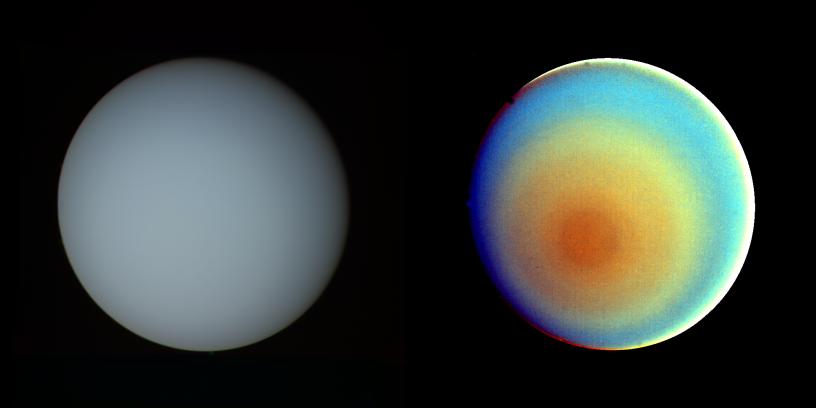
Uranus as seen by Voyager-2, natural colors on left, false color on right. Click for original.
I close today our week-long tour of Voyager-2’s fly-by of Uranus in January 1986 with three cool images, the two images of the planet itself above and a close-up of its rings. All three illustrate that though Voyager-2 gave us our first very good first close-up view of this distant world, it also gave us only a tiny glimpse, very superficial and lacking in any larger context.
The two images above were taken on January 17, 1986 when Voyager 2 was till 5.7 million miles away, on approach.
The picture at left has been processed to show Uranus as human eyes would see it from the vantage point of the spacecraft. The picture is a composite of images taken through blue, green and orange filters. The darker shadings at the upper right of the disk correspond to the day-night boundary on the planet. Beyond this boundary lies the hidden northern hemisphere of Uranus, which currently remains in total darkness as the planet rotates. The blue-green color results from the absorption of red light by methane gas in Uranus’ deep, cold and remarkably clear atmosphere.
The picture at right uses false color and extreme contrast enhancement to bring out subtle details in the polar region of Uranus. Images obtained through ultraviolet, violet and orange filters were respectively converted to the same blue, green and red colors used to produce the picture at left. The very slight contrasts visible in true color are greatly exaggerated here. In this false-color picture, Uranus reveals a dark polar hood surrounded by a series of progressively lighter concentric bands. One possible explanation is that a brownish haze or smog, concentrated over the pole, is arranged into bands by zonal motions of the upper atmosphere. The bright orange and yellow strip at the lower edge of the planet’s limb is an artifact of the image enhancement. In fact, the limb is dark and uniform in color around the planet.
The third cool image below of Uranus’s rings was taken just after the closest approach, when Voyager-2 was in Uranus’s shadow and looking back at its rings from a distance of 142,000 miles.

Click for original image.
From the caption:
All the previously known rings are visible here; However, some of the brightest features in the image are bright dust lanes not previously seen. The combination of this unique geometry and a long, 96 second exposure allowed this spectacular observation, acquired through the clear filter of Voyager’s wide-angle camera. The long exposure produced a noticeable, non-uniform smear as well as streaks due to trailed stars.
The total number of observations of these rings, by both Voyager-2 and other ground- and space-based telescopes, is quite few. Similarly, in the forty years since Voyager-2 scientists have used the Hubble Space Telescope and more recently the Webb Space Telescope to get more data of the planet, its moons, and its rings, but generally that data is poor or very limited. We are simply too far away to see what’s happening on Uranus with any clarity or understanding.
As for the planet’s moons, this later research has so far found 29, but other than the five largest that I have highlighted in the past week (see here, here, here, here, and here), we know little else about them. They are mere dots on images.
Yet, for us to really understand the formation of our solar system, and how the Earth got to be the life-filled planet it is, we need to map in close detail our entire solar system. Right now, however, our map is comparable to that of the New World in the half century after Columbus, filled with blank spots and guesses.
We simply don’t know very much. Worse, it appears to me we often think we know more than we do.

On Christmas Eve 1968 three Americans became the first humans to visit another world. What they did to celebrate was unexpected and profound, and will be remembered throughout all human history. Genesis: the Story of Apollo 8, Robert Zimmerman's classic history of humanity's first journey to another world, tells that story, and it is now available as both an ebook and an audiobook, both with a foreword by Valerie Anders and a new introduction by Robert Zimmerman.
The print edition can be purchased at Amazon or from any other book seller. If you want an autographed copy the price is $60 for the hardback and $45 for the paperback, plus $8 shipping for each. Go here for purchasing details. The ebook is available everywhere for $5.99 (before discount) at amazon, or direct from my ebook publisher, ebookit. If you buy it from ebookit you don't support the big tech companies and the author gets a bigger cut much sooner.
The audiobook is also available at all these vendors, and is also free with a 30-day trial membership to Audible.
"Not simply about one mission, [Genesis] is also the history of America's quest for the moon... Zimmerman has done a masterful job of tying disparate events together into a solid account of one of America's greatest human triumphs."--San Antonio Express-News