
Who fired “the shot heard round the world”?
In just a few months we will be celebrating the 250th anniversary of the signing of the Declaration of Independence. That signing occurred because a little over a year previously a troop of British soldiers went into the heart of Massachusetts to seize weapons and ammunition that the British government did not want Americans to possess, and ended up getting involved in a firefight with the local militia in the town of Lexington, what became known as “the shot heard round the world. That shot started the American Revolution, and eventually forced the members of the Continental Congress to declare their independence from that British government.
As with all history, though that firefight sparked vast changes in politics, history, and culture across the globe and across centuries, the event itself was the act of just one or a few individuals, in a specific moment and place, under very specific circumstances created by those greater movements of politics, history, and culture.
One man fired the gun. A few others fired back. And then a war started.
But who was that man?
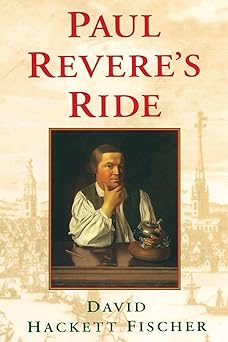
In one of the best histories I have ever read, historian David Hackett Fischer attempts to answer this question. His 1994 book, Paul Revere’s Ride, centers the story on Paul Revere and that man’s actions to warn the citizens throughout Concord and Lexington of the British invasion, so that they could be prepared to fight, if necessary.
Along the way Fischer produces a vivid, page-turner, based on the innumerable memoirs and letters and reports made by the people involved. For you see, the Americans who lived in Massachusetts at that time were among the most educated in the world, with almost 100% literacy and a strong passion to document everything they did or saw. In turn, the British military officers were equally educated, and were required to provide their own perspective describing in detail what happened.
Fischer takes full advantage of this very complete record, which made it possible for him to tell the story of almost every participant, in a human and very personal way. Thus, as you read his book it actually feels like you are on our modern social media, where everyone takes out a smart phone to record what’s happening, thus providing us all with many different perspectives of the same event. Only here those perspectives come from the written word, penned with thoughtful attention and a passionate dedication to telling the truth, as each person saw it.
Fischer however doesn’t just focus on that one moment. His book very carefully provides the greater context, both before and after. And he does so again from the very personal perspective of the individuals involved. You not only learn the history, you find out about the actual people who made it.
I repeat, if you want to know what happened on April 19, 1775, as we prepare to celebrate the 250th anniversary, you must read this book. I should add that Fischer himself should be more widely known. His work is always accurate and amazingly readable. More important, he tries always to focus on the human story, rather than on the larger social forces (such as economics or the clash of nations) that too many modern historians seem so enamored by.
As for that central moment, it turns out the facts are sadly not so simple to determine. As Fischer carefully documents, every witness gives a different answer. While most participants thought a British officer fired first, those witnesses give contradictory testimony. Some even believed the shot came from some nearby American spectators. As Fischer notes:
What probably happened was this: several shots were fired close together–one by a mounted British officer, and another by an American spectator. Men on both sides were sure they heard more than one weapon go off; men on each side were watching only their opponents. If there were several shots at about the same time then all spoke the truth as they saw it, but few were able to see the entire field.
It is possible that one of these first shots was fired delibrately, either from an emotion of the moment, or a cold-blooded intention to create a incident. More likely, there was an accident. Firearms seemed to have a mind of their own in the 18th century. Only a few years earlier, such an accident happened at a military review of the 71st Foot in Edinburgh, “some of the men’s pieces going off as they were presented.” Many weapons at Lexington, both British and American, were worn and defective. An accident may well have occurred on either side. If so, it was an accident that had been waiting to happen.
We shall never know who fired the first at Lexington, or why. But everyone on the Common saw what happened next. The British infantry heard the shots, and began to fire without orders. Their officers could not control them.
What that day wrought.
Prior to that first shot the British had ordered the American Minutemen who had gathered on the Common to throw down their weapons and disperse. And while they did not give up their weapons, their commander did order them to disperse, to not fire. Thus, when the British began firing indiscriminately they ended up killing a good number of those Minutemen.
The initial consequence? The Minutemen now organized an armed resistance, making the retreat of those British troops back to Boston a nightmare journey, killing many.
The larger consequence? The start of the American Revolution, and the birth of a new nation, dedicated to the then very radical idea that a government could be of the people, by the people, for the people, and be dedicated to the even more radical idea of providing those people the right to life, liberty and the pursuit of happiness.

On Christmas Eve 1968 three Americans became the first humans to visit another world. What they did to celebrate was unexpected and profound, and will be remembered throughout all human history. Genesis: the Story of Apollo 8, Robert Zimmerman's classic history of humanity's first journey to another world, tells that story, and it is now available as both an ebook and an audiobook, both with a foreword by Valerie Anders and a new introduction by Robert Zimmerman.
The print edition can be purchased at Amazon or from any other book seller. If you want an autographed copy the price is $60 for the hardback and $45 for the paperback, plus $8 shipping for each. Go here for purchasing details. The ebook is available everywhere for $5.99 (before discount) at amazon, or direct from my ebook publisher, ebookit. If you buy it from ebookit you don't support the big tech companies and the author gets a bigger cut much sooner.
The audiobook is also available at all these vendors, and is also free with a 30-day trial membership to Audible.
"Not simply about one mission, [Genesis] is also the history of America's quest for the moon... Zimmerman has done a masterful job of tying disparate events together into a solid account of one of America's greatest human triumphs."--San Antonio Express-News