
Yesterday’s Senate nomination hearing for Jared Isaacman was irrelevant; America’s real space “program” is happening elsewhere
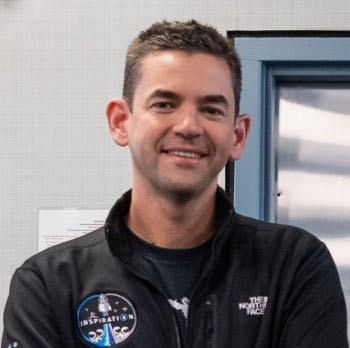
Billionaire Jared Isaacman
Nothing that happened at yesterday’s Senate hearing of Jared Isaacman’s nomination to be NASA’s next administrator was a surprise, or very significant, even if most media reports attempted to imply what happened had some importance. Here are just a small sampling:
- CNN: Trump’s NASA pick faces questions on leaked ‘Project Athena’ plan in rare second confirmation hearing
- UPI: NASA nominee Jared Isaacman affirms need to beat China to moon
- Washington Times: Jared Isaacman, Trump’s NASA nominee, sees lunar landing, space base as crucial to national security
- The Hill: NASA nominee refuses to say if Musk was in room when Trump offered job
- Space News: Isaacman, senators emphasize urgency in returning humans to the moon
- Reuters: Trump’s NASA pick stresses moon race urgency, pressed on Musk ties in Senate hearing
To be fair, all of these reports focused on simply reporting what happened during the hearing, and the headlines above actually provide a good summary. Isaacman committed to the Artemis program, touted SLS and Orion as the fastest way to get Americans back to the Moon ahead of the Chinese, and dotted all the “i”s and crossed all the “t”s required to convince the senators he will continue the pork projects they so dearly love. He also dodged efforts by several partisan Democrats to imply Isaacman’s past business dealings with Musk and SpaceX posed some sort of conflict of interest.
What none of the news reports did — and I am going to do now — is take a deeper look. Did anything Isaacman promise in connection with NASA and its Artemis program mean anything in the long run? Is the race to get back to the Moon ahead of China of any importance?
I say without fear that all of this is blather, and means nothing in the long run. The American space program is no longer being run by NASA, and all of NASA’s present plans with Artemis, using SLS, Orion, and the Lunar Gateway station, are ephemeral, transitory, and will by history be seen as inconsequential by future space historians.
It is very simple. Even if the next few Artemis missions fly as planned, with no problems, all they will accomplish will be to put a few humans on the Moon for a very short time, with no long lasting impact. SLS and Orion as designed can do nothing more than repeat Apollo, plant a flag, provide some politicians some cool photo ops, but do nothing to establish the United States in space, building real colonies on the Moon, Mars, and the asteroids.
You see, NASA’s Artemis program is nothing more than a very expensive toy for politicians, allowing them to strut like proud roosters before the media, claiming they’ve made America a leader in space, when all they’ve really done is spend a lot of money on a one-off project that builds nothing substantial or permanent.
Yesterday’s hearing was simply another example of this, a vapid photo op for these politicians with no real substance. As summarized cogently by Marcia Smith at SpacePolicyOnline.com:
Ultimately, the hearing unveiled no big surprises and most members seem strongly supportive of the nomination. The committee vote on Monday is at 5:30 pm ET, just as Senators return to Washington for next week’s work. Seven other unrelated nominations are on the docket. When it will go before the full Senate is unknown, but the committee’s leadership is eager to get him confirmed.
In other words, this was nothing more than a performance for the cameras, as Isaacman’s nomination was assured even before the hearing began.
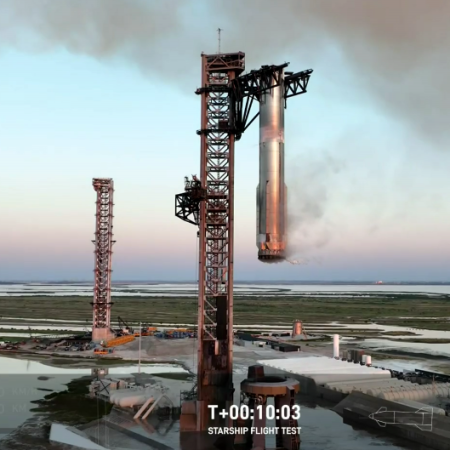
Superheavy after the October 2024 flight,
safely captured during the very first attempt
So what is America’s real space program? I’ve said this more than a few times recently, because the political game described above acts to distract us from reality, but the real American space program is now being run almost entirely by SpaceX. It is building the rocket (Starship) that will make colonization of the Moon and Mars possible. It has the rocket (Falcon 9) that is making a profitable orbital space industry possible.
And most important of all, it has the cash in its own pocket to pay for this. It doesn’t need to cater to the whims and quid pro quos demanded of Washington senators and congressmen to get the funding to pay for Starship. It gets that revenue from Starlink, and in fact those annual revenues are right now getting close to matching NASA’s own annual budget.
Nor is SpaceX alone in this. The American aerospace private sector is across the board becoming increasingly independent from NASA. It now has two rockets that are reusable (SpaceX’s Falcon 9 and Blue Origin’s New Glenn), and by next year will have three more (SpaceX’s Starship, Rocket Lab’s Neutron, and Stoke Space’s Nova).
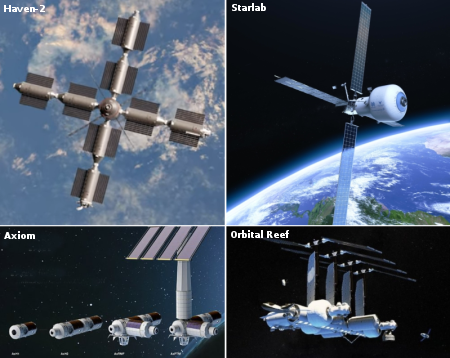
The American space stations under development
That private sector is also building four commercial private space stations, with one (Vast) planning the launch of its first demo station by next year. And that station is being funded entirely with private investment capital.
Multiple American companies are also now making money on orbiting constellations that provide high resolution data and imaging of the Earth, for commercial and government customers. Other companies are making money providing satellite companies tug and robotic servicing.
And even more significant, there are now companies flying recoverable capsules designed expressly to produce products in orbit for sale on Earth, with Varda leading the way. Large amounts of investment capital has been pouring into this new industry, because investors see large amounts of profits from the products it will produce.

Soon to wave in many places not on Earth
The future in space is quite bright, and this isn’t because Jared Isaacman yesterday committed NASA to beating China back to the Moon. It is bright because numerous free Americans are creating their own dreams in space, and making a lot of money as they do so.
And most important of all, despite SpaceX’s present dominance, the American space effort is varied, competitive, and widespread. Its growth is occurring industry wide, with many players all competing for profit. And it is increasingly independent from government funding.
So, it is nice Jared Isaacman will soon be NASA’s next administrator. And it is good that he intends to reshape the agency to make it more effective. But in the end, the real space program is elsewhere, among ordinary Americans following their own dreams. And it will be those Americans, not NASA, that will colonize the solar system for the United States.

On Christmas Eve 1968 three Americans became the first humans to visit another world. What they did to celebrate was unexpected and profound, and will be remembered throughout all human history. Genesis: the Story of Apollo 8, Robert Zimmerman's classic history of humanity's first journey to another world, tells that story, and it is now available as both an ebook and an audiobook, both with a foreword by Valerie Anders and a new introduction by Robert Zimmerman.
The print edition can be purchased at Amazon or from any other book seller. If you want an autographed copy the price is $60 for the hardback and $45 for the paperback, plus $8 shipping for each. Go here for purchasing details. The ebook is available everywhere for $5.99 (before discount) at amazon, or direct from my ebook publisher, ebookit. If you buy it from ebookit you don't support the big tech companies and the author gets a bigger cut much sooner.
The audiobook is also available at all these vendors, and is also free with a 30-day trial membership to Audible.
"Not simply about one mission, [Genesis] is also the history of America's quest for the moon... Zimmerman has done a masterful job of tying disparate events together into a solid account of one of America's greatest human triumphs."--San Antonio Express-News
Great take.
Political reality means a nominee like this has to do what it takes to get the votes. Once installed, he pursues his agenda as best he can. Personally I can’t remember a NASA admin whose apparent agenda so closely matches the ideas and wishes of most of the people who post here (or so I imagine). That at least is something to be thankful for.
Remember that part of that agenda is greater private/commercial development vs traditional old-space contracting. And obviously Isaacman perfectly understands and concurs with your point that Orion and SLS are doomed. But the game must be played. No lip service for the POR, no approval as admin.
Personally I’m optimistic.
S. R. Haddon on government spending . . .
https://www.youtube.com/watch?v=Et4sMJP9FmM
Indeed NASA seems to verge on being irrelevant and slides into preventing innovation. SLS seems like peanut butter spread across the various favored contractors to keep them alive and is a poor overpriced copy of even what Apollo did. I think it is time to return NASA to it’s NACA roots. Fund research including deep space like JPL. If they need lift to deliver satellites buy it competitively. SpaceX, Rocket and perhaps even Blue Origin or ULA will compete. Space feels like it is somewhere near where Aviation was in the Early 1920’s finally ready to really take off and expand commercially. As a kid I grew up with Genmini and Apollo and then was crushed when we basically gave up. The Shuttle seemed like a good idea, but the realities of Challenger and Atlantis made it clear they were a cobbled together solution where NASA management turned a blind eye to design issues (admittedly design choices forced on them by external sources particularly Congress). I despaired of humanity having ANY space presence that wasn’t provided by Roscosmos with Soyuz. Then in the 2010’s this upstart showed up. That upstart, SpaceX, has totally changed the model. If you want to get something to LEO (and you’re NOT the Peoples Republic of China) you can use SpaceX or perhaps Rocket Lab. ULA, ESA and Blue Origin BARELY climb into double digits, Roscosmos has the same number of launches as Rocket lab (admittedly at a higher payload to orbit) and they recently trashed their man capable launch pad.
I’d love to root for someone else, but no other single source even comes close to SpaceX either in total capacity, or in general experimentation (Starship/Heavy, no one else has money to tackle that kind of problem like they do). And Honestly they SEEM to have an overall plan and goals something NASA seems to have lacked since the 1980’s
Robert wrote”[Isaacman] also dodged efforts by several partisan Democrats to imply Isaacman’s past business dealings with Musk and SpaceX posed some sort of conflict of interest.”
That is sort of like saying that someone who has ridden on a Disneyland ride should not be allowed to run a government organization that contracts with Disney Corp. for “company picnics” or to make a film, because such a contract would be seen as a conflict of interest.
“… but the real American space program is now being run almost entirely by SpaceX. …
… Nor is SpaceX alone in this.”
SpaceX may be America’s default space program now, but the entire U.S. commercial space industry will become the space program in the near future. Possibly by the time that the rest of the world realizes that SpaceX is the U.S. space program.
We are switching over from the top-down, central-controlled, governmental space program to the more desirable bottom-up, grass-roots, civilian space program that we proved with Apollo was better than the former. Adam Smith compared the free-market-capitalist economic system to an invisible hand, because it is difficult to imagine that millions of individual transactions chosen by those individuals as being a superior method than some grand plan that is controlled by some form of master mind. Each of these transactions is well thought out between the two parties, the buyer and the provider, but there is no grand scheme from above that directed that transaction. The invisible hand does not exist but is an analogy that helps us to grasp the concept that multiple transactions move an economy in the direction that the customers generally and collectively prefer (e.g. a few individuals may be disappointed that their favorite flavor Pop-Tart has been discontinued, but many others may be happy with new flavors that replaced the less desired one).
America’s space program is turning into that invisible hand, funded by the purchasers themselves and providing what the purchasers want, not what some governmental bureaucrat wants us to have.
A large free-market-capitalist system like ours may seem like a tangled web, but there is a method to the apparent madness.
“And most important of all, despite SpaceX’s present dominance, the American space effort is varied, competitive, and widespread. Its growth is occurring industry wide, with many players all competing for profit. And it is increasingly independent from government funding.”
Just as government has its own priorities for the use of space, priorities that do not necessarily match the public’s priorities, SpaceX has its own priorities, many of which do not cover the public’s priorities. This is why it is important to have a wide variety of companies doing business in space; they cover many of the public’s needs and desires that the current space program — SpaceX — does not cover, just as the previous space program — NASA — did not cover all the needs and desires.
So, yes, NASA is becoming less relevant to the U.S. space program, to what We the People want to see done in space, and what We want to get from our use of space.
Just as it was not good to have only one national space program, NASA, it is not good to have just one national space program, SpaceX. It would be good to have a varied national space program, the invisible hand of a free-market-capitalist space industry, providing what customers want at prices those customers can afford, and funding the program not with taxpayer money but with investment money or with profits from customer spending.
_________________
Tregonsee314 wrote: “Space feels like it is somewhere near where Aviation was in the Early 1920’s finally ready to really take off and expand commercially.”
Amen! So far, we have seen the equivalent of barnstorming, but it looks like a lot of productivity is about to come from the current — and especially from future — commercial space companies.
SpaceX is now the go-to employer for those who want to work on the cutting edge of technology. Some of those employees have their own ideas that are outside of the scope of SpaceX’s goals, and many of them have spun-off their own companies to pursue those ideas. Blue Origin has graduated from suborbital reusable launches to orbital ones. ULA is trying to keep up. Rocket Lab has its own ideas and performs additional services and provides additional goods for its customers. SpaceX’s and Rocket Lab’s customers are currently the ones doing the most in space, but as these new low-cost providers become operational, even more customers will perform even more activities in space. There are plenty of companies to root for, and I root for them all. It is not just the launch providers but also the companies that launch on those providers. The launches are easy to see, but the operations in space are the important part — far more important than the spectacular launches. Space operations are where the benefits to all mankind come from.
For about a decade, I have been saying that this decade, the 2020s, would be exciting times, but I didn’t expect the excitement to be the handoff from government-controlled space to civilian-controlled space. I knew that was coming, but not this soon. I have advocated for it, but I expected slower advancement. I expected commercial space stations and other commercial uses of space, but I didn’t anticipate this decade to have such a dominant commercial space industry. I underestimated the power of free-market-capitalism. I shouldn’t have, because that power, in three centuries, turned a backwoods village into a powerful nation capable of saving the world from tyranny. Twice.
Look how far we have come in the past five and a half years, ever since the first flight of a commercial manned orbital spacecraft. Two decades ago Rutan, Allen, and Scaled Composites put the first manned commercial spacecraft above the Karman line, doing for the first time what had previously taken national space programs to achieve, but we are well on our way to having the usage of space that we have desired from the days of Disney/von Braun television shows that promised this kind of future in space.
To borrow a phrase: excitement guaranteed.
By an interesting coincidence, Space News has a new podcast interview up today with former NASA commercial space division chief Phil McAlister, and he comes across sounding almost like a Behind the Black devotee. McAlister, for those who are not familiar with him, was most notably the NASA manager who personally intervened at the last minute to get Bill Gerstenmeier (now, ironically, a senior SpaceX manager) to reconsider his inclination to award Boeing the sole CCtCap contract for Commercial Crew in 2014. Crew Dragon flies today in no small measure thanks to Phil McAlister.
https://spacenews.com/the-shift-that-saved-american-spaceflight/
McAlister comes out adamantly for cancelling SLS, Orion, and Gateway, and letting the future our host paints in this essay come to fruition instead. “I don’t think we should be trying to recreate Apollo….We can do so much more with a strong vibrant commercial space industry in space than we could without it. Because without it, everything costs so much more. I mean, we could have hundreds of Starship launches for the 5 or 6 SLS launches and Orion launches.”
It is also interesting because of the bleak picture he paints of where NASA is at now, and why he felt essentially forced to retire last year. After Jim Bridenstine arrived as administrator in 2018, he had felt some optimism that NASA was finally starting to shift to understanding and really figuring out how to employ commercial capabilities to fulfill its mission. But everything went backwards very badly once Bill Nelson arrived. The result, as he put it, was not a reversion to “your dad’s NASA,” but “your granddad’s NASA.” After Kathey Lueders was forced out, McAlister says, he felt there was really no one left at the agency but him that appreciated or understood the commercial space sector. As McAlister sees it, a really radical course correction is needed for NASA.
Back when Jared Isaacman was first nominated a year ago, I think I expressed my wish that McAlister might make a very good deputy for him, since he knew how the machine worked (and didn’t work). I think that even more now, but heck….if Jared were to fall under a bus tomorrow, I would be happy to nominate McAlister instead, if he could manage to forge a good relationship with Trump. SpaceX may now be bigger and far better than NASA in so many ways, but a really commercial-oriented NASA could still make a significantly better future possible, too.
Tregonsee314 (“You have been too long absent from the games, [Tregonsee314]):
“Space feels like it is somewhere near where Aviation was in the Early 1920’s finally ready to really take off and expand commercially.”
I have noted that the space industry is very like 1930’s commercial aviation, but notably different in that Commercial Air of the time was heavily dependent on US Mail contracts, as was passenger train service at the time. Government contracts indirectly paid for innovation. Commercial Space is generally not dependent on Government contracts. Yes, cite me a river, but if you took all the Government contracts from Commercial Space, you’d still have Commercial Space. Not so much the case for Commercial Air in the 30’s, and the railroads proved the proposition by ending passenger service at about the same time as US Mail contracts ended.
In related news:
The House subcommittee that oversees NASA just held a hearing yesterday (Thursday, Dec. 4) to review the Artemis program and NASA’s space policy generally. Sounds like a good idea in theory, but once again, someone decided to invite Mike Griffin, and once again, Mike Griffin pleaded with Congress to scrap the entire HLS program, because he just hates, hates, hates the idea of a commercially procured crew vehicle and hates, hates, hates, the idea of in-space cryogenic refueling.
“The bottom line is that an architecture which requires a high number of refueling flights in low-Earth orbit, no one really knows how many, uses a technology that has not yet ever been demonstrated in space, is very unlikely to work—unlikely to the point where I will say it cannot work,” Griffin said.
“Sticking to a plan is important when the plan makes sense,” Griffin continued. “China is sticking to a plan that makes sense. It looks a lot, in fact, like what the United States did for Apollo. Provably, that worked. Sticking to a plan that will not work for Artemis III and beyond makes no sense.”
https://arstechnica.com/space/2025/12/congress-told-there-needs-to-be-consequences-for-nasa-delays-amid-chinas-rise/
If Texas legislators really want more exhibits of obsolete space relics for a museum in Houston, I would like to propose adding Mike Griffin.
Richard M: Mike Griffin might not have good ideas overall, but for a committee to invite him to speak at a hearing knowing he would say such things signals to us that there is growing hostility in the House to Artemis as presently designed.
Congressional hearings like this are never an accident. They are planned photo-ops designed to push a polticial agenda. From Griffin’s remarks that agenda is against Artemis, as presently designed.
Blair, I am unfamiliar with the precise nature of the 1930’s air travel although I was familiar with the fact that airmail was to a large degree (intentionally) subsidizing air travel. We’ve had some of that in space with Commercial Crew and SpaceX (which admittedly produced a far better product for 1/2 the cost of Boeing’s Starliner). However, SpaceX/Elon found an actual commercial reason for Falcon 9 in Starlink and it seems like that is starting to pay off. That’s letting SpaceX push the envelope with Starship/Super Heavy without subsidy.
Honestly, Air Travel is a hard sell in that time other than transoceanic. The early DC2/DC3 were not pressurized (and Ford Trimotors and their equivalents were worse) and although faster than rail, the rail was often overnight with a sleeper. Searches give me no prices for either air or rail from say Miami to NYC. Cross country air was $260 in the mid 1930’s equivalent to over $6,000 today. I suspect that would likely get you a nice roomette or even a drawing room with cash to spare on a rail. No wonder aviation didn’t really take off until after WWII when the planes got faster and things like the B-29 design could used as the base for Boeings 377 Stratocruiser so you can get above most of the weather.
Hello Bob,
Oh, I completely agree. None of this happened by accident. Griffin got invited by someone (likely, multiple someones) on the committee for a reason.
It feels like we are seeing the political version of Mazlow’s Hierarchy asserting itself with rapidly growing strength on space policy: Midterms are coming up, and politicians want to do the sort of things that increase their reelection chances. That means fear-mongering about “the Chinese beating us to the Moon,” and ratcheting up the pork to their districts. Of course, any alternative “simple” lander that Congress might insist on NASA procuring is even *less* likely to get to the Moon first, and I assume people on the Hill might even realize this. But it would a) shove money to the right districts, and b) stick it to Elon Musk, so they will try to do it anyway.
I’d love to see Elon just stick it right back by simply doing his own SpaceX mission to the Moon first. And maybe he will.
P.S. Good post on this. Perhaps I should have responded up there.
Sigh. Irrelevant? Load of garbage. Disclaimer – I worked on Shuttle, ISS, Moon program and with Space X.
NASA is doing what the government should always do. It takes a step back once items are mature enough. Than they push forward to the next thing. Do you think Space X would be going to the moon without NASA backing? Why? Musk likes to talk Mars but he does over promise (Yes, it will happen one day).
You do realize that a Moon base will have numerous parts? (8 different parties/programs in a meeting…well still nightmares). Who handles the infrastructure on the moon base? Comm, power, EVAs, rovers, etc – is everyone doing there own thing or one overriding team. That’s really what NASA will be for a while. You focus on a small part that this will be like Apollo. Fly there, walk, come right back. This is supposed to be a base. There will be multiple rovers that will be used (With and without astronauts there)
You say SpaceX has it’s own money – agreed. Now here is the question – what happens when a private astronaut dies? Space is risky. How will Space X handle it or the PR? What about others?
Spx is doing a great job pushing and refining rocket tech. They haven’t left orbit yet though. Their capsule is capable in low earth orbit. I can’t wait to see there 8-12 Dragon missions to fuel Starship. They will keep improving. Can’t wait to see them dock two dragons together like Gemini/Apollo. Other commercial companies, talk a good game but are no where close.
NASA will have place and will lead. The leadership will be different. Currently, NASA is in charge of the lunar program at least for the foreseeable future. Let’s see in 15 years.
(Btw, Spx is contracted to build the ISS deorbit module which is way behind currently. Yes SLS is a mistake forced by politics, You should also see products that were developed by NASA tech.)
Orion is redundant and SLS is a death trap. This site and Casey Handmer have nailed the lid on both coffins.
Interested to see the case against Gateway though. Smart people ran the math and thought it would make for a decent waystation between Earth’s gravity well and the Moon’s.
Can we keep that but built by less porky (private) funders?
It is?
Nicholas asked: “Do you think Space X would be going to the moon without NASA backing? Why?”
No. Because SpaceX would be concentrating on landing on Mars. Musk’s schedule earlier in the year was to send a Starship to land on Mars during the late 2026 window, which could possibly have been sent before Starship landed on the Moon. Recent setbacks may result in a delay for the Mars mission.
“Musk likes to talk Mars but he does over promise”
Mostly on schedule, and SpaceX does not really promise schedules but announces aggressive schedules. Other companies have a hard time meeting their announced optimistic schedules.
SpaceX promised a reusable cargo spacecraft to ISS, a reusable manned spacecraft to ISS, and various missions, some manned. SpaceX has failed on few of its contractual promises (I can think of only three).
David Ross asked: “Interested to see the case against Gateway though. Smart people ran the math and thought it would make for a decent waystation between Earth’s gravity well and the Moon’s. Can we keep that but built by less porky (private) funders?”
My understanding is that a lunar lander Starship would be capable of traveling between an elliptical Geostationary Transfer Orbit (GTO) and the lunar surface, where the refilling of the tanks would occur in the GTO. This reduces the number of refilling flights than would be necessary for Gateway’s near-rectilinear halo orbit (NRHO).
The NRHO was chosen because SLS is not strong enough to take a large enough Orion/service module to get to low lunar orbit, the way Apollo did. Taking a lunar descent/ascent module would require an even larger service module, which SLS cannot take, much less the added mass of the lunar module. It isn’t a decent way-station, it is a necessary kluge to get around the use of inadequate hardware that had been designed of different missions — or no mission at all, in the case of SLS. Gateway is intended to make up for SLS’s shortcomings and the Orion redesign during, Obama’s aborted project to send Orion to an asteroid. The continually changing hardware and mission requirements bit NASA in the butt. Hard.
All the kluges put in place and workarounds for the inadequacies of the requirements and hardware have made Artemis a Rube Goldberg that does not even accomplish the mission of a sustainable lunar base. No wonder Congress thinks the Chinese are winning. They started with a clean sheet and designed an Apollo-like mission that met the requirements for the simple goal at hand.
Tregonsee314:
As part of a hobby research, I acquired a copy of the May 1951 Official Guide to Railway Schedules, wich gives shipping costs on all North American railways, shipping companies, and airlines during that month. You can see why people dressed up to fly: it was bloody expensive! You are correct about the cost of a transcontinental trip: it was about twice the US median salary. Now, probably not even a week’s wages.