India negotiating a possible Gaganyaan docking at ISS
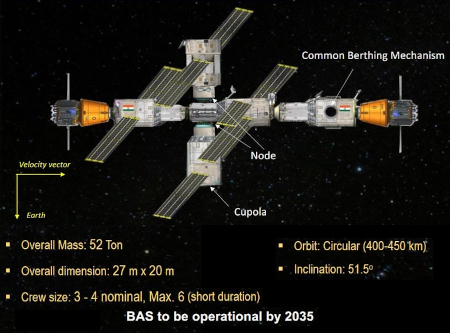
India’s Bharatiya Antariksh Station as outlined in 2024.
Click for original image.
The head of India’s space agency ISRO, it is negotiating with NASA about doing a variety of manned space operations in conjunction with NASA, including a possible Gaganyaan docking to ISS.
According to a presentation by Isro chairman V Narayanan reviewed by TOI [Times of India], the future cooperation areas span three key areas of collaboration between the two nations’ space agencies.
The first involves comprehensive training of ISRO personnel, including astronauts, at NASA facilities across multiple domains, including robotics systems, extravehicular activity (EVA), extravehicular mobility unit (EMU) systems, resource management, space medicine and spaceflight operations, LEO and lunar mission control operations, rendezvous and docking procedures, and payload and science operations.
An important initiative outlined is the uncrewed docking demonstration of India’s Gaganyaan Orbital Module with the US Orbital Segment of the ISS — this would mark a significant technological milestone for India’s human spaceflight programme.
The third area focuses on cooperation in docking, berthing, and inter-operability systems.
It is clear ISRO wishes to get training from NASA for its manned missions. It also makes sense for it to make sure its Gaganyaan’s docking systems are compatible with ISS, Dragon, Starliner, Soyuz, and even China’s station.
Doing a test unmanned docking at ISS would also provide ISRO valuable experience in preparation for its own Bharatiya Antariksh Station (BAS). Its first module is presently scheduled for launch in 2028, with the entire station assembled by 2035.
None of this however has been finalized. If India were to do a docking at ISS, it would like have to wait until 2029, after the two tourist missions assigned to Axiom and Vast. ISS has a limited number of available ports, and I suspect a port really won’t be available until after those missions.

On Christmas Eve 1968 three Americans became the first humans to visit another world. What they did to celebrate was unexpected and profound, and will be remembered throughout all human history. Genesis: the Story of Apollo 8, Robert Zimmerman's classic history of humanity's first journey to another world, tells that story, and it is now available as both an ebook and an audiobook, both with a foreword by Valerie Anders and a new introduction by Robert Zimmerman.
The print edition can be purchased at Amazon or from any other book seller. If you want an autographed copy the price is $60 for the hardback and $45 for the paperback, plus $8 shipping for each. Go here for purchasing details. The ebook is available everywhere for $5.99 (before discount) at amazon, or direct from my ebook publisher, ebookit. If you buy it from ebookit you don't support the big tech companies and the author gets a bigger cut much sooner.
The audiobook is also available at all these vendors, and is also free with a 30-day trial membership to Audible.
"Not simply about one mission, [Genesis] is also the history of America's quest for the moon... Zimmerman has done a masterful job of tying disparate events together into a solid account of one of America's greatest human triumphs."--San Antonio Express-News

India’s Bharatiya Antariksh Station as outlined in 2024.
Click for original image.
The head of India’s space agency ISRO, it is negotiating with NASA about doing a variety of manned space operations in conjunction with NASA, including a possible Gaganyaan docking to ISS.
According to a presentation by Isro chairman V Narayanan reviewed by TOI [Times of India], the future cooperation areas span three key areas of collaboration between the two nations’ space agencies.
The first involves comprehensive training of ISRO personnel, including astronauts, at NASA facilities across multiple domains, including robotics systems, extravehicular activity (EVA), extravehicular mobility unit (EMU) systems, resource management, space medicine and spaceflight operations, LEO and lunar mission control operations, rendezvous and docking procedures, and payload and science operations.
An important initiative outlined is the uncrewed docking demonstration of India’s Gaganyaan Orbital Module with the US Orbital Segment of the ISS — this would mark a significant technological milestone for India’s human spaceflight programme.
The third area focuses on cooperation in docking, berthing, and inter-operability systems.
It is clear ISRO wishes to get training from NASA for its manned missions. It also makes sense for it to make sure its Gaganyaan’s docking systems are compatible with ISS, Dragon, Starliner, Soyuz, and even China’s station.
Doing a test unmanned docking at ISS would also provide ISRO valuable experience in preparation for its own Bharatiya Antariksh Station (BAS). Its first module is presently scheduled for launch in 2028, with the entire station assembled by 2035.
None of this however has been finalized. If India were to do a docking at ISS, it would like have to wait until 2029, after the two tourist missions assigned to Axiom and Vast. ISS has a limited number of available ports, and I suspect a port really won’t be available until after those missions.
On Christmas Eve 1968 three Americans became the first humans to visit another world. What they did to celebrate was unexpected and profound, and will be remembered throughout all human history. Genesis: the Story of Apollo 8, Robert Zimmerman's classic history of humanity's first journey to another world, tells that story, and it is now available as both an ebook and an audiobook, both with a foreword by Valerie Anders and a new introduction by Robert Zimmerman.
The print edition can be purchased at Amazon or from any other book seller. If you want an autographed copy the price is $60 for the hardback and $45 for the paperback, plus $8 shipping for each. Go here for purchasing details. The ebook is available everywhere for $5.99 (before discount) at amazon, or direct from my ebook publisher, ebookit. If you buy it from ebookit you don't support the big tech companies and the author gets a bigger cut much sooner.
The audiobook is also available at all these vendors, and is also free with a 30-day trial membership to Audible.
"Not simply about one mission, [Genesis] is also the history of America's quest for the moon... Zimmerman has done a masterful job of tying disparate events together into a solid account of one of America's greatest human triumphs."--San Antonio Express-News
I think the limiting factor on scheduling a Gaganyaan visit to ISS is going to be the readiness of Gaganyaan itself. The private astronaut missions of Axiom and Vast will only be of about two weeks duration each. That isn’t going to constitute much of a barrier to entry for the Indians, so to speak. The presence of Cargo Dragons for 30 days or more at a time will be more of an obstacle to dodge around.
Not too surprising that India is looking to the US for training and other forms of space station-related cooperation. The Russians are fading fast and India seems to be winding down its long-time relationship with that nation. It has even recently confiscated some of the shadow fleet tankers after ceasing to buy Russian crude oil after Trump’s tariff threats.
And, the PRC, of course, is India’s main geopolitical rival in the world in the same ways it is ours.
“It is clear ISRO wishes to get training from NASA”
That way unskilled Indians can replace American astronauts at half the price just like they replaced Americans in the tech and medical fields.
James Street,
I don’t think NASA is allowed to hire on H1-B visas and the same applies to SpaceX. There are certainly people of Indian extraction working both places, but none of them are immigrants and the ones I’ve heard speak do not do so with South Asian accents. That indicates US birth and upbringing.
Given that the latter two organizations will be the employers of nearly all working astronauts during the next several decades, I think “astronaut” will continue to be a job category populated by American citizens for the most part. Any Indian citizens trained by NASA will be flying for India on Indian vehicles and, soon enough, to and from an Indian LEO space station. The small complements of national astronauts from other allied nations will fly to ISS and future US LEO space stations – and eventually the Moon and Mars – on a barter or cash-and-carry basis. Pioneering the Solar System is not going to be one of those jobs Americans allegedly do not want to do.
Dick Eagleson wrote: “Given that the latter two organizations will be the employers of nearly all working astronauts during the next several decades, I think ‘astronaut’ will continue to be a job category populated by American citizens for the most part.”
Huh. Look at that. SpaceX is becoming the leader that all the others have to follow. Even NASA.
Now that could be a great service NASA could do.
Train the rest of the world for space flight.
By being the worlds official training facility they would have the power to set standards. Things like docking ports, safety equipment/procedures, computer programing and integration, materials used in construction, scientific research procedures. Pretty much everything.
But they have to become the center for training everyone going to space.
Bob,
With the proliferation of space station development projects I’m assuming docking ports will be standardized across all platforms. How about the Chinese? Have they given consideration to possible emergency situations where, say India might be in a position to rescue their astronauts or vice versa? Just a thought.
Jerry Greenwood: It is my understanding that the Chinese ports conform approximately to the same systems used at ISS, all of which are based on the initial Soviet design. However, there may be slight differences that could cause problems in an emergency.
Anyone with better knowledge?
ISS has two different kinds of docking ports, Russian and American. The dimensions, mechanisms, and protocols of each are different, so a visiting vehicle is limited to the ports for which it was built.
The Russian docking system is used by Soyuz, Progress, and formerly by the European ATV. China’s space station is using the Russian design, if I remember correctly.
The American system is used by Dragon and Starliner (via direct docking), Cygnus and HTV (via grapple/berth), and was intended for Dream Chaser. From the article, this port would be used by Gaganyaan.