A tour of Stoke Space
Tim Dodd of Everyday Astronaut yesterday released a long video in which he got a new tour the Stoke Space facility, led by the company’s CEO and founder, Andy Lapsa.
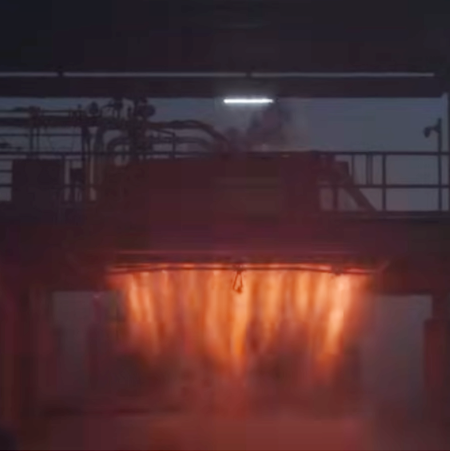
I have embedded that video below. The image to the right is a screen capture of a static fire test of the company’s Nova rocket’s upper stage engine that was done at the end of the tour. The engine uses a radical design of a ring of small nozzles, with a heat shield in the middle. The design aims to allow that upper stage to return to Earth for reuse, after it has deployed its payload. Nova’s first stage will also be reusable, landing vertically like the Falcon 9.
Though as usual Lapsa said nothing about schedule, it appears that the company is getting very close to its first launch. It appears the company’s launchpad in Florida will be ready for launch early in 2026. It also appears that all the rocket’s components are falling into place.
Lapsa noted that though both stages are designed to land and be reused, the goal for that first launch is simply to demonstrate they can get the rocket into orbit. Neither stage will attempt a landing. Once they’ve got that success under their belt, they will then go for other milestones.
Right now only SpaceX and Stoke Space are working to build a completely reusable rocket. SpaceX is going very big, with Starship. Stoke is aiming for the Falcon 9 market. If successful, it will be able to beat that rocket in price.

On Christmas Eve 1968 three Americans became the first humans to visit another world. What they did to celebrate was unexpected and profound, and will be remembered throughout all human history. Genesis: the Story of Apollo 8, Robert Zimmerman's classic history of humanity's first journey to another world, tells that story, and it is now available as both an ebook and an audiobook, both with a foreword by Valerie Anders and a new introduction by Robert Zimmerman.
The print edition can be purchased at Amazon or from any other book seller. If you want an autographed copy the price is $60 for the hardback and $45 for the paperback, plus $8 shipping for each. Go here for purchasing details. The ebook is available everywhere for $5.99 (before discount) at amazon, or direct from my ebook publisher, ebookit. If you buy it from ebookit you don't support the big tech companies and the author gets a bigger cut much sooner.
The audiobook is also available at all these vendors, and is also free with a 30-day trial membership to Audible.
"Not simply about one mission, [Genesis] is also the history of America's quest for the moon... Zimmerman has done a masterful job of tying disparate events together into a solid account of one of America's greatest human triumphs."--San Antonio Express-News
Tim Dodd of Everyday Astronaut yesterday released a long video in which he got a new tour the Stoke Space facility, led by the company’s CEO and founder, Andy Lapsa.
I have embedded that video below. The image to the right is a screen capture of a static fire test of the company’s Nova rocket’s upper stage engine that was done at the end of the tour. The engine uses a radical design of a ring of small nozzles, with a heat shield in the middle. The design aims to allow that upper stage to return to Earth for reuse, after it has deployed its payload. Nova’s first stage will also be reusable, landing vertically like the Falcon 9.
Though as usual Lapsa said nothing about schedule, it appears that the company is getting very close to its first launch. It appears the company’s launchpad in Florida will be ready for launch early in 2026. It also appears that all the rocket’s components are falling into place.
Lapsa noted that though both stages are designed to land and be reused, the goal for that first launch is simply to demonstrate they can get the rocket into orbit. Neither stage will attempt a landing. Once they’ve got that success under their belt, they will then go for other milestones.
Right now only SpaceX and Stoke Space are working to build a completely reusable rocket. SpaceX is going very big, with Starship. Stoke is aiming for the Falcon 9 market. If successful, it will be able to beat that rocket in price.
On Christmas Eve 1968 three Americans became the first humans to visit another world. What they did to celebrate was unexpected and profound, and will be remembered throughout all human history. Genesis: the Story of Apollo 8, Robert Zimmerman's classic history of humanity's first journey to another world, tells that story, and it is now available as both an ebook and an audiobook, both with a foreword by Valerie Anders and a new introduction by Robert Zimmerman.
The print edition can be purchased at Amazon or from any other book seller. If you want an autographed copy the price is $60 for the hardback and $45 for the paperback, plus $8 shipping for each. Go here for purchasing details. The ebook is available everywhere for $5.99 (before discount) at amazon, or direct from my ebook publisher, ebookit. If you buy it from ebookit you don't support the big tech companies and the author gets a bigger cut much sooner.
The audiobook is also available at all these vendors, and is also free with a 30-day trial membership to Audible.
"Not simply about one mission, [Genesis] is also the history of America's quest for the moon... Zimmerman has done a masterful job of tying disparate events together into a solid account of one of America's greatest human triumphs."--San Antonio Express-News
Tim Dodd keeps landing the big rocket factory tours — well done to him. Loved seeing the upgraded heat shield up close, and frankly, I was a little surprised they could show us so much while staying ITAR compliant.
At 3 tons to LEO, Nova will definitely be at the low end of the medium lift market. But there’s a lot of sats on the market that can fit in that, and if Stoke can fly it frequently enough, this could be a major market participant.
Richard M,
Yes on all points. Once Nova is flying and recovering reliably, Stoke will need its own version of Kiko Dontchev to enable a faster and faster operations cadence. The customers will definitely be there so Stoke’s limits of consequence will be operational – post-flight vehicle inspection and minor maintenance, pad turnaround, securing more and more propellant, payload prep, etc. SpaceX landed its first Falcon 9 1st stage a decade ago but did not instantly jump to a three-figures annual launch rate. Stoke should be able to get to that level more quickly, to be sure, but it will need to put in the necessary work.
And by the early 2030s, Stoke should probably be roughly where it is now with Nova on a larger vehicle that scales the Nova technology. One of Lapsa’s recurrent themes throughout Dodd’s factory and test site tour was the fundamental scalability of the Nova technology.
Good video. Thanks, Robert.
______________
Richard M wrote: “… and frankly, I was a little surprised they could show us so much while staying ITAR compliant.”
Quite a bit of the video has parts and pieces fuzzed and the occasional tactically-located display easel in order to avoid showing sensitive (ITAR or proprietary) information.
To Richard M
Phil Bono and plug nozzle advocates pre-existed ITAR…then the problem is that while the knowledge was out there–no one cared.
I think what consigned Truax to history’s dustbin was the belief that pressure fed rockets were “technically uninteresting.”
Stoke is my favorite NewSpace firm.
They are thankful, and hungry in equal measures.