
Ancient Martian drainage into crater lake, now turned into ridges
Click for original image.
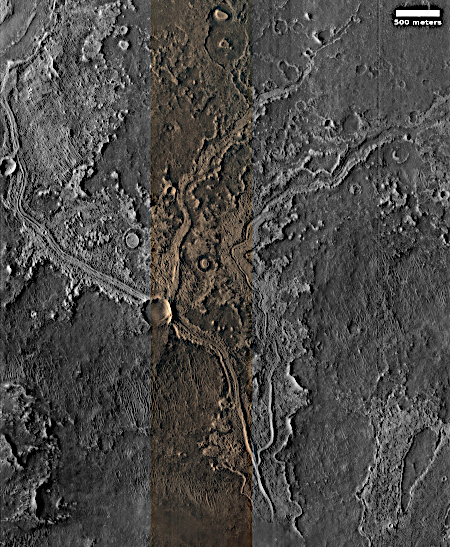
Cool image time! The picture to the right, rotated, cropped, reduced, and sharpened to post here, was taken on September 9, 2025 by the high resolution camera on Mars Reconnaissance Orbiter (MRO). It shows what the science team labels “an inverted channel.” From the caption:
Topographic inversion is a process where geologic features that were once low-lying, like impact craters or riverbeds, become elevated over time, like mesas or ridges. In this process, a crater or channel is filled with lava or sediment that becomes lithified [hardened]. If this infill is more resistant to erosion than the surrounding landscape, the less-resistant material can be eroded away by wind or water. The former crater or valley fill, being more resistant, remains elevated as the landscape around it lowers. The original low-lying feature becomes a mesa or ridge.
In this image, an ancient river network and nearby impact craters have undergone topographic inversion. Impact craters contain round mesas within them, and the stream channel is defined by a network of ridges.
The location of this inverted channel makes its history even more interesting.
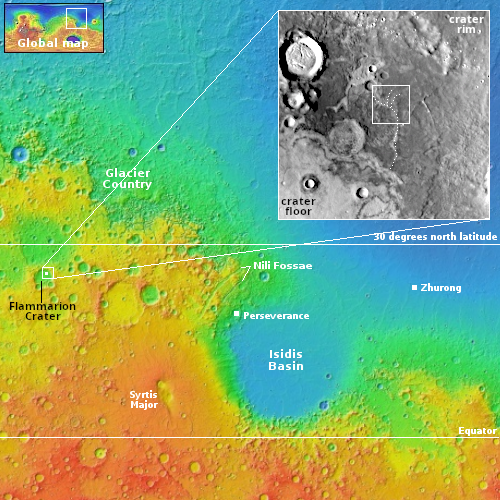
The white dot on the overview map to the right marks the location, in the northeast quadrant of 107-mile-wide Flammarion Crater. In the inset I have indicated the overall drainage pattern of this channel, flowing downhill from the crater rim towards the crater floor.
Flammarion Crater is of interest because some scientists believe it once held a lake. These channels on the periphery of the crater floor support that hypothesis, especially as they seem to drain downward into the crater. In fact, researchers have mapped numerous similar tributary systems throughout this region of Mars, all suggesting the existence of paleo-lakes. From that paper’s abstract:
Using high-resolution satellite images, we investigate a series of sinuous ridges preserved at the Martian surface throughout the ancient Arabia Terra region. These sinuous ridges often occur downslope of river valleys, commonly as the valleys enter topographic basins. The ridges are usually found on the oldest exposed geological surfaces. The morphology of the ridges and their relationship to river valleys suggests that they are sedimentary rocks, which form in or next to rivers. We interpret the basins as ancient lakes and their associated deposits as lake sediments. These rivers were active ~3.7 billion years ago and transported and deposited sediment through the Arabia Terra region.
The tributary system above is thus considered strong evidence that water flowed down into a lake that filled this crater. The assumption is that this flow was liquid water, but there remains the possibility that we are instead seeing evidence of erosion caused by glacial flows into a ice-filled crater.

On Christmas Eve 1968 three Americans became the first humans to visit another world. What they did to celebrate was unexpected and profound, and will be remembered throughout all human history. Genesis: the Story of Apollo 8, Robert Zimmerman's classic history of humanity's first journey to another world, tells that story, and it is now available as both an ebook and an audiobook, both with a foreword by Valerie Anders and a new introduction by Robert Zimmerman.
The print edition can be purchased at Amazon or from any other book seller. If you want an autographed copy the price is $60 for the hardback and $45 for the paperback, plus $8 shipping for each. Go here for purchasing details. The ebook is available everywhere for $5.99 (before discount) at amazon, or direct from my ebook publisher, ebookit. If you buy it from ebookit you don't support the big tech companies and the author gets a bigger cut much sooner.
The audiobook is also available at all these vendors, and is also free with a 30-day trial membership to Audible.
"Not simply about one mission, [Genesis] is also the history of America's quest for the moon... Zimmerman has done a masterful job of tying disparate events together into a solid account of one of America's greatest human triumphs."--San Antonio Express-News

Click for original image.
Cool image time! The picture to the right, rotated, cropped, reduced, and sharpened to post here, was taken on September 9, 2025 by the high resolution camera on Mars Reconnaissance Orbiter (MRO). It shows what the science team labels “an inverted channel.” From the caption:
Topographic inversion is a process where geologic features that were once low-lying, like impact craters or riverbeds, become elevated over time, like mesas or ridges. In this process, a crater or channel is filled with lava or sediment that becomes lithified [hardened]. If this infill is more resistant to erosion than the surrounding landscape, the less-resistant material can be eroded away by wind or water. The former crater or valley fill, being more resistant, remains elevated as the landscape around it lowers. The original low-lying feature becomes a mesa or ridge.
In this image, an ancient river network and nearby impact craters have undergone topographic inversion. Impact craters contain round mesas within them, and the stream channel is defined by a network of ridges.
The location of this inverted channel makes its history even more interesting.
The white dot on the overview map to the right marks the location, in the northeast quadrant of 107-mile-wide Flammarion Crater. In the inset I have indicated the overall drainage pattern of this channel, flowing downhill from the crater rim towards the crater floor.
Flammarion Crater is of interest because some scientists believe it once held a lake. These channels on the periphery of the crater floor support that hypothesis, especially as they seem to drain downward into the crater. In fact, researchers have mapped numerous similar tributary systems throughout this region of Mars, all suggesting the existence of paleo-lakes. From that paper’s abstract:
Using high-resolution satellite images, we investigate a series of sinuous ridges preserved at the Martian surface throughout the ancient Arabia Terra region. These sinuous ridges often occur downslope of river valleys, commonly as the valleys enter topographic basins. The ridges are usually found on the oldest exposed geological surfaces. The morphology of the ridges and their relationship to river valleys suggests that they are sedimentary rocks, which form in or next to rivers. We interpret the basins as ancient lakes and their associated deposits as lake sediments. These rivers were active ~3.7 billion years ago and transported and deposited sediment through the Arabia Terra region.
The tributary system above is thus considered strong evidence that water flowed down into a lake that filled this crater. The assumption is that this flow was liquid water, but there remains the possibility that we are instead seeing evidence of erosion caused by glacial flows into a ice-filled crater.
On Christmas Eve 1968 three Americans became the first humans to visit another world. What they did to celebrate was unexpected and profound, and will be remembered throughout all human history. Genesis: the Story of Apollo 8, Robert Zimmerman's classic history of humanity's first journey to another world, tells that story, and it is now available as both an ebook and an audiobook, both with a foreword by Valerie Anders and a new introduction by Robert Zimmerman.
The print edition can be purchased at Amazon or from any other book seller. If you want an autographed copy the price is $60 for the hardback and $45 for the paperback, plus $8 shipping for each. Go here for purchasing details. The ebook is available everywhere for $5.99 (before discount) at amazon, or direct from my ebook publisher, ebookit. If you buy it from ebookit you don't support the big tech companies and the author gets a bigger cut much sooner.
The audiobook is also available at all these vendors, and is also free with a 30-day trial membership to Audible.
"Not simply about one mission, [Genesis] is also the history of America's quest for the moon... Zimmerman has done a masterful job of tying disparate events together into a solid account of one of America's greatest human triumphs."--San Antonio Express-News
“Inverted channels.”
Somewhere, Percival Lowell might almost be smiling.