Astronomers detect a bar of iron in the center of the Ring Nebula
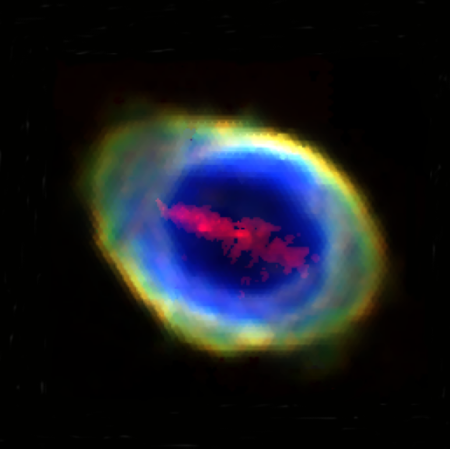
Composite image showing iron bar inside Ring Nebula.
Click for original.
The uncertainty of science: Using a new instrument on the Herschel Telescope in Chile, astronomers have detected a bar of iron cutting across the hole in the center of the Ring Nebula. You can read their paper here.
The cloud of iron atoms, described for the first time in Monthly Notices of the Royal Astronomical Society, is in the shape of a bar or strip: it just fits inside the inner layer of the elliptically shaped nebula, familiar from many images including those obtained by the James Webb Space Telescope at infrared wavelengths. The bar’s length is roughly 500 times that of Pluto’s orbit around the Sun and, according to the team, its mass of iron atoms is comparable to the mass of Mars.
The bar does not cross the nebula’s central star, nor does it exhibit the kind of motion seen by jets flowing outward from such stars. From the paper’s conclusion:
At present, there seem to be no obvious explanations that can account for the presence of the narrow ‘bar’ of [Fe v] and [Fe vi] emission seen in our WEAVE spectra to extend across the central regions of the Ring Nebula. Fresh observations of this newly uncovered feature at much higher spectral resolution seem essential to make progress
The scientists toss out the possibility that the bar is the remains of a rocky planet vaporized at some point in the system’s past, but that is simply a wild guess.
On Christmas Eve 1968 three Americans became the first humans to visit another world. What they did to celebrate was unexpected and profound, and will be remembered throughout all human history. Genesis: the Story of Apollo 8, Robert Zimmerman's classic history of humanity's first journey to another world, tells that story, and it is now available as both an ebook and an audiobook, both with a foreword by Valerie Anders and a new introduction by Robert Zimmerman.
The print edition can be purchased at Amazon or from any other book seller. If you want an autographed copy the price is $60 for the hardback and $45 for the paperback, plus $8 shipping for each. Go here for purchasing details. The ebook is available everywhere for $5.99 (before discount) at amazon, or direct from my ebook publisher, ebookit. If you buy it from ebookit you don't support the big tech companies and the author gets a bigger cut much sooner.
The audiobook is also available at all these vendors, and is also free with a 30-day trial membership to Audible.
"Not simply about one mission, [Genesis] is also the history of America's quest for the moon... Zimmerman has done a masterful job of tying disparate events together into a solid account of one of America's greatest human triumphs."--San Antonio Express-News
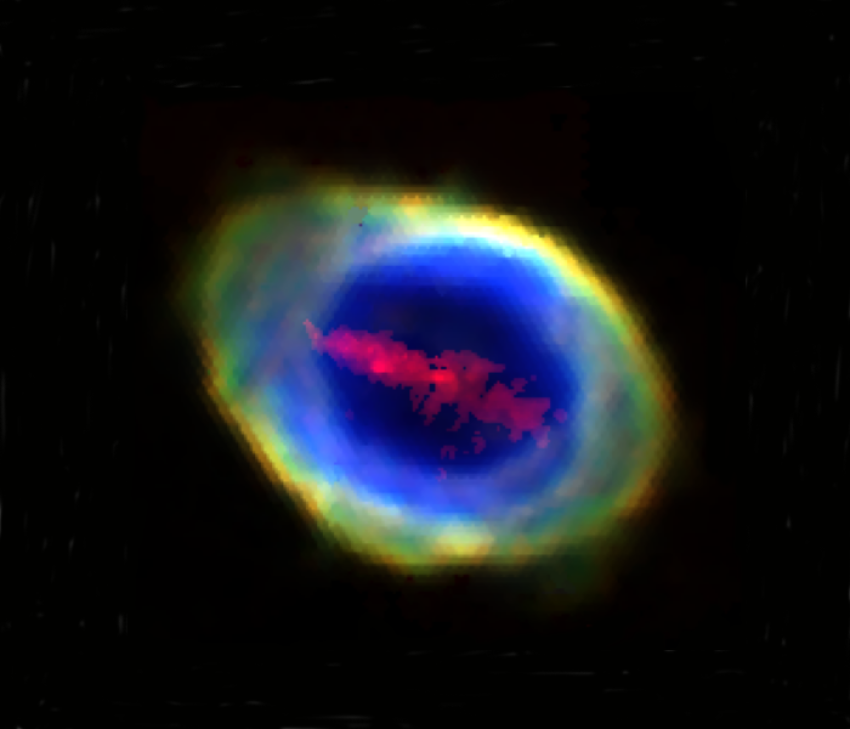
Composite image showing iron bar inside Ring Nebula.
Click for original.
The uncertainty of science: Using a new instrument on the Herschel Telescope in Chile, astronomers have detected a bar of iron cutting across the hole in the center of the Ring Nebula. You can read their paper here.
The cloud of iron atoms, described for the first time in Monthly Notices of the Royal Astronomical Society, is in the shape of a bar or strip: it just fits inside the inner layer of the elliptically shaped nebula, familiar from many images including those obtained by the James Webb Space Telescope at infrared wavelengths. The bar’s length is roughly 500 times that of Pluto’s orbit around the Sun and, according to the team, its mass of iron atoms is comparable to the mass of Mars.
The bar does not cross the nebula’s central star, nor does it exhibit the kind of motion seen by jets flowing outward from such stars. From the paper’s conclusion:
At present, there seem to be no obvious explanations that can account for the presence of the narrow ‘bar’ of [Fe v] and [Fe vi] emission seen in our WEAVE spectra to extend across the central regions of the Ring Nebula. Fresh observations of this newly uncovered feature at much higher spectral resolution seem essential to make progress
The scientists toss out the possibility that the bar is the remains of a rocky planet vaporized at some point in the system’s past, but that is simply a wild guess.
On Christmas Eve 1968 three Americans became the first humans to visit another world. What they did to celebrate was unexpected and profound, and will be remembered throughout all human history. Genesis: the Story of Apollo 8, Robert Zimmerman's classic history of humanity's first journey to another world, tells that story, and it is now available as both an ebook and an audiobook, both with a foreword by Valerie Anders and a new introduction by Robert Zimmerman.
The print edition can be purchased at Amazon or from any other book seller. If you want an autographed copy the price is $60 for the hardback and $45 for the paperback, plus $8 shipping for each. Go here for purchasing details. The ebook is available everywhere for $5.99 (before discount) at amazon, or direct from my ebook publisher, ebookit. If you buy it from ebookit you don't support the big tech companies and the author gets a bigger cut much sooner.
The audiobook is also available at all these vendors, and is also free with a 30-day trial membership to Audible.
"Not simply about one mission, [Genesis] is also the history of America's quest for the moon... Zimmerman has done a masterful job of tying disparate events together into a solid account of one of America's greatest human triumphs."--San Antonio Express-News
What else could it be other than a destroyed rocky planet? If the star at the source of the nebula contained or produced such heavy elements I would think the iron would be more evenly dispersed.
This discovery was covered in a popular British tabloid type website I am addicted to. They headlined it in a way to suggest this is what will happen to Earth billions of years from now when the same happens to the sun.
Coolness on an unimaginable scale.
The Eye of Sauron!
A Messier object, M57 and NGC 6720 in the constellation Lyra, the Ring Nebula is a wonderful object to observe through a telescope. While I have observed this object many times, if it is up, I seldom pass up a chance to take a quick look.
Allen asked:”What else could it be other than a destroyed rocky planet?”
Agree, but given the mass involved ” . . . its mass of iron atoms is comparable to the mass of Mars.”, and the volume of space “The bar’s length is roughly 500 times that of Pluto’s orbit around the Sun.” I would think that the density of atomic Iron would be quite low.
Allan–
We could probably skip the iron-planet created from a supernova, then gets destroyed somehow, step, and go straight to one or more stars producing all the iron present.
How it gets into this specific shape and density is the big question.
Stars fuse all the lighter elements, in ascending order, up until iron which requires energy to fuse. As the star attempts to fuse iron into nickel you get a general equilibrium collapse and supernova, literally within days. (this may or may not produce a black hole or a neutron star, depending on mass.)
At that point you basically have a core of iron that is going to collapse into itself. All the elements heavier than Iron are only produced in the very last minute(s) as the outer layers bounce off the core and ‘explode.’
The Internet tells me that “1/2 of all iron in the universe is produced via supernova.”
Now we know where to put Imperial shipyards.