Astronomers use AI to discover hundreds of weird galaxies in Hubble archive
Click for original image.
In what is a perfect example of the proper use of artificial computer intelligence (AI), astronomers have now used this programming to analyze almost 100 million images taken by the Hubble Space Telescope over the decades to find any galaxies hidden there that have “anomalies” or unusual shapes.
The team analyzed nearly 100 million image cutouts from the Hubble Legacy Archive, each measuring just a few dozen pixels (7 to 8 arcseconds) on a side. They identified more than 1,300 objects with an odd appearance in just two and a half days — more than 800 of which had never been documented in scientific literature.
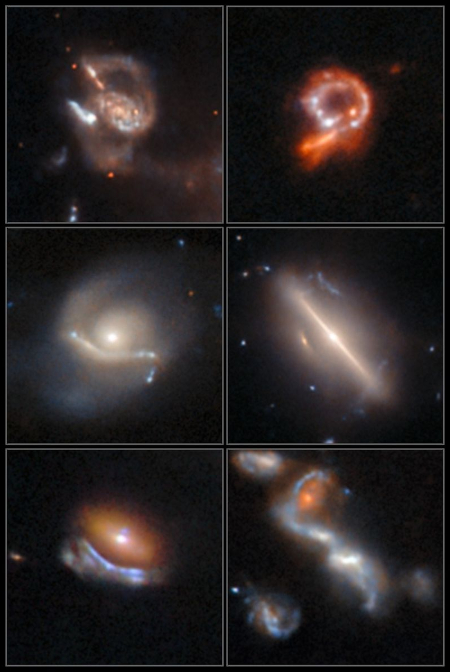
The six galaxies to the right are just a small sample. All six were previously unidentified, and include “three lenses with arcs distorted by gravity, one galactic merger, one ring galaxy, and one galaxy that defied classification” (the galaxy at the top left). From the European Space Agency’s (ESA) press release:
The strange, bi-polar galaxy seen here is certainly anomalous, with its compact, swirling core and two open lobes at the sides. Exactly what kind of galaxy it is is unclear, and it was not previously known to astronomers.
As noted in the first link, the volume of data that astronomers are now collecting from ground-based and orbiting telescopes — many of which are survey telescopes that photograph the entire sky repeatedly — has actually become a problem. They have great data, but don’t have the time or human resources to study it sufficiently. Even employing large numbers of ordinary citizens, working at home with their own computers, can’t get the job done.
This is the kind of grunt work that AI is ideally made for. It can quickly review the data and identify objects that don’t fit normal expectations. Humans then can do the real work, finding the most interesting of these strange objects, such as the top left galaxy, and devote human creativity to studying it.

On Christmas Eve 1968 three Americans became the first humans to visit another world. What they did to celebrate was unexpected and profound, and will be remembered throughout all human history. Genesis: the Story of Apollo 8, Robert Zimmerman's classic history of humanity's first journey to another world, tells that story, and it is now available as both an ebook and an audiobook, both with a foreword by Valerie Anders and a new introduction by Robert Zimmerman.
The print edition can be purchased at Amazon or from any other book seller. If you want an autographed copy the price is $60 for the hardback and $45 for the paperback, plus $8 shipping for each. Go here for purchasing details. The ebook is available everywhere for $5.99 (before discount) at amazon, or direct from my ebook publisher, ebookit. If you buy it from ebookit you don't support the big tech companies and the author gets a bigger cut much sooner.
The audiobook is also available at all these vendors, and is also free with a 30-day trial membership to Audible.
"Not simply about one mission, [Genesis] is also the history of America's quest for the moon... Zimmerman has done a masterful job of tying disparate events together into a solid account of one of America's greatest human triumphs."--San Antonio Express-News

Click for original image.
In what is a perfect example of the proper use of artificial computer intelligence (AI), astronomers have now used this programming to analyze almost 100 million images taken by the Hubble Space Telescope over the decades to find any galaxies hidden there that have “anomalies” or unusual shapes.
The team analyzed nearly 100 million image cutouts from the Hubble Legacy Archive, each measuring just a few dozen pixels (7 to 8 arcseconds) on a side. They identified more than 1,300 objects with an odd appearance in just two and a half days — more than 800 of which had never been documented in scientific literature.
The six galaxies to the right are just a small sample. All six were previously unidentified, and include “three lenses with arcs distorted by gravity, one galactic merger, one ring galaxy, and one galaxy that defied classification” (the galaxy at the top left). From the European Space Agency’s (ESA) press release:
The strange, bi-polar galaxy seen here is certainly anomalous, with its compact, swirling core and two open lobes at the sides. Exactly what kind of galaxy it is is unclear, and it was not previously known to astronomers.
As noted in the first link, the volume of data that astronomers are now collecting from ground-based and orbiting telescopes — many of which are survey telescopes that photograph the entire sky repeatedly — has actually become a problem. They have great data, but don’t have the time or human resources to study it sufficiently. Even employing large numbers of ordinary citizens, working at home with their own computers, can’t get the job done.
This is the kind of grunt work that AI is ideally made for. It can quickly review the data and identify objects that don’t fit normal expectations. Humans then can do the real work, finding the most interesting of these strange objects, such as the top left galaxy, and devote human creativity to studying it.
On Christmas Eve 1968 three Americans became the first humans to visit another world. What they did to celebrate was unexpected and profound, and will be remembered throughout all human history. Genesis: the Story of Apollo 8, Robert Zimmerman's classic history of humanity's first journey to another world, tells that story, and it is now available as both an ebook and an audiobook, both with a foreword by Valerie Anders and a new introduction by Robert Zimmerman.
The print edition can be purchased at Amazon or from any other book seller. If you want an autographed copy the price is $60 for the hardback and $45 for the paperback, plus $8 shipping for each. Go here for purchasing details. The ebook is available everywhere for $5.99 (before discount) at amazon, or direct from my ebook publisher, ebookit. If you buy it from ebookit you don't support the big tech companies and the author gets a bigger cut much sooner.
The audiobook is also available at all these vendors, and is also free with a 30-day trial membership to Audible.
"Not simply about one mission, [Genesis] is also the history of America's quest for the moon... Zimmerman has done a masterful job of tying disparate events together into a solid account of one of America's greatest human triumphs."--San Antonio Express-News
This may be a little off topic.
As a new and expanse tool (AI)- we struggle to describe and define this tools best use and boundaries. It might be helpful to consider a historical perspective, and invent the term AM for artificial muscle. AM moved us from the agrarian age into the industrial age. (Yet, we still to this day retain many of the older descriptions – horsepower, backhoe, etc.) We might romanticize cobble stone roads and pre industrial farms but few of us would embrace the intense physical labor of a muscle powered world. Are we physically weaker as a species having left that life behind? Probably, but how broken was the typical body by 40 years of age during that time? Never-the-less, artificial muscle has magnified our physical strength tremendously and for the most part we drive cars on asphalt road. AM has superseded the organic version to a point where horses are viewed as pets.
Currently, we appear to be experiencing a confluence of the space age, the information age, the nuclear age, the bio tech age, the additive tech age, and many other “ages” of which AI is also part. Will artificial intelligence magnify our intellect allowing us to process vast amounts of information almost instantly or will it leave us intellectually weaker in some form? That remains to be seen, as few of us have the foresight to see deeply into an age which is still in it’s early stages of formation. How will our minds adapt to an all information, everywhere, all the time type of world?
People are already, frequently, glued to a screen – what happens when there is a more direct neural connection and the line between AI and brain is really blurred? I don’t think it’s that far off, as we already see the precursor for the connection – now.
jburn: With any tool humans create, whether it be a bulldozer or a software game, the real problem is deciding how and when to use it, and to avoid its misuse. With new tools, we often don’t think about this very much and thus end up using the tool badly in ways that are not only counter-productive, but often do serious harm to ourselves and others.
This is the fundamental issue with AI right now. The question is not whether we should reject it but whether we are using properly for the most benefit. And that question is not simply one of practicality or efficiency, but of morality and ethics. We should be asking ourselves if using AI in every situation is not only practical or efficient, but moral.
This is one reason I report about both bad and good uses of AI. We need to explore when it does good and when it doesn’t.