Axiom has delayed the launch of its first space station module to ’28
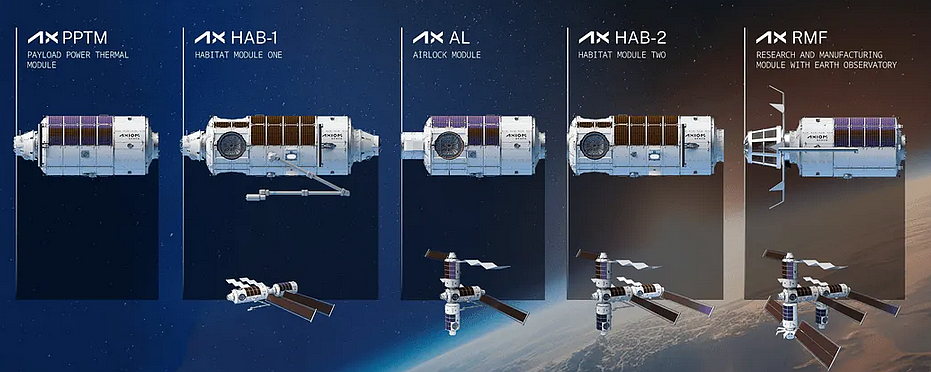
Axiom’s module assembly sequence
When Axiom announced in September 2025 that Redwire would be building the solar panels for the first module of its space station, dubbed the PPTM, it also said that module would launch in late 2027, which was a delay of one year from the original launch date of 2026.
That schedule has now apparently been delayed again. In an interview yesterday, the company’s vice president of human spaceflight, former NASA astronaut Peggy Whitson, indicated the launch was now targeting 2028.
Plans call for the initial Axiom Station to be comprised of two modules, the PPTM — short for Payload Power Thermal Module — and a habitat module. The PPTM, which is to be shipped shortly to Houston for final assembly and integration, is slated to be launched in early 2028, with the second module following just months later. From there, Axiom aims to swiftly begin welcoming crew, Peggy Whitson, the company’s vice president of human spaceflight, told me in an interview.
This schedule almost guarantees that the Axiom station will not detach from ISS as quickly as originally intended. PPTM has a large hatch opening connecting it to ISS, allowing for the easy transfer of much of the research racks held on ISS. Before Axiom can become a free-flying station that ISS equipment must be moved, a process that will take time, likely months. To get it done the company will probably have to also attach its second habitation module so that crews can arrive and begin this transfer process.
In other words, Axiom’s schedule margins for getting its station launched, docked to ISS, loaded with ISS equipment, and then separated before ISS retires in 2030 are shrinking. It can ill afford further delays.
Below are my rankings of the five American space stations presently under development. Note that I now consider Axiom and Starlab tied for second.
- Haven-1, being built by Vast, with no NASA funds. The company is moving fast, with Haven-1 to launch in 2026 for a three-year period during which it will be occupied by four 2-week-long manned missions. The company is already testing an unmanned small demo module in orbit. By flying actual hardware and manned missions it hopes this will put it in the lead to win NASA’s phase 2 contract to build its much larger multi-module Haven-2 station. It has also made preliminary deals with Colombia, Uzbekistan, Japan, and the Maldives possible astronaut flights to Haven-1.
- Axiom, being built by Axiom, has launched four tourist flights to ISS, with the fourth carrying government passengers from India, Hungary, and Poland. The rumors of cash flow issues seem to have been alleviated with an infusion of $100 million from Hungary’s telecommunications company 4iG. The development of its first two modules has been proceeding, though the first module launch is now delayed until 2028. It has also signed Redwire to build that module’s solar panels.
- Starlab, being built by a consortium led by Voyager Space, Airbus, and Northrop Grumman, with extensive partnership agreements with the European Space Agency, Mitsubishi, and others. Though no construction has yet begun on its NASA-approved design, it has raised $383 million in a public stock offering, the $217.5 million provided by NASA, and an unstated amount from private capital. It has also begun signing up a number of companies to build the station’s hardware.
- Thunderbird, proposed by the startup Max Space. It is building a smaller demo test station to launch in ’27 on a Falcon 9 rocket, and has begun work on its manufacturing facility at Kennedy in Florida. Its management includes one former NASA astronaut and one former member of the Bigelow space station team that built the first private orbiting inflatable modules, Genesis-1, Genesis-2, and BEAM (still operating on ISS).
- Orbital Reef, being built by a consortium led by Blue Origin and Sierra Space. This station looks increasingly dead in the water. Blue Origin has built almost nothing, as seems normal for this company. And while Sierra Space has successfully tested its inflatable modules, including a full scale version, its reputation is soured by its failure in getting its Dream Chaser cargo mini-shuttle launched.

On Christmas Eve 1968 three Americans became the first humans to visit another world. What they did to celebrate was unexpected and profound, and will be remembered throughout all human history. Genesis: the Story of Apollo 8, Robert Zimmerman's classic history of humanity's first journey to another world, tells that story, and it is now available as both an ebook and an audiobook, both with a foreword by Valerie Anders and a new introduction by Robert Zimmerman.
The print edition can be purchased at Amazon or from any other book seller. If you want an autographed copy the price is $60 for the hardback and $45 for the paperback, plus $8 shipping for each. Go here for purchasing details. The ebook is available everywhere for $5.99 (before discount) at amazon, or direct from my ebook publisher, ebookit. If you buy it from ebookit you don't support the big tech companies and the author gets a bigger cut much sooner.
The audiobook is also available at all these vendors, and is also free with a 30-day trial membership to Audible.
"Not simply about one mission, [Genesis] is also the history of America's quest for the moon... Zimmerman has done a masterful job of tying disparate events together into a solid account of one of America's greatest human triumphs."--San Antonio Express-News
Axiom’s module assembly sequence
When Axiom announced in September 2025 that Redwire would be building the solar panels for the first module of its space station, dubbed the PPTM, it also said that module would launch in late 2027, which was a delay of one year from the original launch date of 2026.
That schedule has now apparently been delayed again. In an interview yesterday, the company’s vice president of human spaceflight, former NASA astronaut Peggy Whitson, indicated the launch was now targeting 2028.
Plans call for the initial Axiom Station to be comprised of two modules, the PPTM — short for Payload Power Thermal Module — and a habitat module. The PPTM, which is to be shipped shortly to Houston for final assembly and integration, is slated to be launched in early 2028, with the second module following just months later. From there, Axiom aims to swiftly begin welcoming crew, Peggy Whitson, the company’s vice president of human spaceflight, told me in an interview.
This schedule almost guarantees that the Axiom station will not detach from ISS as quickly as originally intended. PPTM has a large hatch opening connecting it to ISS, allowing for the easy transfer of much of the research racks held on ISS. Before Axiom can become a free-flying station that ISS equipment must be moved, a process that will take time, likely months. To get it done the company will probably have to also attach its second habitation module so that crews can arrive and begin this transfer process.
In other words, Axiom’s schedule margins for getting its station launched, docked to ISS, loaded with ISS equipment, and then separated before ISS retires in 2030 are shrinking. It can ill afford further delays.
Below are my rankings of the five American space stations presently under development. Note that I now consider Axiom and Starlab tied for second.
- Haven-1, being built by Vast, with no NASA funds. The company is moving fast, with Haven-1 to launch in 2026 for a three-year period during which it will be occupied by four 2-week-long manned missions. The company is already testing an unmanned small demo module in orbit. By flying actual hardware and manned missions it hopes this will put it in the lead to win NASA’s phase 2 contract to build its much larger multi-module Haven-2 station. It has also made preliminary deals with Colombia, Uzbekistan, Japan, and the Maldives possible astronaut flights to Haven-1.
- Axiom, being built by Axiom, has launched four tourist flights to ISS, with the fourth carrying government passengers from India, Hungary, and Poland. The rumors of cash flow issues seem to have been alleviated with an infusion of $100 million from Hungary’s telecommunications company 4iG. The development of its first two modules has been proceeding, though the first module launch is now delayed until 2028. It has also signed Redwire to build that module’s solar panels.
- Starlab, being built by a consortium led by Voyager Space, Airbus, and Northrop Grumman, with extensive partnership agreements with the European Space Agency, Mitsubishi, and others. Though no construction has yet begun on its NASA-approved design, it has raised $383 million in a public stock offering, the $217.5 million provided by NASA, and an unstated amount from private capital. It has also begun signing up a number of companies to build the station’s hardware.
- Thunderbird, proposed by the startup Max Space. It is building a smaller demo test station to launch in ’27 on a Falcon 9 rocket, and has begun work on its manufacturing facility at Kennedy in Florida. Its management includes one former NASA astronaut and one former member of the Bigelow space station team that built the first private orbiting inflatable modules, Genesis-1, Genesis-2, and BEAM (still operating on ISS).
- Orbital Reef, being built by a consortium led by Blue Origin and Sierra Space. This station looks increasingly dead in the water. Blue Origin has built almost nothing, as seems normal for this company. And while Sierra Space has successfully tested its inflatable modules, including a full scale version, its reputation is soured by its failure in getting its Dream Chaser cargo mini-shuttle launched.
On Christmas Eve 1968 three Americans became the first humans to visit another world. What they did to celebrate was unexpected and profound, and will be remembered throughout all human history. Genesis: the Story of Apollo 8, Robert Zimmerman's classic history of humanity's first journey to another world, tells that story, and it is now available as both an ebook and an audiobook, both with a foreword by Valerie Anders and a new introduction by Robert Zimmerman.
The print edition can be purchased at Amazon or from any other book seller. If you want an autographed copy the price is $60 for the hardback and $45 for the paperback, plus $8 shipping for each. Go here for purchasing details. The ebook is available everywhere for $5.99 (before discount) at amazon, or direct from my ebook publisher, ebookit. If you buy it from ebookit you don't support the big tech companies and the author gets a bigger cut much sooner.
The audiobook is also available at all these vendors, and is also free with a 30-day trial membership to Audible.
"Not simply about one mission, [Genesis] is also the history of America's quest for the moon... Zimmerman has done a masterful job of tying disparate events together into a solid account of one of America's greatest human triumphs."--San Antonio Express-News
Hmm. A slip of one year in the past 4 months of elapsed time suggests that the schedule is slipping faster than time is passing. The launch may never occur, much less the docking to ISS.
When working on a project, watch the schedule slips. Year for year slips (or month for month, etc.) are a bad sign. Axiom is slipping even faster, getting farther away from launch rather than closer to launch.
Edward: To be fair to Axiom, this latest slip in schedule is not a full year. Instead, it appears to be about 3-5 months. Previously they said they’d launch in late ’27. Now it is early ’28.
”Note that I now consider Axiom and Starlab tied for second.”
So the company that has flown four actual astronaut flights conducting actual science at an actual space station, completed its design activity, and built (but not outfitted) its first two modules is tied with the company that has flown nothing, built no significant hardware, and hasn’t even completed CDR yet — but has issued lots of press releases? Ummm…
“Axiom has delayed the launch of its first space station module to ’28.”
I wish I could say this is a surprise, but it’s not.
Even so, however, I think it’s hard to deny that Axiom has a credible shot at winning a Commercial Low Earth Orbit Development Program contract this spring.
What about Vast, which is actually building hardware for Haven 1.
That seems like a significant oversight.
Never mind, I missed it on first read.
I just saw mkent’s comment:
Yeah, I fully share Bob’s enthusiasm for Vast’s Haven stations, but I tend to agree that the ranking here understates Axiom’s tangible advantages, which you note here: They’ve bent the most metal on a *long-term* space station, they’ve finished design work, and they have indeed done multiple private missions to the ISS. These are not small things, and they will matter a good deal to NASA when it makes its awards.
That said, the newly revised CLEODP potentially gives a bigger leg up to Vast and Starlab given how it is structured now, and Starlab has frankly done a more impressive job of living up investors and customers over the last year than Axiom has. I have the sense that Voyager is a better run (and now, better resourced) company, because it has been led by a better management team than Axiom (which relied far too heavily on former NASA executives who just don’t know how to execute a business case) right from the start. I would likely put Axiom ahead right of Voyager/Starlab right now, too, but the gap has been steadily closing.
I’d actually like to see all three of these stations (Axiom, Starlab, and Haven-2) given the CLEODP Phase 2 awards, because while I greatly doubt there is enough market in the Western world to sustain three commercial space stations, I’d like to at least see all three get an *initial* station configuration deployed and running, and then see who sinks and who swims once they do.
Hey, speaking of commercial space stations, Eric Berger just posted a story 35 minutes ago:
https://arstechnica.com/space/2026/01/key-senate-staffer-is-begging-nasa-to-get-on-with-commercial-space-stations/
Not sure this merits a special blog post by Bob, but it might merit taking on as brief a postscript to this one. If congressional leadership really is pushing hard on this, it will probably result in some kind of action at NASA.
Oops, sorry, I screwed up my formatting on that last post!
Richard M: Formating fixed.
Thanks, Bob!
”…a key Senate staff member said an ‘extension’ of the International Space Station is on the table and that NASA needs to accelerate a program to replace the aging station with commercial alternatives…”
I’ve been hoping for this for a while. The USOS part of the ISS should be good to 2035 without much trouble. (Beyond 2035 would require significant upgrades.) ISS is so superior in capability to any of the commercial offerings, we should not throw it away needlessly.
The Russian side, however, has issues. It would be good to get an American propulsion capability up there by 2030 and let the Russians retire their “half” (which is really about 15%) of the ISS.
As for CLD, none of them are going to be ready to conduct science anytime soon. They are all going to take time to get up and running properly, just like commercial cargo did, like commercial crew did, and like CLPS is doing now. There’s nothing wrong with keeping ISS for a few extra years and having a smooth transition instead of a chaotic one like we normally do.