
Because Boeing did nothing to replace a defective part, an airplane crashed killing fifteen
Click for NTSB report.
Despite previously identifying stress fractures in a part that held the engines to the wing on three different MD-11 airplanes, Boeing did nothing to replace the part, and so fifteen people died when the engine fell off a UPS cargo plane at take-off in November 2025.
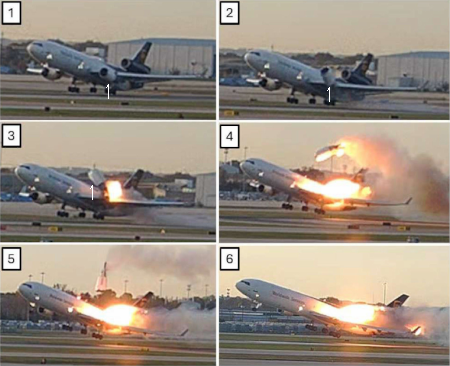
The sequence of images to the right, which I have annotated to show the engine breaking free from the wing, comes from the NTSB preliminary investigation report [pdf]. From the article at the link above:
In an update to its ongoing investigation into the crash of UPS Flight 2976, the National Transportation Safety Board [NTSB] said its team found fatigue cracking and overstress failure across much of the bearing race inside the area that attached the plane’s left engine to its wing. NTSB investigators then went back into Boeing service data and confirmed the design of the bearing assembly was consistent with the original design of that part.
[A] Boeing Service Letter dated Feb. 7, 2011 [and found by the NTSB], told operators the company was aware of four previous bearing race failures on three different airplanes. Boeing had seen the fractures of the bearing race, with the parts splitting in two and moving out of place. However, Boeing told operators its review of the bearing failure “would not result in a safety of flight condition.”
Boeing said further regular inspection of MD-11 airplanes would include a look at this bearing assembly, something scheduled for 60-month service intervals. And while Boeing used that service letter to discuss a new bearing assembly configuration, the installation of the original parts “was not prohibited.”
The plane itself had been built by McDonnell-Douglas, prior to its merger with Boeing. Nonetheless, Boeing engineers and managers were aware of this issue and did nothing to inform the owners of this plane so they could take action. In fact, Boeing apparently continued to ship out the original parts to airlines as replacement spares.
This is another example of a serious quality control problem at Boeing, where engineers no longer view serious engineering failures as serious engineering failures.

On Christmas Eve 1968 three Americans became the first humans to visit another world. What they did to celebrate was unexpected and profound, and will be remembered throughout all human history. Genesis: the Story of Apollo 8, Robert Zimmerman's classic history of humanity's first journey to another world, tells that story, and it is now available as both an ebook and an audiobook, both with a foreword by Valerie Anders and a new introduction by Robert Zimmerman.
The print edition can be purchased at Amazon or from any other book seller. If you want an autographed copy the price is $60 for the hardback and $45 for the paperback, plus $8 shipping for each. Go here for purchasing details. The ebook is available everywhere for $5.99 (before discount) at amazon, or direct from my ebook publisher, ebookit. If you buy it from ebookit you don't support the big tech companies and the author gets a bigger cut much sooner.
The audiobook is also available at all these vendors, and is also free with a 30-day trial membership to Audible.
"Not simply about one mission, [Genesis] is also the history of America's quest for the moon... Zimmerman has done a masterful job of tying disparate events together into a solid account of one of America's greatest human triumphs."--San Antonio Express-News
Click for NTSB report.
Despite previously identifying stress fractures in a part that held the engines to the wing on three different MD-11 airplanes, Boeing did nothing to replace the part, and so fifteen people died when the engine fell off a UPS cargo plane at take-off in November 2025.
The sequence of images to the right, which I have annotated to show the engine breaking free from the wing, comes from the NTSB preliminary investigation report [pdf]. From the article at the link above:
In an update to its ongoing investigation into the crash of UPS Flight 2976, the National Transportation Safety Board [NTSB] said its team found fatigue cracking and overstress failure across much of the bearing race inside the area that attached the plane’s left engine to its wing. NTSB investigators then went back into Boeing service data and confirmed the design of the bearing assembly was consistent with the original design of that part.
[A] Boeing Service Letter dated Feb. 7, 2011 [and found by the NTSB], told operators the company was aware of four previous bearing race failures on three different airplanes. Boeing had seen the fractures of the bearing race, with the parts splitting in two and moving out of place. However, Boeing told operators its review of the bearing failure “would not result in a safety of flight condition.”
Boeing said further regular inspection of MD-11 airplanes would include a look at this bearing assembly, something scheduled for 60-month service intervals. And while Boeing used that service letter to discuss a new bearing assembly configuration, the installation of the original parts “was not prohibited.”
The plane itself had been built by McDonnell-Douglas, prior to its merger with Boeing. Nonetheless, Boeing engineers and managers were aware of this issue and did nothing to inform the owners of this plane so they could take action. In fact, Boeing apparently continued to ship out the original parts to airlines as replacement spares.
This is another example of a serious quality control problem at Boeing, where engineers no longer view serious engineering failures as serious engineering failures.
On Christmas Eve 1968 three Americans became the first humans to visit another world. What they did to celebrate was unexpected and profound, and will be remembered throughout all human history. Genesis: the Story of Apollo 8, Robert Zimmerman's classic history of humanity's first journey to another world, tells that story, and it is now available as both an ebook and an audiobook, both with a foreword by Valerie Anders and a new introduction by Robert Zimmerman.
The print edition can be purchased at Amazon or from any other book seller. If you want an autographed copy the price is $60 for the hardback and $45 for the paperback, plus $8 shipping for each. Go here for purchasing details. The ebook is available everywhere for $5.99 (before discount) at amazon, or direct from my ebook publisher, ebookit. If you buy it from ebookit you don't support the big tech companies and the author gets a bigger cut much sooner.
The audiobook is also available at all these vendors, and is also free with a 30-day trial membership to Audible.
"Not simply about one mission, [Genesis] is also the history of America's quest for the moon... Zimmerman has done a masterful job of tying disparate events together into a solid account of one of America's greatest human triumphs."--San Antonio Express-News
I’m going to push back slightly on the last sentence, because Boeing has forced out a good many engineers over the decades (up to the present day), and management has frequently been the culprit for stupid decisions made at the company. It may be the engineers saying so, but I’d bet money that it’s management somewhere saying to ignore it.
Nate P: You have a point, though I think a relatively weak one. Just because management orders you to ignore a dangerous situation is no excuse for obeying that order.
Regardless, this problem is as much management’s as the engineers. I have added “management” to my next-to-last paragraph to make this clear.
MD-11 is just DC-10 in drag
As in MacDoug…the real culprit.
DC-10s failed the same way…a piece of one of those garbage scows hit Concorde and caused its only crash.
Robert Zimmerman: true. Engineers should push back regardless of what management says, and it’s on them if they didn’t.
”As in MacDoug…the real culprit.”
Douglas Aircraft no longer exists. The organization was disbanded, the buildings were torn down, and the land was sold to real estate developers. The MD-11 program, such as it still exists, is being run out of Boeing Seattle.
Yeah, “pushback.” Yet another modern linguistic construction designed to “connote” as opposed to “denote.”
In the military, pushback becomes insubordination and, during wartime, is punishable with death. In modern corporatopia, pushback reliably labels one “not a team player” and produces an invisible scarlet letter, financial censure, and/or severance – occasionally to include monetary as well as physical.
As is easily argued, both pushback and its absence can maim as well as kill! Perhaps an “HR” department for engineers………….
And while Boeing used that service letter to discuss a new bearing assembly configuration, the installation of the original parts “was not prohibited.”
—-
After careful reading of this, it is not clear to me that a modified “improved” design and parts to implement it existed, allowing an owner/operator of the aircraft to implement the safety improvement, even if they desired to.
Can anyone clarify?
Same or similar failure mechanism as United Flight 191 DC-10 crash at O’Hare in 1979. Engineers can only push back so far; the decisions of management are final. After that, you can only resign. Which doesn’t fix the problem.
Putting high temp caulking over the bearing race was not the best decision ever made. Without the caulking that crack would have been visible to the naked eye.
I think there is more to this (Or am I missing something?)
The text above and linked article seem put the onus on the bearing race. In past instances it failed and moved out of place. That makes sense. It is serious, but I don’t see that at catastrophic in and of itself as the lugs would still keep things in place. (Of course, it could lead to lug failure which would be catastrophic.)
The NTSB report says (P9):
“After initial cleaning of the fracture surfaces, examination of the left pylon aft mount lug fractures found evidence of fatigue cracks in addition to areas of overstress failure. On the aft lug, on both the inboard and outboard fracture surfaces, a fatigue crack was observed where the aft lug bore met the aft lug forward face”
You can even see the fatigue cracks on the images. So the ultimate failure was the lugs, not the bearing race. This interpretation is supported by the way the bearing race appears to have failed in the images.
This appears to be a different failure mode than the previous instances of the non-catastrophic bearing race failures mentioned in the article. This was a lug failure and I do not see any information regarding previous history of that happening. I don’t know the stress numbers for the lugs, but I can think of a few things that could have led to failure that have nothing to do with the bearing.
[why am I being told this comment is spam? It is so frustrating to compose a comment and be denied the ability to post. I have commented here in past and did not expect this.]
jcp: Sorry about that spam notice. It is not coming from this site, but I think from WordPress. Your comment did appear however.
Some talk about bolts
https://www.secretprojects.co.uk/threads/ups-md-11-crash.50196/page-2#post-854587
Revisiting the engineer push-back topic. I can tell you with 100% certainty that any engineer or designer who pushed back on a management decision far enough up the food chain would definitely be shown the door or highly encouraged to retire early. I personally saw it several times during my career.
There is a point where being fired or quitting is the right choice. I’ve never been faced with that issue so I’m not sure where my line would be. However, it’s clearly in the wrong place for many people.
I put more blame on the people who knew – and even reported – the fraud in MN and the suitcases of cash flying out of the country than I do on engineers of a plane that has crashed a few times. A few plane crashes is nothing in comparison to billions of dollars. If the planes were falling out of the sky as fast as money was being loaded onto them, I’d change my mind.
Jeff Wright.
Good point about a decaying DC-10 taking out the Concorde. Awful memory.
That was 3 years after Boeing merged with McDonnell Douglas.
There seem to be about ten times more DC-3 aircraft in commercial operation now than DC-10/MD-11
Mark Sizer noted:”There is a point where being fired or quitting is the right choice.”
Been there, done that.
Never been fired. I have been laid off when they were hiring.
I once turned in a two week notice and was told to make that Friday my last day.
A major part of the reason I’m self employed is the freedom to fire a bad customer. I can push back if necessary knowing that losing this customer just means rearranging my schedule with others.
Being in a position of going along or risking everything you’ve built up is a harder choice than many give credit for. I would have been better off financially over the last several decades if I had just stayed as a construction superintendent, but certainly wouldn’t have been as happy. And too many friends are dead from stress or the things they did to cope with stress.
john hare: True That
Biggest problem with being self-employed is figuring out how to deal with that SOB of a boss
jcp asked: “I think there is more to this (Or am I missing something?)”
It looks to me as though the bearing race problem is mentioned for historical reasons but that the proximal cause of failure was the fatigue cracks and then over stress failure of the lugs.
It seems as though the previous problem, the bearing races, did not contribute to this failure. So, yes, “This appears to be a different failure mode than the previous instances of the non-catastrophic bearing race failures mentioned in the article.”
On the other hand, could it be possible that the bearing race problems allowed additional stresses on the lugs?
It has been my understanding that fatigue failure is usually caused without an over-stress case of the material undergoing fatigue failure and that over-stress causes non-fatigue failures. My understanding is that fatigue failure occurs under design loads and stresses, which makes it especially insidious.
______________
Another thought that I have had about the bearing race problem: Could this have been similar to the problems found with the Space Shuttle O-rings, where the engineers had believed that they had an understanding of the problem when, in fact, they did not?
Or maybe the bearings were not a problem and their mention in the preliminary report has misled us into believing that they had something to do with this accident.
This was done contemporaneously, but sets the stage:
Captain Steeeve Explains
What happened in Louisville?
https://youtu.be/U4q2ORhIQQc
(12:24)
Even though this woman was a lefty—she was smart to record history
https://hackaday.com/2026/01/20/marion-stokes-fought-disinformation-with-vcrs/
Conservatives and others should do likewise.