
Blue Origin announces plans to upgrade New Glenn to match SLS
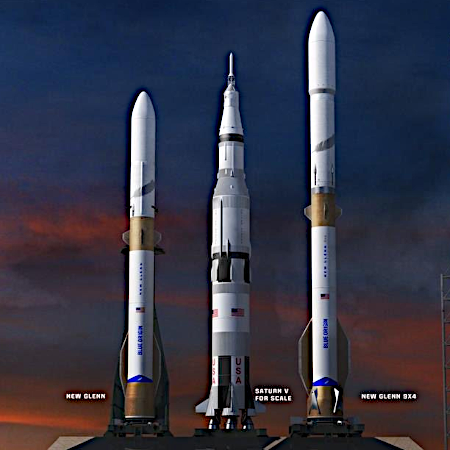
Graphic issued by Blue Origin’s CEO comparing
New Glenn to the Saturn-5. Click for source.
In an update posted today, Blue Origin announced that it is planning to begin upgrades to its New Glenn orbital rocket as soon as its very next launch early in 2026, with those upgrades eventually raising the rocket’s capabilities to that of NASA’s overpriced, cumbersome, and poorly designed SLS rocket.
One of the primary enhancements includes higher-performing engines on both stages. Total thrust for the seven BE-4 booster engines is increasing from 3.9 million lbf (17,219 kN) to 4.5 million lbf (19,928 kN). BE-4 has already demonstrated 625,000 lbf on the test stand at current propellant conditions and will achieve 640,000 lbf later this year, with propellant subcooling increasing the current thrust capability from the existing 550,000 lbf.
The total thrust of the two BE-3Us powering New Glenn’s upper stage is increasing from the original design of 320,000 lbf (1,423 kN) to 400,000 lbf (1,779 kN) thrust over the next few missions. BE-3U has already demonstrated 211,658 lbf on the test stand.
These numbers are a little more than half that put out by the Saturn-5 in the 1960s. New Glenn however has a reusable first stage, so it will cost far less to launch, and will be able to do so frequently. These changes will also make it comparable to SpaceX’s Falcon Heavy.
These engine upgrades however are only a start. Blue Origin also plans to offer a second more powerful version of New Glenn by adding two BE-4 engines to the first stage and two BE-3U engines to the upper stage.
Named after the number of engines on each stage, New Glenn 9×4, is designed for a subset of missions requiring additional capacity and performance. The vehicle carries over 70 metric tons to low-Earth orbit, over 14 metric tons direct to geosynchronous orbit, and over 20 metric tons to trans-lunar injection. Additionally, the 9×4 vehicle will feature a larger 8.7-meter fairing.
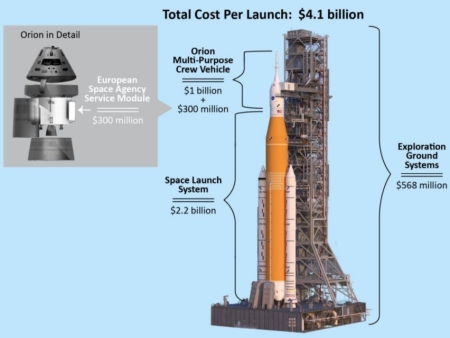
The SLS rocket’s absurd cost
These changes will make New Glenn comparable to NASA’s SLS rocket, but once again, at a far lower cost and with the ability to launch many times per year, instead of once every two years (at the very quickest). Though Blue Origin has not been as open as SpaceX about the amount it charges per launch, based on numerous sources it appears its base price is likely in the same range as SpaceX’s Falcon 9 and Falcon Heavy, ranging from $70 to $150 million, depending on payloard and customer needs. Compared to the per launch cost of SLS, as shown to the right, it is crazy NASA is still relying on SLS for its Artemis program.
It has now become quite evident that the SLS program is an utter waste of money. NASA should have switched to the Falcon Heavy years ago. It would have saved a fortune, and a manned mission to the Moon could already have taken place. With the U.S. now about to have a second private reusable rocket that matches SLS in capability but at far less cost, the logic for continuing that pork boondoggle becomes even more insane. For the cost of a single SLS launch (estimated from $4 to $14 billion depending on who you ask), NASA could launch dozens of Falcon Heavy and New Glenns, and do it NOW or in the very near future.
Whether Blue Origin will follow through as announced is of course open to doubt. The company has never moved this quickly in the past. Two factors however suggest it will this time. First, when New Glenn was first proposed more than a decade ago, this larger version was part of that announcement. The rocket was designed with them in mind from the start, which will make adding them far less difficult.
Second there is the new management culture being imposed by Blue Origin’s new CEO, David Limp. It has been very clear since his appointment in the fall of 2023 that Limp has worked hard to change that slow Blue Origin culture and get things moving. It increasingly appears he is succeeding, though the change has been slow. This announcement indicates his desire to move things even faster.

On Christmas Eve 1968 three Americans became the first humans to visit another world. What they did to celebrate was unexpected and profound, and will be remembered throughout all human history. Genesis: the Story of Apollo 8, Robert Zimmerman's classic history of humanity's first journey to another world, tells that story, and it is now available as both an ebook and an audiobook, both with a foreword by Valerie Anders and a new introduction by Robert Zimmerman.
The print edition can be purchased at Amazon or from any other book seller. If you want an autographed copy the price is $60 for the hardback and $45 for the paperback, plus $8 shipping for each. Go here for purchasing details. The ebook is available everywhere for $5.99 (before discount) at amazon, or direct from my ebook publisher, ebookit. If you buy it from ebookit you don't support the big tech companies and the author gets a bigger cut much sooner.
The audiobook is also available at all these vendors, and is also free with a 30-day trial membership to Audible.
"Not simply about one mission, [Genesis] is also the history of America's quest for the moon... Zimmerman has done a masterful job of tying disparate events together into a solid account of one of America's greatest human triumphs."--San Antonio Express-News
Graphic issued by Blue Origin’s CEO comparing
New Glenn to the Saturn-5. Click for source.
In an update posted today, Blue Origin announced that it is planning to begin upgrades to its New Glenn orbital rocket as soon as its very next launch early in 2026, with those upgrades eventually raising the rocket’s capabilities to that of NASA’s overpriced, cumbersome, and poorly designed SLS rocket.
One of the primary enhancements includes higher-performing engines on both stages. Total thrust for the seven BE-4 booster engines is increasing from 3.9 million lbf (17,219 kN) to 4.5 million lbf (19,928 kN). BE-4 has already demonstrated 625,000 lbf on the test stand at current propellant conditions and will achieve 640,000 lbf later this year, with propellant subcooling increasing the current thrust capability from the existing 550,000 lbf.
The total thrust of the two BE-3Us powering New Glenn’s upper stage is increasing from the original design of 320,000 lbf (1,423 kN) to 400,000 lbf (1,779 kN) thrust over the next few missions. BE-3U has already demonstrated 211,658 lbf on the test stand.
These numbers are a little more than half that put out by the Saturn-5 in the 1960s. New Glenn however has a reusable first stage, so it will cost far less to launch, and will be able to do so frequently. These changes will also make it comparable to SpaceX’s Falcon Heavy.
These engine upgrades however are only a start. Blue Origin also plans to offer a second more powerful version of New Glenn by adding two BE-4 engines to the first stage and two BE-3U engines to the upper stage.
Named after the number of engines on each stage, New Glenn 9×4, is designed for a subset of missions requiring additional capacity and performance. The vehicle carries over 70 metric tons to low-Earth orbit, over 14 metric tons direct to geosynchronous orbit, and over 20 metric tons to trans-lunar injection. Additionally, the 9×4 vehicle will feature a larger 8.7-meter fairing.
The SLS rocket’s absurd cost
These changes will make New Glenn comparable to NASA’s SLS rocket, but once again, at a far lower cost and with the ability to launch many times per year, instead of once every two years (at the very quickest). Though Blue Origin has not been as open as SpaceX about the amount it charges per launch, based on numerous sources it appears its base price is likely in the same range as SpaceX’s Falcon 9 and Falcon Heavy, ranging from $70 to $150 million, depending on payloard and customer needs. Compared to the per launch cost of SLS, as shown to the right, it is crazy NASA is still relying on SLS for its Artemis program.
It has now become quite evident that the SLS program is an utter waste of money. NASA should have switched to the Falcon Heavy years ago. It would have saved a fortune, and a manned mission to the Moon could already have taken place. With the U.S. now about to have a second private reusable rocket that matches SLS in capability but at far less cost, the logic for continuing that pork boondoggle becomes even more insane. For the cost of a single SLS launch (estimated from $4 to $14 billion depending on who you ask), NASA could launch dozens of Falcon Heavy and New Glenns, and do it NOW or in the very near future.
Whether Blue Origin will follow through as announced is of course open to doubt. The company has never moved this quickly in the past. Two factors however suggest it will this time. First, when New Glenn was first proposed more than a decade ago, this larger version was part of that announcement. The rocket was designed with them in mind from the start, which will make adding them far less difficult.
Second there is the new management culture being imposed by Blue Origin’s new CEO, David Limp. It has been very clear since his appointment in the fall of 2023 that Limp has worked hard to change that slow Blue Origin culture and get things moving. It increasingly appears he is succeeding, though the change has been slow. This announcement indicates his desire to move things even faster.
On Christmas Eve 1968 three Americans became the first humans to visit another world. What they did to celebrate was unexpected and profound, and will be remembered throughout all human history. Genesis: the Story of Apollo 8, Robert Zimmerman's classic history of humanity's first journey to another world, tells that story, and it is now available as both an ebook and an audiobook, both with a foreword by Valerie Anders and a new introduction by Robert Zimmerman.
The print edition can be purchased at Amazon or from any other book seller. If you want an autographed copy the price is $60 for the hardback and $45 for the paperback, plus $8 shipping for each. Go here for purchasing details. The ebook is available everywhere for $5.99 (before discount) at amazon, or direct from my ebook publisher, ebookit. If you buy it from ebookit you don't support the big tech companies and the author gets a bigger cut much sooner.
The audiobook is also available at all these vendors, and is also free with a 30-day trial membership to Audible.
"Not simply about one mission, [Genesis] is also the history of America's quest for the moon... Zimmerman has done a masterful job of tying disparate events together into a solid account of one of America's greatest human triumphs."--San Antonio Express-News
Nice writeup, Bob.
Scott Manley quips: “Can you imagine how hard it will be to go before a Senate panel right now as a nominee for NASA administrator and respond to questions about SLS without laughing?”
I think Jared is sharp enough to avoid laughing. But he went well out of his way over the year to single out Blue Origin for praise in both his private and public discourse, so . . . expect him to probably say something about this new development in his discussion with senators, and maybe he’ll hope they take the hint.
Eric Berger has an article on Ars Technica up now, too, which I only mention because he did some digging around on this question of timelines. Take it for what it is worth:
The company did not specify a timeline for the debut of the 9×4 variant. A spokesperson for the company told Ars, “We aren’t disclosing a specific timeframe today. The iterative design from our current 7×2 vehicle means we can build this rocket quickly.”
One source familiar with the company’s plans said the internal timeline would allow for the 9×4 variant of New Glenn to take flight as early as 2027.
But even if they don’t make 2027, this isn’t any less of an indictment against SLS.
I have heard enough from current and former BO employees to think that Limp could have handled the last round of layoffs a lot better than he did — it seems to have been almost random in who it kicked, and it left too many Bob Smith managers in place. Morale seems to have cratered in many teams. But it’s true that BO seems to be moving faster right now, just the same. Note that just yesterday they also revealed that Blue Origin is also working on developing a full-scale deployable aerobrake that will be useful for landing large payloads on Mars or slowing down payloads returning to Earth from the Moon. Link: https://x.com/blueorigin/status/1991251070979391796
By the way, as much as everyone is talking about what this means for SLS, we should spare a thought for its implications for ULA’s Vulcan-Centaur.
I mean, if Blue Origin’s press release is right, the 9×4 version of New Glenn will literally have twice the payload capacity to geosynchronous orbit (over 14 tons) as Vulcan in its max configuration (7 tons). And GSO is supposed to be Vulcan’s wheelhouse.
I wonder if the best time to sell ULA is now already past.
Richard M: The fact that New Glenn is reusable is the real important factor, not its payload capacity. New Glenn creates serious problems for Vulcan right now. As Blue Origin ramps up production and its launch rate, even if it doesn’t upgrade New Glenn, it will become very difficult for ULA to find customers outside the military. And even the military will rank ULA low, because it will now have two much cheaper and more capable options.
I must add that these New Glenn numbers once again illustrate the terrible harm Bob Smith did to Blue Origin and the American space industry by stifling New Glenn’s development by more than five years. Had New Glenn been launching five or even three years ago, as planned, the landscape now would be far different. The U.S. would have had two major companies with reusable rockets, both matching and beating SLS in every way. The effort now in Congress to save SLS would have been difficult if not impossible.
No matter. It is now only a matter of time before SLS/Orion goes away. I just hope it doesn’t kill people in doing so.
Well, the question mark about New Glenn as it exists *now* is not payload capacity but precision to high energy orbits, which, admittedly, Vulcan is extremely good at. But if it ends up being even close…yeah, the case for Vulcan becomes rather weak, once New Glenn is actually available to launch at any reasonable cadence.
For the moment, ULA has a great manifest to work through — over 70 launches on contract. That will keep them humming and the revenue sheets looking very nice for the next few years. But by the time we get to 2030, things start looking pretty challenging for ULA, at least on their current trajectory.
But I bet the guys at the Space Force are feeling pretty good about things right now.
Vulcan would have been a great vehicle for ULA to operate at the height of the EELV era – imagine if they could have been bringing it online not longer after they were formed in the mid-2000’s, and phased out the huge expense of operating the Atlas and Delta lines in parallel. Such a rocket could have made sense…15 years ago.
But reusable rockets are here now, in force. And ULA has to answer to two creaky legacy defense contractors who only care about extracting revenue from it, rather than a centibillionaire willing to spend what it takes to win.
That sounds nice—but SLS strength is that it has only four liquid fueled engines and could simply be re-used a different way.
You saw how painfully slow NG was already.
I hope Bezos guys know what they are doing.
I need to see it fly first.
Jeff Wright wrote, “SLS strength is that it has only four liquid fueled engines and could simply be re-used a different way.”
I highlight that one word to illustrate how divorced from reality many of your comments are when it comes to rockets and SLS in particular. Simply? So NASA and Boeing will simply snap their fingers and a new configuration of SLS will appear? Really?
It has taken Boeing and NASA fifteen years to reconfigure these used shuttle engines to fly them on SLS. Fifteen years! And you think they could do another change “simply.”
Oy.
My understanding is that part of why BO has been so slow to get to this point is that they’ve been looking forward, and were quite willing to accept delay on the initial payoffs in favor of being able to ramp up very quickly at this point. The question has always been whether they can, in fact do that. But trying to predict their pace in the near future based on what we saw before might not be the way to go. We can hope, but we’ll have to watch and see.
Logically, SLS shouldn’t be able to survive this. But of course, if logic mattered, SLS would have been dead years ago. So who knows.
But that very strength comes with huge weaknesses: 1) they’re hydrolox engines, with all the finicky issues of hydrogen leaks on the pad that comes with that, to say nothing of the need for much larger propellant tanks; 2) the previously flown RS-25 engines ended up entailing a $238 million cost overrun paid to Aerojet Rocketdyne – sorry, L3 Harris – to refurbish those used engines for reuse on SLS. That doesn’t count the $146 million per engine it will cost AJR to produce *new* RS-25’s for SLS.
For $146 million, you can basically have an entire, fully expended Falcon Heavy launch.
Jeff Wright,
Are you arguing that having only four engines is better than seven or nine? The Nine engine model is now going to be used by both SpaceX and apparently Blue Origin. It is used by both Rocket Labs rockets. These smaller engines, throttling down, are proving to be the way to go for propulsive landing, which is the future of space lift. New Glenn has shown seven will do also. Firefly’s Eclipse is going with nine. Relativity, an outsider, is going with thirteen.
OR Are you saying that the engines could be stripped from the SLS and used for something else? If so, what? They are not suitable for a rocket that lands itself. I don’t see indications that they can throttle low enough for propulsive landings.
Or, are you saying what Robert suggested, that the rocket could be re-geared for some other use? In that case, why? At that cost? And the cost to covert things. It took them how long just to get here?
Cancel the thing, stop work now, today. The Artemis II launch will be a monument to waste. And it is risky.
It stands today as a prime example to the pace of government work, made obsolete before completed, and the dedication of our Congress to sunk cost, in the name of re-election.
One more thought for Bob:
It’s a great point. And yet, that said, I am brought to mind of what Christian Davenport (author of Rocket Dreams: Musk, Bezos, and the Inside Story of the New, Trillion-Dollar Space Race, and WaPo’s space beat reporter) said in a recent interview when he was asked about Bob Smith. He said, consider the possibility that Bob Smith was put there, and kept there for as long as he was, because he was doing just what Jeff Bezos wanted.
Which is another way of saying that maybe a great deal of the blame has to go to Bezos. Perhaps if he’d been even half as hands-on with Blue Origin as Elon Musk has been at SpaceX, he would have realized just how problematic Smith’s organizational model really was.
Richard M: Of course the real blame must always fall to Jeff Bezos, who hired Smith and kept him there far longer than any responsible owner should have. It could be Bezos wasn’t paying attention at the time, and was fooled by things Smith told him. It could also be that Bezos wanted to slow things down, for reasons that completely baffle me.
Either way, Smith is gone, Bezos is now paying attention, and Blue Origin seems to finally be moving. Let us celebrate small favors!
From Mr. Zimmerman
I highlight that one word to illustrate how divorced from reality many of your comments are when it comes to rockets and SLS in particular. Simply? So NASA and Boeing will simply snap their fingers and a new configuration of SLS will appear? Really?
Starship and New Glenn are taking their time.
Again–I have always said that SLS is a semi stage-and-a-half design Musk should be building—and Boeing (at its height) nneded to do SS/SH as space freighter.
SLS needs no TPS, chopsticks. Look at how Thor grew into Delta II. I could see SLS perhaps with two pair of solids. That might be tough on the pad—but compare NG with SLS in flight. People need to quit sliming MSFC. What Boeing and the suits charge? That’s on them—and they won’t be the ones hurt by killing it.
Mr. Wright…
Oh never mind. Don’t know where to even begin. Your arguments are at odds with anything approaching reality. Keep dreaming those Marshall dreams.
At the risk of piling onto the hindsight is the only exact science argument, I offer the following:
– From an ET perspective, reusing the basic shuttle stack for a heavy lifter makes some sense
– problem is they reused SRBs rather than adopting MM Michoud’s liquid strap-ons which had been on the shelf since the mid-1980s
– they decided they liked Buran’s engines under the ET design but never wanted to do a complete ET structural redesign. Not the first time this happened in aerospace, as Boeing did the same thing with 737 Max with disastrous results
– as the complexity spiraled exponentially, they forgot the real game was to affordably turn sorties, completely ignoring an operable, and perhaps affordable, Shuttle-C option
Sadly, they opted for a solution that would keep the marching armies employed rather than a solution that would affordably turn sorties.
This isn’t that hard, guys. The fact that they made it that hard should paint them as at least incompetent and at worst the very definition of the problem (likely both). Cheers-
The Shuttle-C only made sense if you were processing and flying the Shuttle from along side it.
Jeff Wright,
You wrote: “Starship and New Glenn are taking their time.”
Really? Taking their time? Are you joking or are you trolling?
New Glenn has been going for ten years and is already working on its second version, while SLS has been going for fifteen and is still on its first version. And only a single flight, at that.
Starship was announced nine years ago and they are on their third version (fourth, if you include the change between 2016 and 2017)
SLS is only now about to fly its first operational flight, again, after fifteen years (as long as we don’t want to include the disastrous lead-up years of the Project Constellation).
Then there are the miracles that Starship has already performed, such as landing the first stage by chopstick recovery. Rather than taking three years between flights, as SLS is doing, Starship is launching multiple times per year, and is figuring out the heat tile thermal protection system that NASA gave up on with its Space Shuttle.
Every time you espouse the glories of SLS, I realize more and more that Marshall Space Flight Center is obsolete and either has to get with the modern times or be disbanded so that the NASA employees there can put their talents, skills, and knowledge to work on real rockets.
Jeff Wright,
There is simply no way any part of SLS can be rendered reusable that is economically rational.
SLS “needs” no TPS or chopsticks because those are reusability features and, as noted, SLS isn’t reusable and never will be.
“Starship and New Glenn are taking their time.”
Both have taken quite a bit less time than SLS and, even as development prototypes, both have also flown more. Both will also reach operational status during the coming year. At that point, what will you and the dwindling cadre of other SLS defenders have to say? From the standpoints of both expense and achievable cadence, SLS is simply indefensible compared to Starship and New Glenn.
The end is near for SLS. And for MSFC too, if there is any justice in the world.
All,
It would seem that improved BE-4s will have knock-on benefits for Vulcan performance as well as that of New Glenn, though that isn’t going to influence Vulcan’s – and ULA’s – long-term doom. At best, the new up-rated engines might allow Vulcan to maintain its current payload capability numbers while SMART is incorporated – if it ever is.
”These changes will make New Glenn comparable to NASA’s SLS rocket…”
Not quite. With these changes New Glenn should be able to put 70 metric tons into LEO. As currently configured SLS can do 90 metric tons. With EUS it will increase to 110 metric tons, and with the BOLO boosters it will increase to 130 metric tons.
”…instead of once every two years (at the very quickest)[for SLS].”
SLS can already launch once every two years. The second SLS has been stacked on its launch platform waiting for its payload for almost a year now. The third SLS should be ready by the end of next year but will have to sit for two years waiting again for its payload.
As for long-term cadence, Boeing says they can build core stages at the rate of one every eight months. I believe them. I’m much more skeptical about the payloads.
”For the cost of a single SLS launch (estimated from $4 to $14 billion depending on who you ask)…”
Development units and LRIP units are always more expensive. At full-rate production full-up SLSs should be under $2 billion each.
”It has now become quite evident that the SLS program is an utter waste of money.”
On this you are absolutely right. SLS and Orion are both far too expensive for what they bring to the table. They both should be killed after Artemis III.
I will pass on SLS commentary other than to say even at $2B a launch you could probably launch 10 Starships/Superheavies as expendable missions and place about 2M tons into orbit. So I just don’t see any viable need.
WRT Blue origin and New Glenn the interesting thing to me is that Blue hasn’t even mentioned trying to recover and re-use the fairings which in their case are bodaciously large and expensive. This is a first order reuse goal I would expect to be a much higher priority as the production rate for these must be close to a launcg cadence choke point too.
Finally, wrt “new versions” I don’t expect they will turn these around nearly as fast as SpaceX. The reason simply comes down to manufactuarability. As an assembly of stainless steel weldments rings in SpaceX parlance) SpaceX’s approach is FAR easier to modify without imposing massive re-tooling of the factory floor. Blue Origin instead uses very large monolithic structures machined at scale and their fairings are carbon fiber composites that require an enormous mold to lay up , and then an autoclave big enough to bake them in. All in all quite complex and lots of it very design specific.
”It has taken Boeing and NASA fifteen years to reconfigure these used shuttle engines to fly them on SLS.”
Boeing is not involved in the reconfiguration of the RS-25s. That would be Rocketdyne….er, Pratt & Whitney Rocketdyne….er, Aerojet Rocketdyne….er, where did they end up? L3Harris? Yeah, L3Harris.
”Both have taken quite a bit less time than SLS…”
Development of SLS started in 2011. Development of both Starship and New Glenn started in 2012, probably in response to SLS. SLS made orbit in 2022; New Glenn this year; Starship still hasn’t made orbit.
”I realize more and more that Marshall Space Flight Center is obsolete and either has to get with the modern times or be disbanded…”
MSFC was obsolete decades ago. The reason it was created was to design and build missiles and launch vehicles in the early Cold War and Space Race. Private industry has been doing both of those tasks faster, better, and cheaper (no need to pick only two) now since at least the late 1980s.
It should be noted that the only reason we ever had SLS was to give MSFC and Michoud something to do. Boeing didn’t want it. They wanted to use Delta IV Super Heavies. Lockheed didn’t want it. They wanted to use Atlas V Heavies. It was MSFC and ATK who wanted it. What was ATK now has GBSD. It is MSFC that is without any significant useful product.
mkent: Point well taken about Boeing. I was just listing the main contractor, but you are right, the engines have not been Boeing’s direct responsibility.
Changes nothing significant however. This rocket and program has and continues to be a bad mistake, from the get-go, in design, concept, and cost.
”…the interesting thing to me is that Blue hasn’t even mentioned trying to recover and re-use the fairings which in their case are bodaciously large and expensive. ”
Yes they have. It was in the announcement today.
”This rocket and program has and continues to be a bad mistake, from the get-go, in design, concept, and cost.”
Yes to all of those. I’ve been opposed to what became Ares I, Ares V, and SLS since the release of the 60-Day Study in 2004. None of those made any sense even in the world of Atlas V and Delta IV Heavy, let alone Falcon Heavy, New Glenn 9×4, and Starship. We should have had boots on the moon ten years ago and could have with a better program architecture.
Say what you want about these rockets from the old-timers, but Starship is completely unique:
1. It is fully reusable.
2. It leaves its landing gear on the ground, instead of wasting propellant boosting it to high altitudes where it isn’t needed and then bringing it back down again to where it is.
3. It gets its enormous capacity up out of Earth’s gravity-well, and then lets you add propellant, payload or even crew incrementally, depending on the mission.
The others are also-rans at this point.
Well, more to the point, it was the Alabama congressional delegation, and its allies in other states that stood to benefit from a NASA-operated architecture, that wanted it. Though to be sure, there were MSFC peeps who were happy to play with them in that sandbox…
I think Jared Isaacman’s advocacy of nuclear propulsion of late points to what *could* be salvaged out of MSFC, once it is forced to abandon SLS development: propulsion tech research. That will still require laying off some head count, but at least not all of it. If that’s the price to pay for getting NASA out of the launch business for good, I’m happy to pay it.
I tend to agree. But that was the fatal flaw in Shuttle-C from the perspective of Mike Griffin: He wanted The Shuttle retired for good, with a vengeance, as soon as possible. A Shuttle-C architecture makes it far easier, and more likely, that Shuttle will keep flying on those STS stacks, too, even if perhaps not at the same cadence.
But it remains the case, just the same, that if you wanted a Shuttle Serived Heavy Lift Vehicle architecture, the cheapest and quickest option was going to be Shuttle-C in some form. Yes, it would be nice to upgrade the boosters to liquid-fueled, but that would take more time and more money for an architecture you really don’t want to keep in the long-term anyway.
Richard M
Nuclear thermal propulsion (NTP) in space is a game changer.
Why would you ever need a chemical rocket to get beyond LEO.
Launch everything to LEO, transfer it to a NTP vehicle, and off it goes.
If the destination is close (inner solar system, lunar system), it can then come back and do it again.
I think they call that re-usability. Not sure if people will be okay with that.
/s
But that means big loads destined for distant targets.
To RichardM
the fatal flaw in Shuttle-C from the perspective of Mike Griffin: He wanted The Shuttle retired for good, with a vengeance, as soon as possible. A Shuttle-C architecture makes it far easier, and more likely, that Shuttle will keep flying on those STS stacks, too, even if perhaps not at the same cadence.”
I disagreed with him there–but what he wanted was COMET
https://www.youtube.com/watch?v=uSZtnRJzSBA
One thing to think about here—and that’s optics
https://x.com/michaelsrockets/status/1990875898187251736
“Who wants to go out with that skank? Not even.””
”Well, more to the point, it was the Alabama congressional delegation, and its allies in other states that stood to benefit from a NASA-operated architecture, that wanted it. Though to be sure, there were MSFC peeps who were happy to play with them in that sandbox…”
It wasn’t the congressional delegation from Alabama that was driving it. It was MSFC. By the time SLS came around both Delta IVs and Atlas Vs — the only realistic alternative to SLS at the time — were in production in Alabama. That was good for Alabama, but neither Atlas V nor Delta IV needed MSFC. MSFC needed a big project to manage, or it was going to be massively downsized if not eliminated.
SLS was pushed through Congress by a congressional staffer to — I think — Kay Bailey Hutchinson. He was receiving input directly from MSFC. The Senate didn’t come up with those detailed requirements in the NASA budget bill on its own. Those requirements came from MSFC through this staffer into the bill. The requirements were written such that only SLS could satisfy them.
A cleaner example of Pournelle’s Iron Law you could hardly find. SLS wasn’t good for the space program. It wasn’t good for America. It wasn’t even good for NASA as a whole. But it was very good for MSFC.
To be fair, SLS / Orion is actually far better and more cost effective than the Ares I / Ares V architecture that it replaced, but it’s still an order of magnitude more expensive than it needed to be. And we are still living with the consequences.
mkent,
I have to take issue with your asserted New Glenn and Starship development timelines.
Blue was working on both BE-4 and BE-3U as early as 2012, but the notional – and never built – launch vehicle they were to be used for was much smaller than New Glenn and was never named New Glenn. New Glenn, under that name, dates back to 2015.
SpaceX spitballed a lot of notional future large rockets and large engines as early as 2005, but they were all pretty much PowerPoint exercises – including, for quite some time, Falcon Heavy. A notional carbon-fiber Mars Colonial Transporter started being mentioned by SpaceX in 2012 and was described in considerable detail in 2016, by then renamed Interplanetary Transport System. Some prototype components were even constructed. But this whole project was scrapped around Oct. 2018 in favor of a smaller stainless steel vehicle called Starship. Starship first flew in 2023, about 4.5 years after project start vs. the 11+ years required to debut SLS.
Full-size Raptor engines date from about this same switch-to-stainless-and-re-do-from-scratch design point, though sub-scale proof-of-concept versions went back to a start point a few years before that. So there is a – tenuous – case to be made that Starship development should include sub-scale Raptor and MCT/ITS. But that is only reasonable if one also includes the ill-fated Constellation program in SLS’s development timeline. SLS, like Starship, is the direct descendant of a prior, bigger rocket that was canceled. If one counts the predecessor vehicle’s development history as part of the current vehicle’s development history in one case, there seems no reasonable basis not to do that for the other as well.
New Glenn took about a decade to go from concept to first flight. That is more than twice as long as Starship, but still at least a year faster than SLS. It is also fair to note that both New Glenn and Starship required a lot more new technology development than did SLS.
I know you are no SLS partisan, but to assert that the development timelines prior to first flight for SLS, New Glenn and Starship are roughly comparable is erroneous.
Richard M & Ray Van Dune,
Ditto.
Jeff,
I wasn’t aware that Griffin had any involvement in the Comet HLLV Rocket. What was his role, exactly?
Hello mkent,
Interesting, if true. I knew MSFC was a team player, so to speak, in the rebellion against Obama’s Constellation cancellation in 2010 — obviously all the detailed architecture requirements had to come from *somewhere* — but I had thought the initial spur for SLS came from elsewhere. But I suppose this makes sense. And yes, it would be a paradigmatic exemplar of Pournelle’s Law at work.
I’m sure if I did some AI googling I could come up with some nonsense, but I would rather ask here for a knowledgeable answer..
I have been a fan of nuclear propulsion since I heard about it decades ago. It always seemed like a no brainer. But speaking of no brains, the only system I can remember the mechanics of is the pebble bed reactor. Is this still on the table , or are there different options favoured these days? Any links to information on current favourite options would be much appreciated.
With all of this talk about SLS, I think we missed something important: New Glenn 9×4 isn’t meant to be an SLS killer. It’s meant to be an **H**LS killer*.
Someone on NASAspaceflight ran the numbers (which I have not verified) and found that New Glenn 9×4 has the performance to send a Blue Moon Mk I with a 2-ton crew compartment on top to lunar transfer orbit. From there Blue Moon can maneuver itself into NHRO to meet up with an Orion launched by SLS.
If the numbers hold up, it would appear Blue Origin could bypass SpaceX on Artemis III (and further Artemis flights with Blue Moon Mk II). With all of the development problems Starship is having, this could be important.
*OK, I’m being a bit hyperbolic. Not a killer, but a substitute.
sippin_bourbon,
I think Nuclear Thermal Rockets have a fairly narrow band of utility – pretty much just Mars. The Moon is too close, the inner solar system is too hot and everything else, including the Asteroid Belt, is too far.
NTRs “burn” hydrogen. If the intent is to go somewhere and stay for awhile after arrival – as opposed to just flying by – then one must save a lot of the total propellant load for deceleration to zero relative velocity at the goal terminus. That’s tricky with hydrogen and gets trickier the farther out one wants to go as well as for going sunward. It’s hard to keep hydrogen liquified in regions as warm as Venus or Mercury orbit or for as long as would be necessary if going anywhere trans-Mars.
For notional manned missions, the problem is still worse for one must also carry sufficient propellant to return and then stop a second time. The only exception would be Mars where hydrogen is available for refilling.
Nuclear Electric Propulsion is far less problematical. Argon is a lot easier to handle in quantity over long periods than is hydrogen. It’s also available for refill on Mars. And the very high ISP of NEP, compared to chemical rockets and NTRs, really comes into its own on very deep space missions.
It is also far easier to design a long-lived nuclear reactor that is optimized for electricity generation rather than being the heat source for “steam” rocketry. For long-duration unmanned orbiter missions to The Belt and outer planets and moons, NEP can also provide copious on-going power once arrived. This allows, straightforwardly, for payloads such as powerful radars.
All in all, I think Jared Isaacman is correct in wishing to prioritize development of NEP. It just has a lot more good use cases than does NTR.
mkent,
You wrote: “Development of SLS started in 2011. Development of both Starship and New Glenn started in 2012, probably in response to SLS. SLS made orbit in 2022; New Glenn this year; Starship still hasn’t made orbit.”
Nope. I’m not going to let you get away with that one. Starship was still a powerpoint presentation in 2017, and that was after it was reimagined from its larger 2016 vision, not to compete with SLS but to go farther and do more than SLS — to take men and materiel to Mars, each man for a similar price as buying a house on Earth.
If you want to put Starship development back that far, then I will make you put SLS development back to 2005 when Ares was first proposed, as it uses much of the same parts. In fact, I could and should argue that SLS development started with Space Transportation System development, since the hardware is supposed to be the same. And since SLS is also a system, where that system includes ground support hardware that existed since the 1960s, I could, but shouldn’t, argue that it goes all the way back to then.
Comparison for timelines is difficult, because the start points are not firm due to the differences in intentions — reusing established hardware and methods vs developing entirely new hardware and methods. New Shepard and Starship were ideas before they were plans or designs. It is like saying that our moonshot “Apollo” started in 1962, when it was proposed, or that it started in 1955, when the F1 engine was designed, or earlier, when we started dreaming of going to the moon, e.g. 1902 for the Georges Méliès movie, or the 1865 Jules Verne book. Using that last reckoning, it took a century to get to the Moon the first time, also with a few redesigns along the way.
Starship and New Glenn were started from scratch, from the engines to the nosecones to the ground support equipment to the manufacturing facilities, and in the case of Starship, to the test facilities. SLS, on the other hand, was intentionally designed with existing hardware so that the design and development would be quick and cheap. Where that plan went wrong is a mystery (well, not really a mystery), but SLS was neither quick nor cheap. On the other hand, it kept plenty of heritage employees employed for the past decade and a half, and it looks like they will remain employed for another half decade — at taxpayer expense (thus solving the mystery).
Wouldn’t it have been so much better if these experts in rocketry had been working for the newer startups that are turning new and innovative ideas into reality rather than build a worse version of a 1960s rocket and capsule?
“The requirements were written such that only SLS could satisfy them.”
That still makes it Congress’s fault.
___________
sippin_bourbon,
“Nuclear thermal propulsion (NTP) in space is a game changer. Why would you ever need a chemical rocket to get beyond LEO. Launch everything to LEO, transfer it to a NTP vehicle, and off it goes. If the destination is close (inner solar system, lunar system), it can then come back and do it again.”
And this could make much of Starship obsolete. We should always be searching for efficiencies like this to make spaceflight better and less expensive.
____________
Dick Eagleson wrote: “A notional carbon-fiber Mars Colonial Transporter started being mentioned by SpaceX in 2012 and was described in considerable detail in 2016, by then renamed Interplanetary Transport System. Some prototype components were even constructed.”
One prototype component was a carbon-fiber propellant tank as a part of the development process, six or seven years ago, and lessons applied from that test are why they abandoned the composite materials for Stainless.™ They can make major and minor modifications to the iterative designs much easier and faster with the steel materials.
Starship has gone through a large variety of design changes, because it is a revolutionary new kind of rocket, solving the problems of interplanetary travel in ways never even thought of before. Who was the insane person who suggested catching a returning rocket with “chopsticks,” Karate Kid style? That idea was even crazier than the flat thrust diverter under the launch pad, because everyone knew that the echo from the engines would damage the rocket and make it explode before getting off the pad.
SpaceX, some day, may go back to the carbon-fiber propellant tank idea, as Rocket Lab is doing, but right now they are still modifying the design as the development program develops. When the design settles down, the materials may be able to change, depending upon manufacturing capabilities of alternate materials.
Jeff Wright,
Comet was certainly a piece of work. It looks like a Falcon Heavy designed by a bunch of corn-country farmers. There’s a very strong whiff of “silo” about it. Interestingly, it has the same number of 1st-stage engines as Falcon 9, though distributed differently. Thanks for digging up the clip. Very entertaining.
Lee S:
You have triggered my curiosity (okay, not a high bar). I have seen reactor films of NERVA tests, where reactor elements are floating around in the flux. It looks a bit unnerving. The professional community here may differ, but I believe the lack of nuclear options is more political, than technical.
Yes, but this assumes that that either (let alone both) New Glenn 9×4 or Blue Moon Mk I will realistically be operational within the next few years.
Dave Limp has accelerated things a little, but Blue Origin is still not exactly setting records for speed.
@Blair… I’ve triggered my own curiosity also! I have a couple of quiet (hopefully! ) days to do some digging… If I unearth any interesting engineering stuff I will post back.
And regarding the political aspect… I’m sure you are correct… If memory serves me correctly ( no promises! ) I think the discussion was being had around the time of the Cassini mission launch, and the fact it was carrying plutonium caused all sorts of protests… Basically putting any nuclear propulsion proposals to bed.
Come on Bob! This is your wheelhouse.. am I even close here? I’m pretty sure there were several space show episodes discussing nuclear propulsion back in the day, but I was also pretty sure it was Monday this morning… Very happy tho when I realised it was Sunday! ;-)
More on COMET
https://web.archive.org/web/20160820174234/http://www.astronautix.com/f/firstlunaroutpost.html
https://www.autoevolution.com/news/nasas-comet-rocket-is-what-should-have-kickstarted-the-colonization-of-the-moon-186221.html
This would have been been attacked too. Even if MSFC only did nuclear propulsion, folks would still snipe at it.
Compared to the Iraq war and other endeavors, SLS costs far less.
Bezos and Musk have what may be approaching a trillion bucks–and still will be behind MSFC.
That I suspect is the real reason many want to kill SLS/Orion quickly as possible…hiding behind the aegis of safety.
Where Glenn was slow, the SRBs will get you away from the pad.
No one put real money into wet workshops like Musk did for Starship. Had the concept been funded by another billionaire, it too would rank up there with Starship ‘s audacity.
New Glenn+ really isn’t the best SLS replacement.
This is:
https://x.com/twin_sunsett/status/1993581462520840666