
China begins hurried preparations to launch rescue Shenzhou capsule to Tiangong-3
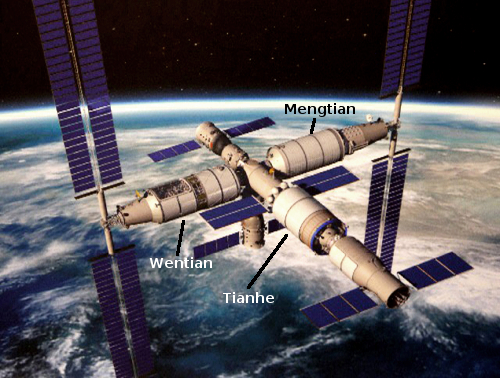
The Tiangong-3 station, as presently configured
According to China’s state run press, it has begun emergency procedures to quickly launch the Shenzhou-22 capsule — originally scheduled to carry the next crew to its Tiangong-3 station in April 2026 — in order to provide the present station crew a lifeboat and a return capsule.
The China Manned Space Agency has started preparations for the launch of an unmanned spacecraft to carry a full cargo load, including provisions for astronauts and equipment for the Tiangong space station, according to a senior engineer. Zhou Yaqiang, who works with the agency’s general technical bureau, told China Central Television on Saturday that all systems involved in the upcoming Shenzhou-22 cargo mission “are busy getting ready for it, testing the rocket and the spaceship and preparing the payloads”.
The Shenzhou-22 spacecraft will be launched in due course to dock with the Tiangong space station, the agency said.
The report provided no details on when this launch would occur, though another Chinese report said getting the rocket (a Long March 2F) and capsule ready in the next 10 to 20 days would be “difficult.”
At the moment, the three astronauts on Tiangong-3 have no lifeboat. Should anything go wrong at the station before that launch they will have no way to get back to Earth, unless they use the damaged Shenzhou-21 capsule still docked to the station. That capsule has cracks in a window, caused by what the Chinese think was an impact from “space debris.” The Chinese have already determined it is not safe for human travel. Thus, using it in an emergency would be a desperate act.
Since the first space station, Salyut-1, was launched and occupied in 1971, this is the first time that a crew has been in space with absolutely no way to get home. The press last year repeatedly claimed the Starliner crew was “stranded” on ISS, but that wasn’t so. They could have always come home on their Starliner craft, as was proven when it returned unmanned with no problems. NASA had simply made the decision to be cautious and wait for the launch of next Dragon to bring them home instead.

On Christmas Eve 1968 three Americans became the first humans to visit another world. What they did to celebrate was unexpected and profound, and will be remembered throughout all human history. Genesis: the Story of Apollo 8, Robert Zimmerman's classic history of humanity's first journey to another world, tells that story, and it is now available as both an ebook and an audiobook, both with a foreword by Valerie Anders and a new introduction by Robert Zimmerman.
The print edition can be purchased at Amazon or from any other book seller. If you want an autographed copy the price is $60 for the hardback and $45 for the paperback, plus $8 shipping for each. Go here for purchasing details. The ebook is available everywhere for $5.99 (before discount) at amazon, or direct from my ebook publisher, ebookit. If you buy it from ebookit you don't support the big tech companies and the author gets a bigger cut much sooner.
The audiobook is also available at all these vendors, and is also free with a 30-day trial membership to Audible.
"Not simply about one mission, [Genesis] is also the history of America's quest for the moon... Zimmerman has done a masterful job of tying disparate events together into a solid account of one of America's greatest human triumphs."--San Antonio Express-News
The Tiangong-3 station, as presently configured
According to China’s state run press, it has begun emergency procedures to quickly launch the Shenzhou-22 capsule — originally scheduled to carry the next crew to its Tiangong-3 station in April 2026 — in order to provide the present station crew a lifeboat and a return capsule.
The China Manned Space Agency has started preparations for the launch of an unmanned spacecraft to carry a full cargo load, including provisions for astronauts and equipment for the Tiangong space station, according to a senior engineer. Zhou Yaqiang, who works with the agency’s general technical bureau, told China Central Television on Saturday that all systems involved in the upcoming Shenzhou-22 cargo mission “are busy getting ready for it, testing the rocket and the spaceship and preparing the payloads”.
The Shenzhou-22 spacecraft will be launched in due course to dock with the Tiangong space station, the agency said.
The report provided no details on when this launch would occur, though another Chinese report said getting the rocket (a Long March 2F) and capsule ready in the next 10 to 20 days would be “difficult.”
At the moment, the three astronauts on Tiangong-3 have no lifeboat. Should anything go wrong at the station before that launch they will have no way to get back to Earth, unless they use the damaged Shenzhou-21 capsule still docked to the station. That capsule has cracks in a window, caused by what the Chinese think was an impact from “space debris.” The Chinese have already determined it is not safe for human travel. Thus, using it in an emergency would be a desperate act.
Since the first space station, Salyut-1, was launched and occupied in 1971, this is the first time that a crew has been in space with absolutely no way to get home. The press last year repeatedly claimed the Starliner crew was “stranded” on ISS, but that wasn’t so. They could have always come home on their Starliner craft, as was proven when it returned unmanned with no problems. NASA had simply made the decision to be cautious and wait for the launch of next Dragon to bring them home instead.
On Christmas Eve 1968 three Americans became the first humans to visit another world. What they did to celebrate was unexpected and profound, and will be remembered throughout all human history. Genesis: the Story of Apollo 8, Robert Zimmerman's classic history of humanity's first journey to another world, tells that story, and it is now available as both an ebook and an audiobook, both with a foreword by Valerie Anders and a new introduction by Robert Zimmerman.
The print edition can be purchased at Amazon or from any other book seller. If you want an autographed copy the price is $60 for the hardback and $45 for the paperback, plus $8 shipping for each. Go here for purchasing details. The ebook is available everywhere for $5.99 (before discount) at amazon, or direct from my ebook publisher, ebookit. If you buy it from ebookit you don't support the big tech companies and the author gets a bigger cut much sooner.
The audiobook is also available at all these vendors, and is also free with a 30-day trial membership to Audible.
"Not simply about one mission, [Genesis] is also the history of America's quest for the moon... Zimmerman has done a masterful job of tying disparate events together into a solid account of one of America's greatest human triumphs."--San Antonio Express-News
It was bound to happen to someone at some point. And so, here we are.
Here’s hoping that CMSA can get a Shenzou up there quickly – and without any damage. Honestly, it’s impressive that they are in a position to do it that fast.
What are the chances that the port’s cracking was caused by a failure, not an impact? The size of that window is very tiny compared to the overall surface area of the spacecraft (and station). Are there any other pockmarks, or just on that tiny porthole? The probabilities seem off. And is the pressure in the docked craft holding?
Ray Van Dune: China ain’t saying. It has been bluntly silent on details.
Can Dragon dock with the Chinese station?
Good question M Puckett. Since the Chinese copied the Russian designs, it is the APAS docking sytem. which is kind of compatible with the International Docking System Standard (IDSS) that pretty much everyone is using. Even India is making their docking system IDSS compliant on the Gaganyaan and BAS spacecraft, which are copies of Soyuz and Saylut/Mir stations.
Not many people know if China’s docking system is compatible with IDSS, but I bet it is with modifications.
Getting a replacement capsule up to the station ASAP to handle any emergency is obviously the priority. Even if the odds of needing a lifeboat are low, they clearly and sensibly don’t want to take that risk. But I’m curious what impact that will have on the NEXT mission. They’ve effectively discarded one capsule as unsafe to use, then used the one slated for the next crew rotation as the back-up, and will be using the one slated for the crew rotation after that for the current mission. How long will it take them to refill the pipeline? Will they be able to build and prepare the capsules and rockets to stay on a normal crew rotation schedule, is a crew going to do a long mission, or will they end up having to leave the station uncrewed for a few months sometime soon?
We were likely lucky that none of the ISS assembly missions that the Space Shuttle flew in 2005-2011 sustained compromising damage to its heat shield or wings on launch — NASA calculates that the odds of a loss of crew event were 1 in 90 at this point, and loss of mission even worse — but if it had, those astronauts would have been in the same position as the Chinese taikonauts. Because even though NASA had instituted “launch on need” (LON) Shuttles to fly up for a rescue on short notice, with the idea that the astronauts would at least be able to use the station as a “safe haven.” But they’d still have had to wait 40 days for that rescue, and in the meantime, they’d be toast if the station sustained any serious damage.
It was better than nothing, I suppose, but it is one more reason we should be thankful we’re flying Crew Dragon now and not the Shuttle.
Any pictures of the damage.
pzatchok: No. As I said, China’s state-run press has been robustly lacking in details.
I figured that if they let hem out you would find them. thanks.
Shenzhou-22 is currently scheduled to launch November 24th our time.
”Can Dragon dock with the Chinese station?”
No.
They have a lot of brands in the fire. They could easily be much farther ahead had they simply embraced hypergolics.
RD-270 is similar to Raptor, yet needs no spark plug, as it were.
Nine of those and they could have had an SHLLV 20 years ago had they not diversified. They believe in having good rocketry across the board, but that should have waited.
Had they went to the Moon earlier, we would have responded earlier and the current political mess avoided.
I bet some spy/intelligence organization out there has the plans for the Chinese docking collar.
I bet someone could even buy it from someone in China if they had to.
I wonder if the Russians have the plans.
It could even be possible that an adapter is already made and sitting on someones shelf just in case.
You could also assume that someone is sitting on the radio traffic between the station and China.
Come on man We can hide alien spaceships and the fact that Trump is really a South American Drug lord eliminating his rivals. Why not a little radio interception.
Jeff Wright,
The PRC has “embraced” hypergolics for decades. Its newer rockets are all LOX-hydrocarbon (kerosene or methane) as the sea-level ISPs are better and the propellants are much cheaper.
You seem to assume the PRC could have arranged access to the RD-270 tech two or more decades ago. Why do you think that? For that matter, why do you think the PRC could have gone to the Moon earlier?