
China completes launch abort test of Mengzhou capsule; also vertically lands Long March 10A 1st stage in ocean
Click for source.
China today completed a major test for its future manned lunar program. In launch for the first time the first stage of its new Long March 10A, it not only succeeded in completing a launch abort of its next generation Mengzhou manned capsule — intended not only for its space station but for its manned lunar program — the first stage successfully completed a vertical soft splashdown in the ocean.
The uncrewed vessel took off from the Wenchang Satellite Launch Centre on the southern island of Hainan aboard a Long March-10 prototype test rocket at 11am on Wednesday.
The Mengzhou vessel separated from the rocket shortly after launch, before splashing down in the ocean at its designated landing spot, according to the China Aerospace Science and Technology Corporation (CASC).
The first stage of the Long March-10 rocket also safely splashed down in its designated ocean landing spot, CASC said. The state-owned aerospace contractor developed both the rocket and the crewed spacecraft.
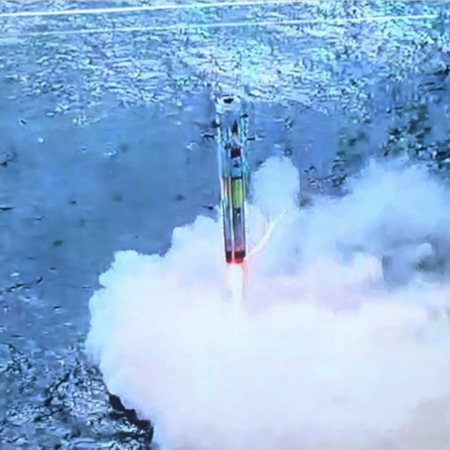
Courtesy of BtB’s stringer Jay, video of the launch can be seen here. Jay also found two additional images, one showing the stage just before splashdown standing vertical (as shown in the picture to the right) and the other of the stage floating in the water just before it was picked up by a recovery vessel. According to comments at these tweets, it is speculated that the interstage unit that connected the capsule to the stage was either ejected at landing or was torn off when the stage hit the water.
This is a major achievement for China. It gets it closer to being able to use Mengzhou for longer missions to places like the Moon.
The modular Mengzhou spacecraft has two variants: a seven-astronaut near-Earth model designed to support the country’s Tiangong space station and a model with a smaller crew capacity for missions to the moon. The latter is expected to work in tandem with the Lanyue lunar surface lander, designed to carry two astronauts to the moon’s surface.
The soft splashdown of the Long March 10A first stage also gets China closer to its first reuse of a rocket.
I must note that this success is part of a larger story about China’s space industry that is not so hopeful.
Since the failure on January 17, 2026 of the first launch of the Ceres-3 rocket, built by the pseudo-company Galactic Energy, there has been a pause in all Chinese pseudo-company launches. Every launch since has been a government-built Long March rocket run by a government agency.

China’s communists to its citizens “Nice business you got here.
Shame if something happened to it.”
This pause might be simply a scheduling issue, but I think not. What I think has happened is that the new agency the Chinese government created in November to supervise its pseudo-companies has shut everything down to establish its control, using as an excuse not simply that January 17th failure, but two other failures last year by these pseudo-companies (in August and November). The Ceres-3 failure was not unexpected, as it was the rocket’s maiden flight. The other two failures however were of rockets that had launched previously.
As these are all pseudo-companies, allowed to operate independently solely at the discretion of this authoritarian top-down communist government, I have been expected that government to eventually want to lay its hands on these companies for its own reasons of power and control, a suspicion that was strengthened when that government created that supervisory agency in November. This could be happening now.
The launch pause links to this Long March 10A vertical landing in that several of these pseudo-companies had been developing this vertical landing technology, and were saying they were going to do their first landing attempts this year. These companies however were required to share that technology with each other and the government. That China’s government has now attempted a first stage landing with both its Long March 12A in December and today with its Long March 10A suggests to me that it might have gotten what it wants from these companies, and is in the process of absorbing them back into the government.
I could be wrong, but I suspect something akin to this is happening. If I am right, however, it bodes ill for China’s long term space effort, as a consolidation into the government of its pseudo-competitive industry will squelch innovation and development significantly.

On Christmas Eve 1968 three Americans became the first humans to visit another world. What they did to celebrate was unexpected and profound, and will be remembered throughout all human history. Genesis: the Story of Apollo 8, Robert Zimmerman's classic history of humanity's first journey to another world, tells that story, and it is now available as both an ebook and an audiobook, both with a foreword by Valerie Anders and a new introduction by Robert Zimmerman.
The print edition can be purchased at Amazon or from any other book seller. If you want an autographed copy the price is $60 for the hardback and $45 for the paperback, plus $8 shipping for each. Go here for purchasing details. The ebook is available everywhere for $5.99 (before discount) at amazon, or direct from my ebook publisher, ebookit. If you buy it from ebookit you don't support the big tech companies and the author gets a bigger cut much sooner.
The audiobook is also available at all these vendors, and is also free with a 30-day trial membership to Audible.
"Not simply about one mission, [Genesis] is also the history of America's quest for the moon... Zimmerman has done a masterful job of tying disparate events together into a solid account of one of America's greatest human triumphs."--San Antonio Express-News
Click for source.
China today completed a major test for its future manned lunar program. In launch for the first time the first stage of its new Long March 10A, it not only succeeded in completing a launch abort of its next generation Mengzhou manned capsule — intended not only for its space station but for its manned lunar program — the first stage successfully completed a vertical soft splashdown in the ocean.
The uncrewed vessel took off from the Wenchang Satellite Launch Centre on the southern island of Hainan aboard a Long March-10 prototype test rocket at 11am on Wednesday.
The Mengzhou vessel separated from the rocket shortly after launch, before splashing down in the ocean at its designated landing spot, according to the China Aerospace Science and Technology Corporation (CASC).
The first stage of the Long March-10 rocket also safely splashed down in its designated ocean landing spot, CASC said. The state-owned aerospace contractor developed both the rocket and the crewed spacecraft.
Courtesy of BtB’s stringer Jay, video of the launch can be seen here. Jay also found two additional images, one showing the stage just before splashdown standing vertical (as shown in the picture to the right) and the other of the stage floating in the water just before it was picked up by a recovery vessel. According to comments at these tweets, it is speculated that the interstage unit that connected the capsule to the stage was either ejected at landing or was torn off when the stage hit the water.
This is a major achievement for China. It gets it closer to being able to use Mengzhou for longer missions to places like the Moon.
The modular Mengzhou spacecraft has two variants: a seven-astronaut near-Earth model designed to support the country’s Tiangong space station and a model with a smaller crew capacity for missions to the moon. The latter is expected to work in tandem with the Lanyue lunar surface lander, designed to carry two astronauts to the moon’s surface.
The soft splashdown of the Long March 10A first stage also gets China closer to its first reuse of a rocket.
I must note that this success is part of a larger story about China’s space industry that is not so hopeful.
Since the failure on January 17, 2026 of the first launch of the Ceres-3 rocket, built by the pseudo-company Galactic Energy, there has been a pause in all Chinese pseudo-company launches. Every launch since has been a government-built Long March rocket run by a government agency.
China’s communists to its citizens “Nice business you got here.
Shame if something happened to it.”
This pause might be simply a scheduling issue, but I think not. What I think has happened is that the new agency the Chinese government created in November to supervise its pseudo-companies has shut everything down to establish its control, using as an excuse not simply that January 17th failure, but two other failures last year by these pseudo-companies (in August and November). The Ceres-3 failure was not unexpected, as it was the rocket’s maiden flight. The other two failures however were of rockets that had launched previously.
As these are all pseudo-companies, allowed to operate independently solely at the discretion of this authoritarian top-down communist government, I have been expected that government to eventually want to lay its hands on these companies for its own reasons of power and control, a suspicion that was strengthened when that government created that supervisory agency in November. This could be happening now.
The launch pause links to this Long March 10A vertical landing in that several of these pseudo-companies had been developing this vertical landing technology, and were saying they were going to do their first landing attempts this year. These companies however were required to share that technology with each other and the government. That China’s government has now attempted a first stage landing with both its Long March 12A in December and today with its Long March 10A suggests to me that it might have gotten what it wants from these companies, and is in the process of absorbing them back into the government.
I could be wrong, but I suspect something akin to this is happening. If I am right, however, it bodes ill for China’s long term space effort, as a consolidation into the government of its pseudo-competitive industry will squelch innovation and development significantly.
On Christmas Eve 1968 three Americans became the first humans to visit another world. What they did to celebrate was unexpected and profound, and will be remembered throughout all human history. Genesis: the Story of Apollo 8, Robert Zimmerman's classic history of humanity's first journey to another world, tells that story, and it is now available as both an ebook and an audiobook, both with a foreword by Valerie Anders and a new introduction by Robert Zimmerman.
The print edition can be purchased at Amazon or from any other book seller. If you want an autographed copy the price is $60 for the hardback and $45 for the paperback, plus $8 shipping for each. Go here for purchasing details. The ebook is available everywhere for $5.99 (before discount) at amazon, or direct from my ebook publisher, ebookit. If you buy it from ebookit you don't support the big tech companies and the author gets a bigger cut much sooner.
The audiobook is also available at all these vendors, and is also free with a 30-day trial membership to Audible.
"Not simply about one mission, [Genesis] is also the history of America's quest for the moon... Zimmerman has done a masterful job of tying disparate events together into a solid account of one of America's greatest human triumphs."--San Antonio Express-News
All: I notice no one has commented on my analysis of China’s space industry below the fold of this post. Have I hidden it too successfully?
Robert Zimmerman,
Given how much squelching is going on in other sectors within the PRC these days, your speculation anent its “commercial” space sector could easily be true. Pooh Bear seems more than usually peevish lately and such types usually shorten the reins across the board at such times.
Unlike how Kurita turned tail at Leyte, China shows no sign of backing off—“Novel Bond Coat Material Enables Thermal Barrier Coatings To Operate At 1,200 C°”
If hexanitrogen can somehow be used as a monopropellant, such coatings might last longer as exhaust liners where no hot oxygen exists to attack materials.