
Commercial changes at France’s French Guiana spaceport
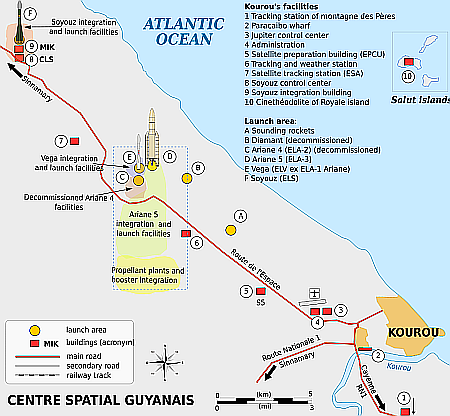
The French Guiana spaceport. The Diamant launchsite is labeled “B.”
Click for full resolution image. (Note: The Ariane-5 pad is now the
Ariane-6 pad.)
Once France’s space agency CNES regained control of its spaceport in French Guiana several years ago from the European Space Agency’s (ESA) commercial pseudo-company Arianespace, it has moved aggressively to make that spaceport attractive to the new European rocket startups.
Beginning in 2022, it began to sign deals with every one of those rocket startups to allow them to establish launch facilities at the spaceport using several long abandoned pads, including the French Diamant rocket site not used for decades as well as the Soyuz launch site unused due to Russia’s invasion of the Ukraine.
CNES decided to standardize Diamant for multiple rocket companies, while leasing the Soyuz site to one.
In a news story today, it appears the startup MaiaSpace, a wholly owned subsidiary of the much larger aerospace company ArianeGroupk, has shifted its launch plans at French Guiana. Initially it was going to launch its rocket from the Diamant pad. In 2024 however it won the contract to use the Soyuz pad, and it has now withdrawn its plans to use Diamant entirely.
CNES has therefore put out a call to the European rocket industry to fill this slot at Diamant. At present Isar Aerospace, PLD Space, Rocket Factory Augsburg, and Latitude have agreements to use Diamant, though only Latitude and PLD had done any development work on their facilities there.
As far as I know, these companies comprise the entire cadre of new European rocket startups, so I don’t know what other users CNES hopes to find. Furthermore, CNES had wanted to standardize the launch site for everyone, and the companies had balked at that idea. PLD got a deal to use its own pad at Diamant. I suspect the reason Isar and Rocket Factory have done little there is because they want their own facilities as well.
Either way, French Guiana is moving the direction of supporting competitive commercial operations, and that is a very good thing.

On Christmas Eve 1968 three Americans became the first humans to visit another world. What they did to celebrate was unexpected and profound, and will be remembered throughout all human history. Genesis: the Story of Apollo 8, Robert Zimmerman's classic history of humanity's first journey to another world, tells that story, and it is now available as both an ebook and an audiobook, both with a foreword by Valerie Anders and a new introduction by Robert Zimmerman.
The print edition can be purchased at Amazon or from any other book seller. If you want an autographed copy the price is $60 for the hardback and $45 for the paperback, plus $8 shipping for each. Go here for purchasing details. The ebook is available everywhere for $5.99 (before discount) at amazon, or direct from my ebook publisher, ebookit. If you buy it from ebookit you don't support the big tech companies and the author gets a bigger cut much sooner.
The audiobook is also available at all these vendors, and is also free with a 30-day trial membership to Audible.
"Not simply about one mission, [Genesis] is also the history of America's quest for the moon... Zimmerman has done a masterful job of tying disparate events together into a solid account of one of America's greatest human triumphs."--San Antonio Express-News

The French Guiana spaceport. The Diamant launchsite is labeled “B.”
Click for full resolution image. (Note: The Ariane-5 pad is now the
Ariane-6 pad.)
Once France’s space agency CNES regained control of its spaceport in French Guiana several years ago from the European Space Agency’s (ESA) commercial pseudo-company Arianespace, it has moved aggressively to make that spaceport attractive to the new European rocket startups.
Beginning in 2022, it began to sign deals with every one of those rocket startups to allow them to establish launch facilities at the spaceport using several long abandoned pads, including the French Diamant rocket site not used for decades as well as the Soyuz launch site unused due to Russia’s invasion of the Ukraine.
CNES decided to standardize Diamant for multiple rocket companies, while leasing the Soyuz site to one.
In a news story today, it appears the startup MaiaSpace, a wholly owned subsidiary of the much larger aerospace company ArianeGroupk, has shifted its launch plans at French Guiana. Initially it was going to launch its rocket from the Diamant pad. In 2024 however it won the contract to use the Soyuz pad, and it has now withdrawn its plans to use Diamant entirely.
CNES has therefore put out a call to the European rocket industry to fill this slot at Diamant. At present Isar Aerospace, PLD Space, Rocket Factory Augsburg, and Latitude have agreements to use Diamant, though only Latitude and PLD had done any development work on their facilities there.
As far as I know, these companies comprise the entire cadre of new European rocket startups, so I don’t know what other users CNES hopes to find. Furthermore, CNES had wanted to standardize the launch site for everyone, and the companies had balked at that idea. PLD got a deal to use its own pad at Diamant. I suspect the reason Isar and Rocket Factory have done little there is because they want their own facilities as well.
Either way, French Guiana is moving the direction of supporting competitive commercial operations, and that is a very good thing.
On Christmas Eve 1968 three Americans became the first humans to visit another world. What they did to celebrate was unexpected and profound, and will be remembered throughout all human history. Genesis: the Story of Apollo 8, Robert Zimmerman's classic history of humanity's first journey to another world, tells that story, and it is now available as both an ebook and an audiobook, both with a foreword by Valerie Anders and a new introduction by Robert Zimmerman.
The print edition can be purchased at Amazon or from any other book seller. If you want an autographed copy the price is $60 for the hardback and $45 for the paperback, plus $8 shipping for each. Go here for purchasing details. The ebook is available everywhere for $5.99 (before discount) at amazon, or direct from my ebook publisher, ebookit. If you buy it from ebookit you don't support the big tech companies and the author gets a bigger cut much sooner.
The audiobook is also available at all these vendors, and is also free with a 30-day trial membership to Audible.
"Not simply about one mission, [Genesis] is also the history of America's quest for the moon... Zimmerman has done a masterful job of tying disparate events together into a solid account of one of America's greatest human triumphs."--San Antonio Express-News
Nationalism perhaps plays a role here…nothing as Eurospace as Diamant after all. That and maybe, just maybe–they see R-7 coming back perhaps…some hoping the war concludes….preferring to work with Ivan than the US so they can all be part of the League of Calamitous Elon-cursers or whatever.
In terms of R-7 not having a pad….it might actually be easier for Russia to re-think killing Proton and put Soyuz capsules atop it. That was done in part with the Zonds….the closest the USSR ever came to replicate Saturn IB.
Zond doesn’t have a giant rolling ashtray under it, so.
Jeff Wright,
You’re projecting your unaccountable enthusiasm for antique Soviet rocketry onto Europeans who definitely do not share it. The R-7 is never coming back to Kourou.
Separately, why would the Russians use Protons, which are much more expensive than R-7s, to launch Soyuz capsules? The only remaining use case for Soyuz capsules is crew rotation to and from ISS. The Russian manned space program is barely scraping by now even with reduced mission frequency. Adding pointless expense is a non-starter.
That giant tray is quite a piece of work. Angara will (eventually) replace R-7 and Proton both. Having Soyuz atop UR-500s that remain might be an apple Putin can toss their way.
As for what Europe gets up to….that seems to change with the winds.
Jeff Wright,
At least you are consistent – your fine disregard for financial realities is as evident in your speculations about Russia as they are about US efforts.
Angara, I fear, will never replace the R-7 and Proton because the relevant models are more expensive than either predecessor. Russia is more cash-strapped by the day as the shadow fleet tankers are incrementally seized and interned. In fact, Russia as a functioning nation-state, may not make it into the next decade – perhaps not even the next year. Thus, there is a huge question mark attending any speculation about future Russian space activity.
I generally agree about the fecklessness of Europe when it comes to space. There are a few signs of their getting their space act together, but, even so, they are falling further and further behind the US and even the PRC. I don’t foresee any obvious fix for that.