Computer model: A thin ice cap can preserve liquid water on Mars
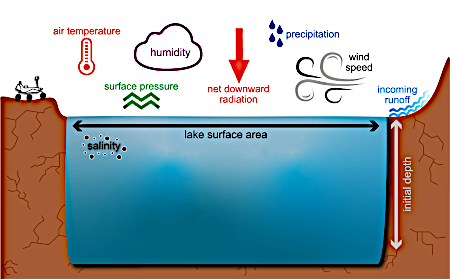
Figure 1 of the paper, showing the parameters
used in the computer model
Using a computer model, scientists have found that a thin cap of ice can act to allow liquid water to exist in lakes on Mars, for extended periods of time.
You can read their paper here. From the abstract:
Working at a localized scale, we combine climate input from the Mars Weather Research & Forecasting general circulation model with geologic constraints from Curiosity rover observations to identify potential climatic conditions required to maintain a seasonally ice-free lake. Our results show that an initially small lake system (10 m deep) with ∼50 mm monthly water input and seasonal ice cover would retain seasonal liquid water for over 100 years, demonstrating conditions close to long-term lake survivability.
From the press release:
In some simulations, the lakes completely froze during colder seasons, whereas in others, the lakes remained liquid and were covered by a thin layer of ice instead of freezing solid. This thin ice acted as an insulating lid, significantly reducing water loss while still allowing sunlight to warm the lake ice during warmer months. As a result of this seasonal cycling, some simulated lakes barely changed in depth over decades, suggesting that they could be stable for longer durations even with average air temperatures below freezing for much of the time.
Because this research is based on computer modeling, it carries great uncertainties. At the same time, it seems to explain the puzzling nature of Martian geology, which has repeatedly suggested the existence of liquid water in the past on a planet that has always been too cold with too thin an atmosphere for liquid water to exist. Data has also suggested that pockets of liquid water might have existed at the base of glaciers. This research aligns with that data.

On Christmas Eve 1968 three Americans became the first humans to visit another world. What they did to celebrate was unexpected and profound, and will be remembered throughout all human history. Genesis: the Story of Apollo 8, Robert Zimmerman's classic history of humanity's first journey to another world, tells that story, and it is now available as both an ebook and an audiobook, both with a foreword by Valerie Anders and a new introduction by Robert Zimmerman.
The print edition can be purchased at Amazon or from any other book seller. If you want an autographed copy the price is $60 for the hardback and $45 for the paperback, plus $8 shipping for each. Go here for purchasing details. The ebook is available everywhere for $5.99 (before discount) at amazon, or direct from my ebook publisher, ebookit. If you buy it from ebookit you don't support the big tech companies and the author gets a bigger cut much sooner.
The audiobook is also available at all these vendors, and is also free with a 30-day trial membership to Audible.
"Not simply about one mission, [Genesis] is also the history of America's quest for the moon... Zimmerman has done a masterful job of tying disparate events together into a solid account of one of America's greatest human triumphs."--San Antonio Express-News
Figure 1 of the paper, showing the parameters
used in the computer model
Using a computer model, scientists have found that a thin cap of ice can act to allow liquid water to exist in lakes on Mars, for extended periods of time.
You can read their paper here. From the abstract:
Working at a localized scale, we combine climate input from the Mars Weather Research & Forecasting general circulation model with geologic constraints from Curiosity rover observations to identify potential climatic conditions required to maintain a seasonally ice-free lake. Our results show that an initially small lake system (10 m deep) with ∼50 mm monthly water input and seasonal ice cover would retain seasonal liquid water for over 100 years, demonstrating conditions close to long-term lake survivability.
From the press release:
In some simulations, the lakes completely froze during colder seasons, whereas in others, the lakes remained liquid and were covered by a thin layer of ice instead of freezing solid. This thin ice acted as an insulating lid, significantly reducing water loss while still allowing sunlight to warm the lake ice during warmer months. As a result of this seasonal cycling, some simulated lakes barely changed in depth over decades, suggesting that they could be stable for longer durations even with average air temperatures below freezing for much of the time.
Because this research is based on computer modeling, it carries great uncertainties. At the same time, it seems to explain the puzzling nature of Martian geology, which has repeatedly suggested the existence of liquid water in the past on a planet that has always been too cold with too thin an atmosphere for liquid water to exist. Data has also suggested that pockets of liquid water might have existed at the base of glaciers. This research aligns with that data.
On Christmas Eve 1968 three Americans became the first humans to visit another world. What they did to celebrate was unexpected and profound, and will be remembered throughout all human history. Genesis: the Story of Apollo 8, Robert Zimmerman's classic history of humanity's first journey to another world, tells that story, and it is now available as both an ebook and an audiobook, both with a foreword by Valerie Anders and a new introduction by Robert Zimmerman.
The print edition can be purchased at Amazon or from any other book seller. If you want an autographed copy the price is $60 for the hardback and $45 for the paperback, plus $8 shipping for each. Go here for purchasing details. The ebook is available everywhere for $5.99 (before discount) at amazon, or direct from my ebook publisher, ebookit. If you buy it from ebookit you don't support the big tech companies and the author gets a bigger cut much sooner.
The audiobook is also available at all these vendors, and is also free with a 30-day trial membership to Audible.
"Not simply about one mission, [Genesis] is also the history of America's quest for the moon... Zimmerman has done a masterful job of tying disparate events together into a solid account of one of America's greatest human triumphs."--San Antonio Express-News
I have just had a thought.
Does the Mars soil stop water from sinking deep.
Will it even hold a significant amount of water on the surface?
In the past yes there was just more water but now today?
Mars surface has been impacted and pulverized. So I’m thinking that even though it has 1/3 the gravity of earth, any water or ice on the surface would be soaked up like a sponge.
When Helenus Impact occurred would have been covered in dirt and material that filled the atmosphere. A atmosphere thick enough to raise air pressure to melt and saturate the soil deep under the comets muddy rain.
Deep frozen now, releasing just enough gases to maintain 7 mbar of pressure to replace what the solar wind carries away. (Ice boils at 6 mbar in near vacuum)
The solar wind “carries away” a mere 1-2 kg/s of the martian atmosphere. It’s a slow process taking many millions of years. Humans could easily make up for the rate of loss.
I will reiterate that Mars will likely be the cheapest source of water in the Inner System.
If this is their direction, a suggestion would be to take a look at lakes in the cold country. Some freeze solid. Some don’t. Ice fishermen pull a lot of fish through holes in ice during the winter. Use the models to describe what you see from year to year.
Up here in ANC, it is not uncommon for a yard (or meter) if ice to form on a lake over the course of the winter. Most lakes are deep enough to preserve the fish (and associated plant and food species) throughout the winter. Few freeze to the point where all the fish die, which happens from time to time on the shallow lakes. Ice thickness varies based on how harsh the winters are. Even the Prudhoe Bay oilfields have fish that overwinter, though they tend to do that in streams rather than the shallow lakes up there. Cheers –
agimarc: Scientists have already begun doing what you suggest. See this paper for instance:
https://agupubs.onlinelibrary.wiley.com/doi/full/10.1029/2020JE006530?campaign=wolacceptedarticle
I posted about its results in 2021.
The researchers doing this work repeatedly refer back to Earth comparables. Sometimes that helps. Other times it distorts their view, as Earth is NOT Mars.
If a colony could be established on Mars drawing water from Mars then over the next thousand years I can see many hundreds in not thousands of asteroids being dropped on Mars to bring more water and mass..
I would like to see a water extraction experiment on Mars to see if water could be pulled from the atmosphere.
You know sort of like those Star Wars evaporators.
Not much need for “pulling water out of the atmosphere” when there’s so much of it lying around the surface as glaciers in the mid-latitudes.
Transportation.
A thousand miles is way farther on Mars than on the nice safe Earth.
A gallon a day with full recycling would be more than enough. Plus it can be automated to store it for a monthly or annual recovery. And be fully solar powered. And add in the fact it can be dropped on the planet and left alone for years until people actually get there.
Grand ideas will take decades. Small ideas can be done very fast and soon.