Computer simulations suggest Jupiter and Saturn have fundamentally different interiors
The uncertainty of science: In attempting to explain why the polar vortexes of Jupiter and Saturn are so different, scientists running large computer simulations have found that the difference could be because Jupiter’s interior is “softer” than Saturn’s.
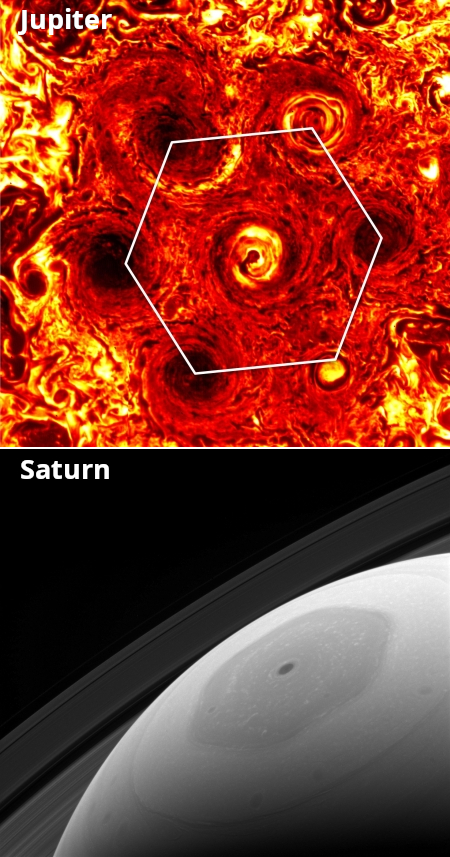
The two images to the right illustrate the different polar vortexes of both planets. Jupiter’s (top) is made up of multiple chaotic small storms that form a hexagon-like ring around the pole. Saturn’s (bottom) is a single very coherent hexagon-shaped storm.
Over multiple different simulations, they observed that some scenarios evolved to form a single large polar vortex, like Saturn, whereas others formed multiple smaller vortices, like Jupiter. After analyzing the combinations of parameters and variables in each scenario and how they related to the final outcome, they landed on a single mechanism to explain whether a single or multiple vortices evolve: As random fluid motions start to coalesce into individual vortices, the size to which a vortex can grow is limited by how soft the bottom of the vortex is. The softer, or lighter the gas is that is rotating at the bottom of a vortex, the smaller the vortex is in the end, allowing for multiple smaller-scale vortices to coexist at a planet’s pole, similar to those on Jupiter.
Conversely, the harder or denser a vortex bottom is, the larger the system can grow, to a size where eventually it can follow the planet’s curvature as a single, planetary-scale vortex, like the one on Saturn.
If this mechanism is indeed what is at play on both gas giants, it would suggest that Jupiter could be made of softer, lighter material, while Saturn may harbor heavier stuff in its interior.
This conclusion however runs completely counter to what we should expect. Jupiter has a much great mass, and one would assume from this that its interior would therefore be denser and thus harder.

On Christmas Eve 1968 three Americans became the first humans to visit another world. What they did to celebrate was unexpected and profound, and will be remembered throughout all human history. Genesis: the Story of Apollo 8, Robert Zimmerman's classic history of humanity's first journey to another world, tells that story, and it is now available as both an ebook and an audiobook, both with a foreword by Valerie Anders and a new introduction by Robert Zimmerman.
The print edition can be purchased at Amazon or from any other book seller. If you want an autographed copy the price is $60 for the hardback and $45 for the paperback, plus $8 shipping for each. Go here for purchasing details. The ebook is available everywhere for $5.99 (before discount) at amazon, or direct from my ebook publisher, ebookit. If you buy it from ebookit you don't support the big tech companies and the author gets a bigger cut much sooner.
The audiobook is also available at all these vendors, and is also free with a 30-day trial membership to Audible.
"Not simply about one mission, [Genesis] is also the history of America's quest for the moon... Zimmerman has done a masterful job of tying disparate events together into a solid account of one of America's greatest human triumphs."--San Antonio Express-News
The uncertainty of science: In attempting to explain why the polar vortexes of Jupiter and Saturn are so different, scientists running large computer simulations have found that the difference could be because Jupiter’s interior is “softer” than Saturn’s.
The two images to the right illustrate the different polar vortexes of both planets. Jupiter’s (top) is made up of multiple chaotic small storms that form a hexagon-like ring around the pole. Saturn’s (bottom) is a single very coherent hexagon-shaped storm.
Over multiple different simulations, they observed that some scenarios evolved to form a single large polar vortex, like Saturn, whereas others formed multiple smaller vortices, like Jupiter. After analyzing the combinations of parameters and variables in each scenario and how they related to the final outcome, they landed on a single mechanism to explain whether a single or multiple vortices evolve: As random fluid motions start to coalesce into individual vortices, the size to which a vortex can grow is limited by how soft the bottom of the vortex is. The softer, or lighter the gas is that is rotating at the bottom of a vortex, the smaller the vortex is in the end, allowing for multiple smaller-scale vortices to coexist at a planet’s pole, similar to those on Jupiter.
Conversely, the harder or denser a vortex bottom is, the larger the system can grow, to a size where eventually it can follow the planet’s curvature as a single, planetary-scale vortex, like the one on Saturn.
If this mechanism is indeed what is at play on both gas giants, it would suggest that Jupiter could be made of softer, lighter material, while Saturn may harbor heavier stuff in its interior.
This conclusion however runs completely counter to what we should expect. Jupiter has a much great mass, and one would assume from this that its interior would therefore be denser and thus harder.
On Christmas Eve 1968 three Americans became the first humans to visit another world. What they did to celebrate was unexpected and profound, and will be remembered throughout all human history. Genesis: the Story of Apollo 8, Robert Zimmerman's classic history of humanity's first journey to another world, tells that story, and it is now available as both an ebook and an audiobook, both with a foreword by Valerie Anders and a new introduction by Robert Zimmerman.
The print edition can be purchased at Amazon or from any other book seller. If you want an autographed copy the price is $60 for the hardback and $45 for the paperback, plus $8 shipping for each. Go here for purchasing details. The ebook is available everywhere for $5.99 (before discount) at amazon, or direct from my ebook publisher, ebookit. If you buy it from ebookit you don't support the big tech companies and the author gets a bigger cut much sooner.
The audiobook is also available at all these vendors, and is also free with a 30-day trial membership to Audible.
"Not simply about one mission, [Genesis] is also the history of America's quest for the moon... Zimmerman has done a masterful job of tying disparate events together into a solid account of one of America's greatest human triumphs."--San Antonio Express-News
Interesting that the dark area around Saturn’s pole is also hexagon-shaped
Perhaps Saturn is transjupitering…
“The softer, or lighter the gas is that is rotating at the bottom of a vortex, the smaller the vortex is in the end…”
Strange wording. Are they referring to ambient gas pressure or composition or what? Perhaps a less soft, light understanding of physics would help.
“Jupiter has a much great mass, and one would assume from this that its interior would therefore be denser and thus harder.”
I agree with your conclusion.
Saturn, although very large, has only 1/10 more gravity than earth. Jupiter has 2 1/2 times earths gravity.
That means Saturn is a ball of fluff with a very thick atmosphere, storms on its surface will be difficult to see beneath all that upper haze. I guess at the polar vortex is just one storm. Driven and discolored by the magnetic field.
Jupiter not only has more gravity making the atmosphere more dense quicker, it has enough air pressure to create a layer of plasma which drives it storm systems and creates its surface heat/and strong magnetic field.
Surface vortex will not extend very deep if the atmosphere becomes extremely thick acting like a fluid. And yet Jupiter is covered in bands and zones, moving in different directions having a different temperature. There’s some powerful mechanisms at work to generate this much force. I jump to electromagnetic in my thoughts because it’s the most powerful force we know of.
I think of the great red spot like a relief valve, Upwelling of red material from beneath the plasma layer with some connection to Jupiters second magnetic south pole where a strong negative field exits the planet from it’s side. Most likely the induction heating method of Io as it passes over it every 10 hours.
Ray Van Dune noted: “Perhaps a less soft, light understanding of physics would help.”
Oooohhh. That should leave a mark in newsrooms, but won’t.
Max: You come up with some very intriguing analysis on matters here. I could have been thinking about NFL Conference Championships, but now, there’s this.