
Former astronaut once again blasts NASA decision to fly Artemis-2 manned
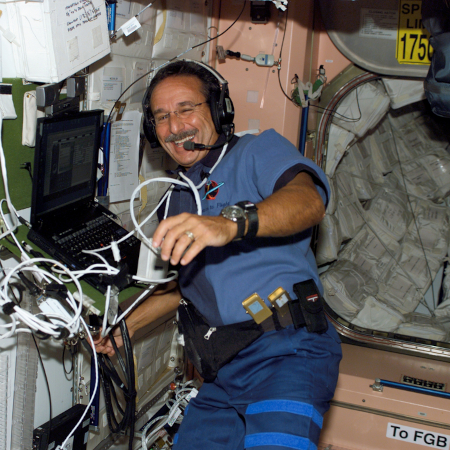
Charles Camarda on the first shuttle flight
after the Columbia failure.
The opposition to NASA’s decision to fly humans in the Orion capsule around the Moon with a questionable heat shield continues. Charles Camarda, an engineer and former NASA astronaut who has repeatedly expressed concerns about that heat shield and had been invited to attend the review meeting that NASA administrator Isaacman had arranged to ease his concerns, has now revealed his concerns were not eased in the slightest by that meeting, and that the Ars Technica article by Eric Berger that suggested otherwise was wrong, and that he is still “outraged” at NASA’s bad engineering decisions.
The rage you witnessed was my observing the exact behaviors used to construct risk and flight rationale which caused both Challenger and Columbia Accidents. Using “tools” inappropriately and then claiming results to be “Conservative.” Not to mention the reliance on Monte Carlo simulations to predict failure probabilities which were also proven to be inaccurate by orders of magnitude in my book “Mission Out of Control” which you claim to have read.
I suggest, in the spirit of transparency, you should ask NASA to release just the “Findings” of NESC Report TI-23-01849 Volume I. Finding 1 states the analysis cannot accurately predict crack initiation and propagation at flight conditions. And there was so much more which was conveniently not presented.
In other words, he finds NASA’s engineering claims that Orion’s heat shield will work using a different less stressful return trajectory as it dives back into the atmosphere about 25,000 mph to be false and untrustworthy. Worse, he sees it as proof that this is a continuation of the same culture at NASA that resulted in the Columbia failure.
Some of the exact same people responsible for failing to understand the shortcomings of the Crater Analysis tool (used tiny pieces of foam impacts to Shuttle tiles to predict a strike from a piece of foam which was 6000 larger and which caused the Columbia Accident) were on the Artemis Tiger Team now claiming they could predict the outcome of the Orion heatshield using a tool (similar to CRATER) called the Crack Identification Tool (CIT) which was also not physics based and relied on predictions of the key paramenter, permeability, which they claim to be the “root” cause, pressure, to vary by three orders of magnitude (that’s over 1000x).
In defense of NASA, those engineers had also presented data that showed Orion’s hull was strong enough to survive re-entry, even if the heat shield failed entirely. It is unclear if Camarda’s objections here apply to that data as well.
Regardless, his strong public disagreement with NASA on this once again raises serious questions about the upcoming manned Artemis-2 mission, set to launch sometime in the February to March time frame.

On Christmas Eve 1968 three Americans became the first humans to visit another world. What they did to celebrate was unexpected and profound, and will be remembered throughout all human history. Genesis: the Story of Apollo 8, Robert Zimmerman's classic history of humanity's first journey to another world, tells that story, and it is now available as both an ebook and an audiobook, both with a foreword by Valerie Anders and a new introduction by Robert Zimmerman.
The print edition can be purchased at Amazon or from any other book seller. If you want an autographed copy the price is $60 for the hardback and $45 for the paperback, plus $8 shipping for each. Go here for purchasing details. The ebook is available everywhere for $5.99 (before discount) at amazon, or direct from my ebook publisher, ebookit. If you buy it from ebookit you don't support the big tech companies and the author gets a bigger cut much sooner.
The audiobook is also available at all these vendors, and is also free with a 30-day trial membership to Audible.
"Not simply about one mission, [Genesis] is also the history of America's quest for the moon... Zimmerman has done a masterful job of tying disparate events together into a solid account of one of America's greatest human triumphs."--San Antonio Express-News
Charles Camarda on the first shuttle flight
after the Columbia failure.
The opposition to NASA’s decision to fly humans in the Orion capsule around the Moon with a questionable heat shield continues. Charles Camarda, an engineer and former NASA astronaut who has repeatedly expressed concerns about that heat shield and had been invited to attend the review meeting that NASA administrator Isaacman had arranged to ease his concerns, has now revealed his concerns were not eased in the slightest by that meeting, and that the Ars Technica article by Eric Berger that suggested otherwise was wrong, and that he is still “outraged” at NASA’s bad engineering decisions.
The rage you witnessed was my observing the exact behaviors used to construct risk and flight rationale which caused both Challenger and Columbia Accidents. Using “tools” inappropriately and then claiming results to be “Conservative.” Not to mention the reliance on Monte Carlo simulations to predict failure probabilities which were also proven to be inaccurate by orders of magnitude in my book “Mission Out of Control” which you claim to have read.
I suggest, in the spirit of transparency, you should ask NASA to release just the “Findings” of NESC Report TI-23-01849 Volume I. Finding 1 states the analysis cannot accurately predict crack initiation and propagation at flight conditions. And there was so much more which was conveniently not presented.
In other words, he finds NASA’s engineering claims that Orion’s heat shield will work using a different less stressful return trajectory as it dives back into the atmosphere about 25,000 mph to be false and untrustworthy. Worse, he sees it as proof that this is a continuation of the same culture at NASA that resulted in the Columbia failure.
Some of the exact same people responsible for failing to understand the shortcomings of the Crater Analysis tool (used tiny pieces of foam impacts to Shuttle tiles to predict a strike from a piece of foam which was 6000 larger and which caused the Columbia Accident) were on the Artemis Tiger Team now claiming they could predict the outcome of the Orion heatshield using a tool (similar to CRATER) called the Crack Identification Tool (CIT) which was also not physics based and relied on predictions of the key paramenter, permeability, which they claim to be the “root” cause, pressure, to vary by three orders of magnitude (that’s over 1000x).
In defense of NASA, those engineers had also presented data that showed Orion’s hull was strong enough to survive re-entry, even if the heat shield failed entirely. It is unclear if Camarda’s objections here apply to that data as well.
Regardless, his strong public disagreement with NASA on this once again raises serious questions about the upcoming manned Artemis-2 mission, set to launch sometime in the February to March time frame.
On Christmas Eve 1968 three Americans became the first humans to visit another world. What they did to celebrate was unexpected and profound, and will be remembered throughout all human history. Genesis: the Story of Apollo 8, Robert Zimmerman's classic history of humanity's first journey to another world, tells that story, and it is now available as both an ebook and an audiobook, both with a foreword by Valerie Anders and a new introduction by Robert Zimmerman.
The print edition can be purchased at Amazon or from any other book seller. If you want an autographed copy the price is $60 for the hardback and $45 for the paperback, plus $8 shipping for each. Go here for purchasing details. The ebook is available everywhere for $5.99 (before discount) at amazon, or direct from my ebook publisher, ebookit. If you buy it from ebookit you don't support the big tech companies and the author gets a bigger cut much sooner.
The audiobook is also available at all these vendors, and is also free with a 30-day trial membership to Audible.
"Not simply about one mission, [Genesis] is also the history of America's quest for the moon... Zimmerman has done a masterful job of tying disparate events together into a solid account of one of America's greatest human triumphs."--San Antonio Express-News
This is the worst part, in my opinon (bolding mine)
‘Some of the **exact same people** responsible for **failing to understand the shortcomings** of the Crater Analysis tool (used tiny pieces of foam impacts to Shuttle tiles to predict a strike from a piece of foam which was 6000 larger and which caused the Columbia Accident) were on the Artemis Tiger Team now claiming they could predict the outcome of the Orion heatshield using a tool (similar to CRATER) called the Crack Identification Tool (CIT) which was also **not physics based and relied on predictions** of the key paramenter, permeability, which they claim to be the “root” cause, pressure, to vary by **three orders of magnitude** (that’s over 1000x).’
When you have the same people responsible for previous deaths assuming that software is capable enough to determine outcomes, what is that but a recipe for further problems? If the astronauts make it home alive, but Orion’s heatshield is again damaged in ways that NASA doesn’t expect and (apparently) doesn’t understand, will they play Russian roulette again with the Artemis 3 crew, or will they finally realize that there’s no substitute for flight experience?
There was an interesting set of exchanges involving Camarda on X, earlier today:
SERGE DUMONT: I prefer to focus on technical issues. What solutions would you recommend?
CAMARDA: There is not enough time or space to explain. I did present a 60-page report to HQ before I retired. Crickets. The last chapter of my book hints at the plan.
DUMONT: Is that report public? I am sure a few people here would take a look.
CAMARDA: I did not make it public yet. I would like Jared to see it first. I touch on it in Chapter 8 of my book. Back in 2019. We can do so much more with AI today. Let’s get NASA out of the dark ages.
. . .
CIRRUS147: So suppose you are right? Tooling could be off? But the meeting confirmed that even if it happened the Capsule integrity would be fine on this trajectory. So with the current plan we will get the learning, no delays and also ensure crew safety it seems. So still the right decision is to proceed… albiet with an additional small but managable risk factor, like an aircraft taking off with a *possible* defect, on a Non-Essential item. Risks compound, and accidents are always a chain, so it should still be discussed however.
CAMARDA: We really cannot ensure crew safety if we cannot predict when the Heatshield fails. That is why we create analytical models that predict behavior up to and including failure! We cannot bound this problem otherwise.
. . .
Well, I would love to see Camarda’s report, when he is in a position to make it public.
Nate P: According to NASA, it is using a redesigned heat shield on the next Artemis mission, so these issues will be replaced with flying an untested redesigned heat shield rather than one with known problems.
P.S. I’m not sure that posting his response essay on LinkIn was the best way to get his views out there; normatively, you need a LinkedIn account to read any posts on LinkedIn, and a lot of people are not on LinkedIn, or simply refuse to do so. That limits his reach. I grok that his official website is not set up with a blog option, and his X account is not verified, so his character count is limited, unless he wants to post it as a set of image files or a long string of tweets.
His post on X, however, has over 25,000 views, and has a mounting set of discussions responding to and quoting it, so there’s an awareness of it out there, growing.
So far as I can tell, neither Eric Berger nor Jared Isaacman has responded publicly to Camarda’s essay.
Robert Zimmerman: great. I’m glad NASA has so much confidence in their models that they don’t feel the need to do extensive real-world testing.
(for the slow: yes, that’s sarcasm)
By the way, for those who want to hear Charlie Camarda speak at length on this issue — actually, more generally about what he sees as an ongoing poor safety culture in NASA human spaceflight — Ellie In Space did a 45 minute interview with him last January on her YT channel:
https://youtu.be/oISaScoQ92I
I watched it at the time, and I clean forgot about until Ellie mentioned it again yesterday.
The astronaut is right to be worried about questionable heat shields
https://www.reddit.com/r/SpaceXMasterrace/comments/1i2hxta/another_day_another_leaked_starship_internal_view/
Nate P wrote: “I’m glad NASA has so much confidence in their models that they don’t feel the need to do extensive real-world testing.”
Sarcasm or not, models have limited use. Models only say what you tell them to say. They can only analyze the way they are designed to analyze. They only know what you tell them, and they don’t know more than you do.
When a model analyzes a material that you don’t understand, the model does not understand it better than you do. If the model says that the material of the heat shield is safe, but you don’t know how or why the material behaved as it did (at what temperature did the spallation occur and after being soaked at the temperature for how long, etc.), then the model does not know, either.
When the engineers concluded that the capsule is safe even “if large chunks of the heat shield were stripped away entirely from the composite base of Orion” (From the Berger/ArsTechnica article), they tested “this base material to high energies for periods of 10 seconds up to 10 minutes,” what exactly does that test mean? Did they just use a chunk of the material, or did they strip off large chunks of heat shield from an actual reentry shield exposing a large area of the “composite base of Orion?” Further, what happens to the material behind the base material?
As an example of the limits of models, about forty years ago the electrical engineers that I worked with had software for modeling their electronics circuits, but they knew that the models did not reflect reality. I told them, at that time, that the analysis was not a complete waste, because if it didn’t work in the model then they couldn’t ever get it to work. A major problem was that the models used nominal values for the electronic parts, such as resistors. Real resistors come in ranges of actual resistance. There are 5% resistors that have values within 5% of the marked (nominal) value, and 10% resistors that have actual values within 10% of the nominal value. The software did not take those errors into account. Worse, when screening these components, the ones within 5% are taken out and marked as 5%, so the 10% resistors are at least off by 5%, one direction or the other. The modeling software only told the engineers what it was designed to tell them, the answer for the ideal system.
“Test like you fly, and fly like you test” is a common aerospace mantra. It means do not make a test that does not accurately simulate the flight conditions, even if you have to use flight articles. The proper English of the mantra uses the word “as” in place of the word “like,” but then that does not sound right: Test as you fly, and fly as you test. Properly said, but not properly done, especially with a crew on board.
Except that Artemis II is the first test of both the life support and the new reentry profile with the misbehaving heat shield. It is a manned flight in which they are testing as they fly and flying as they test.
Charlie Camarda Linked In Comment in Full
Doubting Thomas: To make clear what you are quoting, I have put it in a blockquote tag.
I’m not sure why you quoted it. All one has to do is click on the link to his comment. It requests you to register, but all you have to do is hit “esc” and that goes away.
I’m in the engineering business and a long-time observer (not supporter) of NASA. From what I have seen there are 2 general ways an engineering project gets done. One is to have rational management that puts people with the appropriate experience and attitude in charge to complete a quality project, and is willing to tell the client that the work will cost more and take longer to complete than they would like to properly address risk while accomplishing the project’s goals.
The second way is to agree to unrealistic deadlines and budgets to get the project approved, and then throw inexperienced people at the project (to keep costs low) and ignore the experienced people’s concerns over risk. Then deliver a known shoddy product, leave the problems you caused to others, and hope you don’t get sued. (If you have private clients people often get fired, though often not the management).
NASA/Congress has found a third way with Artemis: Go with the second way but take far longer and cost far more than originally agreed to achieve something already done 55 years ago. No one gets fired, in fact they get promoted. Compared to these people the Somali day care owners are amateurs at fraud.
Edward: my engineering professors always told us not to rely too much on analysis and simulations for precisely those reasons. Forget to model all the possible bend stresses in a material? The model won’t tell you. The real world will.
Eric Berger at Ars Technica has long been guilty of making news up that differs from reality. Shame on him. He should not be considered a journalist.
I’m curious to know just what you believe Berger has “made up.”
Eric’s work is primarily what we would call “news analysis” more than “news” as such, though he has been known to break some stories. But that still counts as journalism.
He does have a perspective on the industry, and that does shape his coverage. I don’t think that diminishes the value of what he does, at least not most of the time. I think it also helps that he’s quite open about that, which is not something I can say for every space journalist.
Nate P. said
My engineering professors always told us not to rely too much on analysis and simulations for precisely those reasons.
My Engineering/Computer Science Professors would have strongly agreed. In particular, the CRATER and CIT tools mentioned apparently use parametric, not physics based modelling. Parametric models are multi parametered models that effectively interpolate via various equations on known data sets. There are several basic ways of causing a parametric model to fail. For example, using an equation type that really doesn’t match the data interpolated (e.g. a linear model where the linear data fit is poor), or underdetermining the data (too few parameters such that the fit is poor). One of the most egregious failure modes is to extrapolate well outside the data from which the parameters were obtained. The failure of the CRATER model with Columbia where the object was three orders of magnitude outside the modeled data represents that class of failure. Mr. Camarda is arguing that the usage of CIT is making the same class of error with pressures several orders of magnitude greater than the CIT model’s data. If what he claims is true then this appears to be a misuse of the model. Interpolation within the confines of the data is usually fairly trustworthy, presuming the programming is correct. Values near the edge of the data parameterized are less trustworthy, and should be used with caution. Numbers far outside the parameter space are likely noise or just plain wrong. Sometimes management types seem to view software as magical solutions (witness the current love affair with LLMs which are rather like really large language based parametric systems with huge datasets of unknown quality).
Honestly with an untried environmental system and either a poorly performing heat shield or an untested new heat shield you couldn’t get me on that thing even if I did get to go around the moon. As far as I can tell, there is no reason other than stupid pride ( or not wanting to admit that the Artemis SLS based hardware is 20 years of failure theater starting with ARES) that ANY humans should be on that flight. The additional scientific data gathered by said humans are of far less consequence than 4 human lives. Effectively, the astronauts in the Artemis capsule are the “spam in a can” referenced by the Right Stuff.
At 4.1 billion ( from online estimates which likely don’t really cover development costs) per flight and a flight rate of ~1/year Artemis seems ludicrous at best. That cost represents >25 fully expended Falcon 9 Heavy rockets at 150 million each. Dragon crew is known to be capable of ~5 days on orbit stretching it to 8-10 days for a 3 person crew instead of 4 seems not too hard a stretch. At present Dragon on Falcon Heavy is not man-rated, but truthfully, it is far more trustworthy than Artemis with its SLS derived SRB’s implicated as the root cause in the deaths of the 7 Challenger astronauts. Probably the only big issue is the Dragon Crew heatshield might not be up to the lunar reentry. Close on that is does the Dragon Crew service module have enough Delta V to do the TLI and TEI burns? Issues like these could be addressed through testing and spending far less than 4 billion dollars. NASA is notorious for having Not Invented Here syndrome throughout the 2000’s (look how hard they fought Dragon Crew).
I think some of the biggest issues around is that Congress has just been throwing money at this with some vague goal of putting humans on the moon again with no broader goal or requirements or worse yet, randomly changing requirements. A goal should be stated (e.g. Long duration stays to explore for scientific purposes to determine lunar base feasibility) and then a program created using existing and near term hardware and capabilities extending them as needed. The Artemis hardware was current when Ares was designed in the early 2000’s but in 20+ years the technology has moved on. SpaceX wasn’t even a twinkle in Elon’s eye in 2005 as opposed to the world-dominating force it is now.
Tregonsee314: re: your last paragraph. Yes. Absolutely. Congress and NASA itself either have vague platitudes designed to put people to sleep as they spend gobs of money, or they have every single possible niche wish written down in generally unsuccessful attempts at getting Congress to spend larger gobs of money. Say what you will about the Apollo program; it had a clearly defined goal, a clear target date, and a commitment to continue in the face of technical challenges. NASA’s history for decades has been giving up in the face of new technical challenges (sometimes warranted, often not), and trying to please everyone (but especially their Congressional masters), while Congress’s history with civilian spaceflight is benign neglect from most members, and frankly malicious ill-use by a handful (see: Shelby, Mikulski et al). The longer we go without clearly defined goals for civilian spaceflight, good leadership willing to fight when it’s tough, and bad actors using the agency’s budget for their own ends, the worse off the USA is. It’s not all bad, because the private sector will increasingly drive forward space development, but NASA could do far more in research and development than it is. Hopefully Isaacman will be able to effect lasting change there.
Nate P wrote, “The longer we go without clearly defined goals for civilian spaceflight, good leadership willing to fight when it’s tough, and bad actors using the agency’s budget for their own ends, the worse off the USA is.”
I say, the longer we rely on government politicians for any leadership in anything, the longer things will go sour. Only in very rare unusual circumstances should we ever turn to these power-hungry lowlifes for anything (such as when the nation is attacked).
It is not in the make-up or design for Congress or the President to have appropriate goals when it comes to space exploration. Survival in their jobs depends on bringing funding to their states or districts, or having some wonderful photo op they can claim as their legacy. Getting them to lay out a rational and clearly defined goal and program (as Kennedy did in 1961) is the rare exception, not the rule.
I promise you that if planetary science shifts to the private sector, we will get more science for less money, and quicker. There is profit to be made there, if we can rip control from the people at NASA that now run everything.
A few hours ago, Jared Isaacman, responding to a post from Danny Olivas (who said, “I have faith in NASA and know they have made the right decision”) put up a post about this on X:
“Thank you to everyone who engaged in a thoughtful and productive discussion regarding the Orion heat shield.
Human spaceflight will always involve uncertainty. NASA’s standard engineering process is to identify it early, bound the risk through rigorous analysis and testing, and apply operational mitigations that preserve margin and protect the crew. That process works best when concerns are raised early and debated transparently.
I appreciate the willingness of participants to engage on this subject, including former NASA astronaut Danny Olivas, whose perspective reflects how serious technical questions can be addressed through data, analysis, testing, and decisions grounded in the best engineering judgment available.
Crew safety remains our foremost priority at NASA. With this disciplined approach in place every step of the way, we are moving steadily—and confidently—toward sending astronauts farther into space than ever before.”
Homer Hickam had an interesting response:
“Of course, I respect your decision which I know was well-considered. However, long before your tenure and past the technical aspects of this situation, are the decision-makers in NASA who, rather than stand up and declare a need to fix the obvious failures of the Orion’s heat shield at the moment they were detected, instead decided on a work-around, most likely for valid and understandable schedule and cost purposes. What engineers and managers in the space/aviation business haven’t faced such situations? The better ones, however, even with the risk of losing their positions, don’t let schedule and cost be a higher priority than risking human lives or, indeed, the entire program. It may very well be and even probable this work-around will work but it is still a work-around of an engineering anomaly. Flying is a risk, of course, and one that we must face if we are to go forward but this was a known risk which was handled if not poorly, then let’s say oddly considering NASA’s history. I believe a major aspect of @CharlieCamarda’s concern is that if Artemis II is successful (as we all pray it will be), it may reinforce the acceptance and normalization of anomalies for schedule and cost reasons in the future simply because they haven’t yet caused disaster, a management thought-process and approach that recalls very well Apollo I, Challenger, and Columbia. Fingers crossed for now but I am confident you will root out this kind of thinking in the future.”
Link:
https://x.com/i/status/2010835238805524971
Tell me again, how long did it take NASA to publicly admit the extent of the Artemis 1 TPS problem, and what office in NASA actually exposed the problem?
Patrick Underwood: It took NASA two years to admit to the problem, and it only did so after an inspector general report exposed it.
I will have much to say about Isaacman’s statement in a post early tomorrow.
“It took NASA two years to admit to the problem, and it only did so after an inspector general report exposed it.”
An awkward fact that NASA’s institutional gatekeepers seem to keep skipping over. Why did the press and the public have to learn about this from NASA’s OIG?
Richard M: I keep asking why Isaacman seems unaware or uninterested in this. I am increasingly unimpressed with him. But then, I had doubts during and after his first nomination.
Robert Zimmerman: I agree. What I’m getting at is that as long as we have a federal space agency, it would be helpful if it could be broadly redirected away. Nothing in the agency’s charter says it must fly manned missions to the Moon or anywhere else. Ultimately most progress will come from the private sector, as it should. But an NACA-style NASA would be more beneficial to the private sector than what we have now.
When I wrote about models, I feared that the vague description would get complaints from those who love models. Thank you to those who supported this view — and with additional facts and examples.
_________________
Tregonsee314 wrote: “Sometimes management types seem to view software as magical solutions.”
I once worked at a place where this happened. If the computer said it, it must be true. We created a phrase to describe the phenomenon: Garbage In, Gospel Out.
“I think some of the biggest issues around is that Congress has just been throwing money at this with some vague goal of putting humans on the moon again with no broader goal or requirements or worse yet, randomly changing requirements.”
Congress did not set a goal for SLS when they designed it, but they should have. George W. Bush had set a goal of going back to the Moon, and it Congress had stayed with that goal then SLS could have been made as a suitable rocket. Instead, Congress just wanted a jobs program, and that is what they got. Another ditch dug. It was about the time that Isaacman was nominated that Congress seemed to get a bug to Beat the Chinese™ to the Moon. Once again, the requirements changed late in the project.
“ A goal should be stated (e.g. Long duration stays to explore for scientific purposes to determine lunar base feasibility) and then a program created using existing and near term hardware and capabilities extending them as needed.”
Instead, the SLS goal was just to put a preset amount of mass into low Earth orbit, as though that were enough for whatever project would be chosen next. Too bad that mass was not the same or greater than the Saturn V, because we keep hearing comparisons with that great (though inefficient) rocket rather than the contrasts that SLS deserves.
Is a long duration lunar base a suitable goal for the U.S. government, or should it be a goal from U.S. commerce, a base with the intention of making a profit from exploration, mining, and manufacturing? If a profit can be made, it is a useful idea and maybe even a good idea.
_________________
Nate P wrote: “NASA’s history for decades has been giving up in the face of new technical challenges (sometimes warranted, often not), and trying to please everyone (but especially their Congressional masters), while Congress’s history with civilian spaceflight is benign neglect from most members, and frankly malicious ill-use by a handful (see: Shelby, Mikulski et al). ”
Even our elected officials have different priorities than We the People. One has to wonder whether we really are being represented or whether we are merely choosing different sets of dictators, spending our own money on bread and circuses in order to remain as our elected dictators.
“The longer we go without clearly defined goals for civilian spaceflight, good leadership willing to fight when it’s tough, and bad actors using the agency’s budget for their own ends, the worse off the USA is.”
It would be best if civilians defined the goals for civilian spaceflight and NASA, or maybe Congress, defined the goals for the government’s civil ( non-military/ non-reconnaissance) goals. We civilians know and care about what we want, but the government doesn’t.
“But an NACA-style NASA would be more beneficial to the private sector than what we have now.”
I am very much in agreement with this, so long as such a redefined organization assists commercial entities, as NACA did, or functions to achieve government’s goals, preferably inexpensively and in a timely manner. Artemis has failed on these last two counts. Three counts, if you include the goal of a sustainable presence on the Moon.
_____________________
Richard M,
From your Homer Hickam quote:
“I believe a major aspect of @CharlieCamarda’s concern is that if Artemis II is successful (as we all pray it will be), it may reinforce the acceptance and normalization of anomalies for schedule and cost reasons in the future simply because they haven’t yet caused disaster, a management thought-process and approach that recalls very well Apollo I, Challenger, and Columbia.”
I’m even more impressed with Hickam than I was before. That may be an excellent interpretation regarding Camarda’s concerns. Apollo I taught us that we can lack imagination of what can go wrong. Challenger taught us (perhaps through Diane Vaughn’s book: The Challenger Launch Decision) that we can suffer from the sin of normalization of deviance (acceptance and normalization of anomalies). Such deviances and anomalies indicate that something is wrong. Columbia taught us that NASA didn’t apply the lesson of Challenger.
A problem that engineers have is that every system has its unexpected behaviors, which are by definition deviances or anomalies. Even our very safe airliners fly with minor problems or glitches, and it is very rare that the minor ones are indicators (obscure or not) of a more serious problem. How do we know which ones are major problems? Aircraft and spacecraft are wildly complex, and unlike a car (much more simple, in comparison), they cannot pull over to the side of the street and wait for a tow when a problem occurs. Knowing the serious problems on a manned aircraft or spacecraft can be matter’s of life or death, and it is a bad idea to treat them like minor problems just because they haven’t killed anyone yet.
We are seeing in this scenario that Apollo I, Challenger, and Columbia are lessons learned, but not lessons applied.
https://www.youtube.com/watch?v=q-mMJxIttBc#t=540
about 9 minutes in:
“… and at NASA we’re not just about lessons learned, we’re always about lessons applied.” — 6 March 2025 Dr Nicola Fox, Associate Administrator, NASA Science Mission Directorate
http://www.youtube.com/watch?v=GXbdJ3kyVyU (7 minutes, Bill Whittle, “The Deal” from 2011)
4:17: “As with civil aviation, we learned from these events, that wishful thinking is a poor substitute for good engineering. So we went back and fixed the engineering, but we lost the stomach for it, because we didn’t go anywhere or do anything new. Part of the deal, you see, is that you pay in blood for progress. If there’s no progress, what’s the point?”
If we don’t apply the lessons, did we make progress in our engineering or in our management?
I am certain that it is too late to remove the crew from Artemis II, because it is clear that the usual political practices have won out against the good engineering practices. The government wants to Beat the Chinese™ even if we put four lives at greater risk than necessary. No matter what happens, we are likely to hear, “See, I told you so.” Either the new trajectory will be deemed perfectly safe (so why do we need to change the heat shield?) or it was a reckless mission and blame must be assigned. Isaacman is in the job that takes that blame. He definitely takes the blame for removing the crew, but he only takes blame if the mission fails. In a few weeks, the dice will be cast.
So, here is to a successful Artemis II mission, but also here’s to the future application of the past lessons, learned the hard way.