Four launches today with mostly positive results
This morning saw a string of launches from China, Russia, America, and Europe, with all four appearing to get their payloads into orbit though the American launch, by ULA’s Vulcan rocket, appeared to have a problem with one of its solid-fueled boosters.
First, a Chinese pseudo-company owned entirely by a Chinese government agency successfully placed seven satellites in orbit, its Smart Dragon-3 rocket (also called Jielong-3) lifting off from a platform off the coast of northeast China. Of the satellites, the prime payload was a Pakistani Earth observation satellite.
Though this launch was from a pseudo-company, I think I can safely say that the pause in launches by China’s so-called commercial market continues. Smart Dragon-3 was built by the China Aerospace Science and Technology Corporation (CASC), which while structured as a private company is owned and controlled by several agencies of the Chinese government.
Next, Russia successfully launched a new weather satellite, its Proton rocket launching from Baikonur in Kazakhstan. This was the first Proton launch in three years, a pause partly because Russia is in the process of retiring that rocket. The lower stages crashed in a range of spots in Kazakhstan and across southern Russia, just missing China in two places.
The American company ULA then followed with its first launch in 2026, its Vulcan rocket lifting off from Cape Canaveral in Florida and carrying two military satellites designed to track other satellite operations in high geosynchronous orbit.
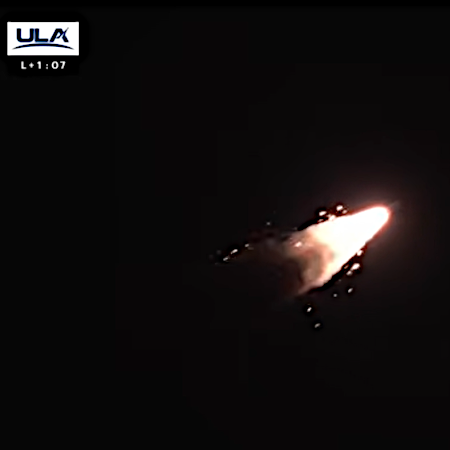
Unexpected debris falling from rocket at about T-1:00
While it appears the launch was able to get the satellites into their correct orbits, the Vulcan rocket had an issue during the launch. According to ULA, one of the rocket’s four solid-fueled boosters had a problem during its flight. More details can be found here, suggesting the booster, built by Northrop Grumman, might have had a been a failure of the booster’s nozzle, similar to the same burn-through that occurred on a booster during Vulcan’s second launch in 2024, and also occurred during a Northrop Grumman static fire test in 2025.
This issue is likely going to delay further Vulcan launches, and will likely make it impossible for ULA to meet its goal of launching 16 to 18 Vulcan missions this year. It will also raise hackles within the Pentagon, which certified Vulcan for military launches in 2025. That certification will likely be questioned, and possibly even pulled.
Finally, Arianespace sent 32 Leo satellites into orbit for Amazon, its Ariane-6 rocket lifting off from French Guiana. This was the first Ariane-6 launch in its most powerful variant, using four strap-on boosters.
Amazon has now launched 212 Leo satellites. Its FCC license however requires it to have 1,616 in orbit by July. The company has requested a waiver on that requirement, and is likely to get it, since it is now demonstrating that it is serious about launching the constellation.
The 2026 launch race:
16 SpaceX
8 China
2 Rocket Lab
2 Russia
1 ULA
1 Europe (Arianespace)

On Christmas Eve 1968 three Americans became the first humans to visit another world. What they did to celebrate was unexpected and profound, and will be remembered throughout all human history. Genesis: the Story of Apollo 8, Robert Zimmerman's classic history of humanity's first journey to another world, tells that story, and it is now available as both an ebook and an audiobook, both with a foreword by Valerie Anders and a new introduction by Robert Zimmerman.
The print edition can be purchased at Amazon or from any other book seller. If you want an autographed copy the price is $60 for the hardback and $45 for the paperback, plus $8 shipping for each. Go here for purchasing details. The ebook is available everywhere for $5.99 (before discount) at amazon, or direct from my ebook publisher, ebookit. If you buy it from ebookit you don't support the big tech companies and the author gets a bigger cut much sooner.
The audiobook is also available at all these vendors, and is also free with a 30-day trial membership to Audible.
"Not simply about one mission, [Genesis] is also the history of America's quest for the moon... Zimmerman has done a masterful job of tying disparate events together into a solid account of one of America's greatest human triumphs."--San Antonio Express-News
This morning saw a string of launches from China, Russia, America, and Europe, with all four appearing to get their payloads into orbit though the American launch, by ULA’s Vulcan rocket, appeared to have a problem with one of its solid-fueled boosters.
First, a Chinese pseudo-company owned entirely by a Chinese government agency successfully placed seven satellites in orbit, its Smart Dragon-3 rocket (also called Jielong-3) lifting off from a platform off the coast of northeast China. Of the satellites, the prime payload was a Pakistani Earth observation satellite.
Though this launch was from a pseudo-company, I think I can safely say that the pause in launches by China’s so-called commercial market continues. Smart Dragon-3 was built by the China Aerospace Science and Technology Corporation (CASC), which while structured as a private company is owned and controlled by several agencies of the Chinese government.
Next, Russia successfully launched a new weather satellite, its Proton rocket launching from Baikonur in Kazakhstan. This was the first Proton launch in three years, a pause partly because Russia is in the process of retiring that rocket. The lower stages crashed in a range of spots in Kazakhstan and across southern Russia, just missing China in two places.
The American company ULA then followed with its first launch in 2026, its Vulcan rocket lifting off from Cape Canaveral in Florida and carrying two military satellites designed to track other satellite operations in high geosynchronous orbit.
Unexpected debris falling from rocket at about T-1:00
While it appears the launch was able to get the satellites into their correct orbits, the Vulcan rocket had an issue during the launch. According to ULA, one of the rocket’s four solid-fueled boosters had a problem during its flight. More details can be found here, suggesting the booster, built by Northrop Grumman, might have had a been a failure of the booster’s nozzle, similar to the same burn-through that occurred on a booster during Vulcan’s second launch in 2024, and also occurred during a Northrop Grumman static fire test in 2025.
This issue is likely going to delay further Vulcan launches, and will likely make it impossible for ULA to meet its goal of launching 16 to 18 Vulcan missions this year. It will also raise hackles within the Pentagon, which certified Vulcan for military launches in 2025. That certification will likely be questioned, and possibly even pulled.
Finally, Arianespace sent 32 Leo satellites into orbit for Amazon, its Ariane-6 rocket lifting off from French Guiana. This was the first Ariane-6 launch in its most powerful variant, using four strap-on boosters.
Amazon has now launched 212 Leo satellites. Its FCC license however requires it to have 1,616 in orbit by July. The company has requested a waiver on that requirement, and is likely to get it, since it is now demonstrating that it is serious about launching the constellation.
The 2026 launch race:
16 SpaceX
8 China
2 Rocket Lab
2 Russia
1 ULA
1 Europe (Arianespace)
On Christmas Eve 1968 three Americans became the first humans to visit another world. What they did to celebrate was unexpected and profound, and will be remembered throughout all human history. Genesis: the Story of Apollo 8, Robert Zimmerman's classic history of humanity's first journey to another world, tells that story, and it is now available as both an ebook and an audiobook, both with a foreword by Valerie Anders and a new introduction by Robert Zimmerman.
The print edition can be purchased at Amazon or from any other book seller. If you want an autographed copy the price is $60 for the hardback and $45 for the paperback, plus $8 shipping for each. Go here for purchasing details. The ebook is available everywhere for $5.99 (before discount) at amazon, or direct from my ebook publisher, ebookit. If you buy it from ebookit you don't support the big tech companies and the author gets a bigger cut much sooner.
The audiobook is also available at all these vendors, and is also free with a 30-day trial membership to Audible.
"Not simply about one mission, [Genesis] is also the history of America's quest for the moon... Zimmerman has done a masterful job of tying disparate events together into a solid account of one of America's greatest human triumphs."--San Antonio Express-News
There is a lot of online discussion now about that roll of the vehicle after the SRB event, and I think it really does look like they came closer to loss of the vehicle and the mission than they did on the Cert-2 flight. I think it has to be treated as a more serious failure, even if they appear to have got the payloads to the proper orbit.
ULA has now confirmed that the payloads have been successfully delivered:
https://x.com/ulalaunch/status/2021989144751198326
But ULA has also announced an official investigation into what happened:
https://newsroom.ulalaunch.com/releases/ula-vulcan-rocket-successfully-launches-the-future-of-defense
USSF announces they will “work closely” with ULA on the investigation before Vulcan launches again, in a rather ominouus press release:
https://x.com/SciGuySpace/status/2022005254066470989/photo/1
For the record, the investigation into the nozzle failure on Cert-2 lasted five months. The return to flight was about ten months. It is hard to say, without knowing a lot more, whether they will match those timelines. But this is definitely going to cost them some time.
It at least speaks well of the Centaur ‘s ability to bail them out.
The BE-4s would like a word.
Had the burnthru happened on the core-facing side, debris might have impacted the BE-4s and ended things quickly.
NG is facing an unhappy customer.
“Once is happenstance, twice is coincidence…”
What Patrick said. The Centaur has the makings of a very good expendable upper stage ( it has been flawless over all four missions) but it was the booster core that did the work of saving this mission.
And yes, once again ULA was lucky that the nozzle burn through happened on an outward facing side.
First, let’s get this out of the way…
”Amazon has now launched 222 Leo satellites…”
212. 180+32=212.
And with that, Amazon Leo passes Starshield (198 acknowledged satellites) to become the third-largest satellite constellation in the world behind Starlink and OneWeb.
Note: The US government has launched 14 additional satellites with the Starlink form factor, but they are not part of the acknowledged Starshield constellation. They are probably initial prototypes and test satellites for block upgrades. For consistency’s sake I’m not counting Amazon’s prototype satellites either.
Second, poor ULA. Had they remained glitch-free I think they could have made their goal of 18-20 launches this year. Even at their current pace, they were on track to complete eight launches from the VIF-G / SLC-41 facility. With the new VIF-A / MLP-A at SLC-41 about to begin stacking, an additional eight launches per year seems plausible. Add an additional three launches from their newly upgraded pad at Vandenberg (scheduled for completion in July), and they’re up to 19.
So now that they are putting the finishing touches on the necessary infrastructure and the Pentagon and Amazon are finally delivering payloads to launch, this happens.
Ugh! Poor ULA! At least we have SpaceX.
mkent: I never claim to be a math whiz. Math error fixed. Thanks.
To finish up some thoughts on this…
1) The other parts of Vulcan seem to work really well. Vulcan’s flight control system was able to compensate for the asymmetric thrust, the BE-4s had enough additional roll control to stabilize the trajectory, and the new Centaur V had enough spare capability to compensate for the first stage’s reduced thrust. Quite the robust not-so-little vehicle. Now if only Northrop Grumman can get their manufacturing processes nailed down.
2) ATK doesn’t seem to have managed the ATK—>Orbital—>Northrop Grumman transition chain well. Besides this one ATK also had problems with the nozzle on one of the Cert-2 SRBs and on the BOLO booster test last year. It’s getting to be an annual issue.
In addition ATK is said to be having some fairly major problems on the GBSD program, to the point that the program is not able to advance through the acquisition gates. I haven’t followed the program too much, but the delays there seem pretty serious.
3) I think the first step will be to isolate the cause of the failure on the fault tree enough to rule out a common problem with the regular GEM-63s. That would allow the Atlas V to fly out some of its Starliner and Amazon manifest while ATK gets the Vulcan SRBs back up to snuff. Up to two Starliner and four Amazon missions might then be able to fly on Atlas this year.
4) I’m expecting ULA’s return-to-flight mission to be Starliner-1 on an Atlas V and Vulcan’s to be Amazon LV-01. That assumes the fault is not common to both types of GEMs.
5) It’s been confirmed that the next Ariane flight will be LE-02 in late March or early April. I expect LE-03 to follow in May or June. That would add another 72 Leos before the deadline.
This is another reason why Vulcan should have been Pyrios.
With two F-1s, they could have kicked solids to the curb and replaced SLS’ SRBs to boot….but no
I hope I live long enough to see Centaurs atop Falcons.
P.S.
Atlas V uses similar solids –but these have different noses…rounded…not pointy.
SLS wears strakes above the SRBs these days
Perhaps Vulcan needs them.
Could aerodynamics play a role here?
Atlas nozzles don’t seem to have these troubles–or is that luck of the draw?