German startup Spark Microgravity to build first space-based commercial cancer lab
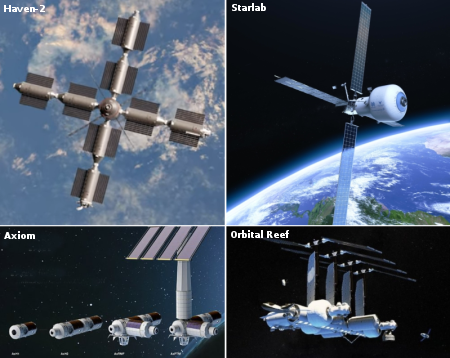
The American space stations under development
The German startup Spark Microgravity announced yesterday it is negotiating with two commercial space stations, one re-entry capsule company, and one French rocket startup to launch the first commercial cancer lab in space.
SPARK Microgravity is collaborating with Axiom Space and Voyager Technologies on commercial low Earth orbit (LEO) opportunities, with ATMOS Space Cargo supporting future return missions. A first flight demonstration with Swedish Space Corporation is scheduled in May. The cancer research will be launched in partnership with HyPrSpace, which developed Baguette-One, the first rocket to be launched from France.
Axiom hopes to launch its first modules in ’28, while Voyager’s Starlab station can’t launch until Starship is operational, possibly about the same time. ATMOS is a German startup developing a returnable capsule that can fly in orbit for several months. It has a deal with Hyperspace to fly a demo capsule on Baguette-1, which is a suborbital rocket.
Similar research has been done on ISS, but NASA’s rules forbid that research to produce a product for sale. Those rules won’t apply on the private stations, and Spark’s existence is a reflection of this new profit-oriented reality. Spark is going to attract investment capital from the pharmaceutical and academic communities, and thus is another profit center for the commercial space stations, outside of government funding.
The market for these new space stations is growing, making any NASA construction contracts less critical in the long run.

On Christmas Eve 1968 three Americans became the first humans to visit another world. What they did to celebrate was unexpected and profound, and will be remembered throughout all human history. Genesis: the Story of Apollo 8, Robert Zimmerman's classic history of humanity's first journey to another world, tells that story, and it is now available as both an ebook and an audiobook, both with a foreword by Valerie Anders and a new introduction by Robert Zimmerman.
The print edition can be purchased at Amazon or from any other book seller. If you want an autographed copy the price is $60 for the hardback and $45 for the paperback, plus $8 shipping for each. Go here for purchasing details. The ebook is available everywhere for $5.99 (before discount) at amazon, or direct from my ebook publisher, ebookit. If you buy it from ebookit you don't support the big tech companies and the author gets a bigger cut much sooner.
The audiobook is also available at all these vendors, and is also free with a 30-day trial membership to Audible.
"Not simply about one mission, [Genesis] is also the history of America's quest for the moon... Zimmerman has done a masterful job of tying disparate events together into a solid account of one of America's greatest human triumphs."--San Antonio Express-News
The American space stations under development
The German startup Spark Microgravity announced yesterday it is negotiating with two commercial space stations, one re-entry capsule company, and one French rocket startup to launch the first commercial cancer lab in space.
SPARK Microgravity is collaborating with Axiom Space and Voyager Technologies on commercial low Earth orbit (LEO) opportunities, with ATMOS Space Cargo supporting future return missions. A first flight demonstration with Swedish Space Corporation is scheduled in May. The cancer research will be launched in partnership with HyPrSpace, which developed Baguette-One, the first rocket to be launched from France.
Axiom hopes to launch its first modules in ’28, while Voyager’s Starlab station can’t launch until Starship is operational, possibly about the same time. ATMOS is a German startup developing a returnable capsule that can fly in orbit for several months. It has a deal with Hyperspace to fly a demo capsule on Baguette-1, which is a suborbital rocket.
Similar research has been done on ISS, but NASA’s rules forbid that research to produce a product for sale. Those rules won’t apply on the private stations, and Spark’s existence is a reflection of this new profit-oriented reality. Spark is going to attract investment capital from the pharmaceutical and academic communities, and thus is another profit center for the commercial space stations, outside of government funding.
The market for these new space stations is growing, making any NASA construction contracts less critical in the long run.
On Christmas Eve 1968 three Americans became the first humans to visit another world. What they did to celebrate was unexpected and profound, and will be remembered throughout all human history. Genesis: the Story of Apollo 8, Robert Zimmerman's classic history of humanity's first journey to another world, tells that story, and it is now available as both an ebook and an audiobook, both with a foreword by Valerie Anders and a new introduction by Robert Zimmerman.
The print edition can be purchased at Amazon or from any other book seller. If you want an autographed copy the price is $60 for the hardback and $45 for the paperback, plus $8 shipping for each. Go here for purchasing details. The ebook is available everywhere for $5.99 (before discount) at amazon, or direct from my ebook publisher, ebookit. If you buy it from ebookit you don't support the big tech companies and the author gets a bigger cut much sooner.
The audiobook is also available at all these vendors, and is also free with a 30-day trial membership to Audible.
"Not simply about one mission, [Genesis] is also the history of America's quest for the moon... Zimmerman has done a masterful job of tying disparate events together into a solid account of one of America's greatest human triumphs."--San Antonio Express-News
Yes. New use cases for commercial LEO stations keep popping up, a process I expect to continue. I also expect it to pick up steam as initial operational capability for these stations approaches.
Scott Manley: How Space Manufacturing Could Be Revolutionary
https://www.youtube.com/watch?v=U1sH2a57eXM (14 minutes)
NASA tended to discourage profitable manufacturing aboard its Space Shuttle and the ISS. This means that we did not get the space manufactured products that we had been promised, half a century ago. Which means that we didn’t get drugs or useful materials that could have made life even better than it has been.
The Outer Space Treaty said that the use of space should benefit all mankind, but the implementation of this treaty resulted in only some of the world’s governments benefitting, not We the People. We paid for it, but we did not benefit much from the money we paid.
That is about to change, and not at the expense of the taxpayer.
Edward: NASA didn’t “tend to discourage profitable manufacturing.” It downright forbid it. You could do research, but god forbid you manufactured anything for sale afterward.
This stupidity however had nothing to do with the Outer Space Treaty, which puts no limitations on private property or commercial operations on a space station or any free-flying spacecraft. It only limits property rights on planetary and asteroid surfaces. NASA made these rules as a result of Reagan’s edict after the Challenger accident that it was no longer to use the space shuttle to launch commercial satellites. It then took that edict and expanded it absurdly to outlaw any commercial operation on any NASA spacecraft.
Robert: and then some people wonder why commerce and industry hadn’t flowered offworld previously (usually the answer I see is that it’s impossible to make money in space. This is taken as a law of the universe). It galls me sometimes to think of where we could have been if the government had kept its nose out of space, or at least did nothing more than stand up and NACA-equivalent and military branch.
Nate P: Ditto from me. I watched decades wasted on non-achievement because the government wanted it that way. And people wonder why I am hostile to government-run “programs.”
Non-achievement at high costs, too, whereas firms like Spark have no alternatives but to look for the best deal they can, and figure out how to deliver without going bankrupt-constraints politicians generally don’t care about. I’d rather have a thousand more Sparks than a single Senator Shelby.