Haven-1 launch delayed until 2027
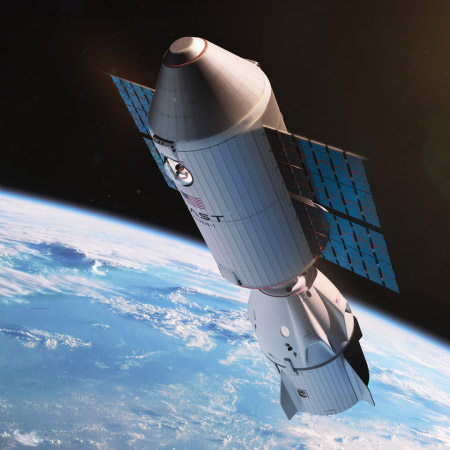
Artist rendering of Haven-1 with docked
Dragon capsule
According to Vast’s CEO, Max Haot, the launch of its single module Haven-1 space station has now been pushed back to the first quarter of ’27.
Last Saturday (January 10) we reached the key milestone of fully completing the primary structure, and some of the secondary structure; all of the acceptance testing occurred in November as well. Now we are starting clean room integration, which starts with TCS (thermal control system), propulsion, interior shells, and then moving on to avionics. And then final close out, which we expect will be done by the fall, and then we have on the books with NASA a full test campaign at the end of the year at Plum Brook. Then the launch in Q1 next year.
Until recently the company had been targeting a launch in the first half of 2026. This is a delay of almost a full year, and suggests the previous launch date has not been a serious target for quite some time.
Haot at the article at the link provides some new details about the manned missions to the station. It will launch unmanned, and after check-out in orbit that could last two weeks or longer, a professional SpaceX Dragon crew will fly a two-week mission there to do further check-outs.
After this up to three more two-week missions are planned, with Vast already having a deposit for the first. It also is willing to do more during Haven-1’s three year lifespan.
More and more it appears to me that in my rankings below of the five commercial space stations presently under development, the top three space stations are practically tied. And of the five stations, three are hoping to begin launching modules in the ’27-’28 time frame.
- Haven-1, being built by Vast, with no NASA funds. The company plans to launch its single module Haven-1 demo station in 2027 for a three-year period during which it will be occupied by at least four 2-week-long manned missions. The company is already testing an unmanned small demo module in orbit. By flying actual hardware and manned missions it hopes this will put it in the lead to win NASA’s phase 2 contract to build its much larger multi-module Haven-2 station. It has also made preliminary deals with Colombia, Uzbekistan, Japan, and the Maldives possible astronaut flights to Haven-1.
- Axiom, being built by Axiom, has launched four tourist flights to ISS, with the fourth carrying government passengers from India, Hungary, and Poland. The rumors of cash flow issues seem to have been alleviated with an infusion of $100 million from Hungary’s telecommunications company 4iG. The development of its first two modules has been proceeding, though the first module launch is now delayed until 2028. It has also signed Redwire to build that module’s solar panels.
- Starlab, being built by a consortium led by Voyager Space, Airbus, and Northrop Grumman, with extensive partnership agreements with the European Space Agency, Mitsubishi, and others. Though no construction has yet begun on its NASA-approved design, it has raised $383 million in a public stock offering, the $217.5 million provided by NASA, and an unstated amount from private capital. It has also begun signing up a number of companies to build the station’s hardware.
- Thunderbird, proposed by the startup Max Space. It is building a smaller demo test station to launch in ’27 on a Falcon 9 rocket, and has begun work on its manufacturing facility at Kennedy in Florida. Its management includes one former NASA astronaut and one former member of the Bigelow space station team that built the first private orbiting inflatable modules, Genesis-1, Genesis-2, and BEAM (still operating on ISS).
- Orbital Reef, being built by a consortium led by Blue Origin and Sierra Space. This station looks increasingly dead in the water. Blue Origin has built almost nothing, as seems normal for this company. And while Sierra Space has successfully tested its inflatable modules, including a full scale version, its reputation is soured by its failure in getting its Dream Chaser cargo mini-shuttle launched.

On Christmas Eve 1968 three Americans became the first humans to visit another world. What they did to celebrate was unexpected and profound, and will be remembered throughout all human history. Genesis: the Story of Apollo 8, Robert Zimmerman's classic history of humanity's first journey to another world, tells that story, and it is now available as both an ebook and an audiobook, both with a foreword by Valerie Anders and a new introduction by Robert Zimmerman.
The print edition can be purchased at Amazon or from any other book seller. If you want an autographed copy the price is $60 for the hardback and $45 for the paperback, plus $8 shipping for each. Go here for purchasing details. The ebook is available everywhere for $5.99 (before discount) at amazon, or direct from my ebook publisher, ebookit. If you buy it from ebookit you don't support the big tech companies and the author gets a bigger cut much sooner.
The audiobook is also available at all these vendors, and is also free with a 30-day trial membership to Audible.
"Not simply about one mission, [Genesis] is also the history of America's quest for the moon... Zimmerman has done a masterful job of tying disparate events together into a solid account of one of America's greatest human triumphs."--San Antonio Express-News
Artist rendering of Haven-1 with docked
Dragon capsule
According to Vast’s CEO, Max Haot, the launch of its single module Haven-1 space station has now been pushed back to the first quarter of ’27.
Last Saturday (January 10) we reached the key milestone of fully completing the primary structure, and some of the secondary structure; all of the acceptance testing occurred in November as well. Now we are starting clean room integration, which starts with TCS (thermal control system), propulsion, interior shells, and then moving on to avionics. And then final close out, which we expect will be done by the fall, and then we have on the books with NASA a full test campaign at the end of the year at Plum Brook. Then the launch in Q1 next year.
Until recently the company had been targeting a launch in the first half of 2026. This is a delay of almost a full year, and suggests the previous launch date has not been a serious target for quite some time.
Haot at the article at the link provides some new details about the manned missions to the station. It will launch unmanned, and after check-out in orbit that could last two weeks or longer, a professional SpaceX Dragon crew will fly a two-week mission there to do further check-outs.
After this up to three more two-week missions are planned, with Vast already having a deposit for the first. It also is willing to do more during Haven-1’s three year lifespan.
More and more it appears to me that in my rankings below of the five commercial space stations presently under development, the top three space stations are practically tied. And of the five stations, three are hoping to begin launching modules in the ’27-’28 time frame.
- Haven-1, being built by Vast, with no NASA funds. The company plans to launch its single module Haven-1 demo station in 2027 for a three-year period during which it will be occupied by at least four 2-week-long manned missions. The company is already testing an unmanned small demo module in orbit. By flying actual hardware and manned missions it hopes this will put it in the lead to win NASA’s phase 2 contract to build its much larger multi-module Haven-2 station. It has also made preliminary deals with Colombia, Uzbekistan, Japan, and the Maldives possible astronaut flights to Haven-1.
- Axiom, being built by Axiom, has launched four tourist flights to ISS, with the fourth carrying government passengers from India, Hungary, and Poland. The rumors of cash flow issues seem to have been alleviated with an infusion of $100 million from Hungary’s telecommunications company 4iG. The development of its first two modules has been proceeding, though the first module launch is now delayed until 2028. It has also signed Redwire to build that module’s solar panels.
- Starlab, being built by a consortium led by Voyager Space, Airbus, and Northrop Grumman, with extensive partnership agreements with the European Space Agency, Mitsubishi, and others. Though no construction has yet begun on its NASA-approved design, it has raised $383 million in a public stock offering, the $217.5 million provided by NASA, and an unstated amount from private capital. It has also begun signing up a number of companies to build the station’s hardware.
- Thunderbird, proposed by the startup Max Space. It is building a smaller demo test station to launch in ’27 on a Falcon 9 rocket, and has begun work on its manufacturing facility at Kennedy in Florida. Its management includes one former NASA astronaut and one former member of the Bigelow space station team that built the first private orbiting inflatable modules, Genesis-1, Genesis-2, and BEAM (still operating on ISS).
- Orbital Reef, being built by a consortium led by Blue Origin and Sierra Space. This station looks increasingly dead in the water. Blue Origin has built almost nothing, as seems normal for this company. And while Sierra Space has successfully tested its inflatable modules, including a full scale version, its reputation is soured by its failure in getting its Dream Chaser cargo mini-shuttle launched.
On Christmas Eve 1968 three Americans became the first humans to visit another world. What they did to celebrate was unexpected and profound, and will be remembered throughout all human history. Genesis: the Story of Apollo 8, Robert Zimmerman's classic history of humanity's first journey to another world, tells that story, and it is now available as both an ebook and an audiobook, both with a foreword by Valerie Anders and a new introduction by Robert Zimmerman.
The print edition can be purchased at Amazon or from any other book seller. If you want an autographed copy the price is $60 for the hardback and $45 for the paperback, plus $8 shipping for each. Go here for purchasing details. The ebook is available everywhere for $5.99 (before discount) at amazon, or direct from my ebook publisher, ebookit. If you buy it from ebookit you don't support the big tech companies and the author gets a bigger cut much sooner.
The audiobook is also available at all these vendors, and is also free with a 30-day trial membership to Audible.
"Not simply about one mission, [Genesis] is also the history of America's quest for the moon... Zimmerman has done a masterful job of tying disparate events together into a solid account of one of America's greatest human triumphs."--San Antonio Express-News
Haot seemed at pains to emphasize that, as far as internal planning was concerned, nothing has changed: they have been “tracking” the 1Q 2027 time frame for launch for quite a while now. They’re just making it public now, he seems to say.
Of course, that could be spin. But either way, it’s a small schedule slide, so…
Richard M: It is actually a large schedule slide. Up until this interview, the company had been claiming it would launch in the first half of ’26. Now it is aiming for the first quarter of ’27. That’s essentially a year delay, as far as I am concerned.
As I noted in my post, I instantly thought they have been hiding this launch date, giving out a fake earlier date when they knew the launch would be later. I understand why startups do this, but I still think it is a bad look.
Richard & Robert,
I make the delay about 9 months.
A possible motivation for Vast’s continuing with the mid-2026 story until recently is that this would have placed Haven-1’s notional launch in an earlier calendar year than that of Axiom’s first module. Now that Axiom has officially slipped its own initial module launch until 2028, Vast can now acknowledge a 2027 launch date for Haven-1 and still preserve that earlier calendar year thing. Both companies have, it would seem, been playing a game of chicken with schedules. When neither could keep up the pretense that their originally announced schedules would hold, first one, then the other, elected to acknowledge reality – or at least something closer to it. Venial sins at best in the space patch.
Haot had been talking along the lines of “Summer 2026” when I’d been last tracking this. Now he says it’s 1Q 2027, and further that this has really been their super secret internal timeline all along. That makes it closer to what Dick says — 9 months — but then that assumes no further schedule slips. Which is, well, hard to be sure of.
I grok that what they’re doing is hugely difficult and on a hugely accelerated timeline, and stuff happens. A failure of the station on orbit would be devastating, probably fatal for the company, so they need to be sure it’s really in good order. But yeah, I think it would have been better to just be up front and say that “2026” ain’t happening.
Robert Zimmerman’s comment: “Up until this interview, the company had been claiming it would launch in the first half of ’26. Now it is aiming for the first quarter of ’27.”
As I post this comment, RocketLaunchLive still has the Haven-1 launch scheduled in May of this year.
https://www.rocketlaunch.live
I count that as being the latest announced (by press release) launch date. I’m not sure what we all would consider to be an official announcement, but I think that an interview is not as official as a press release announcement. It may be reality, or closer to it, but is it a rumor, or is it more than a rumor?
Edward,
I don’t think anything said publicly by a company CEO can fairly be considered “rumor.”