
Mars Reconnaissance Orbiter’s high resolution camera takes its 100,000 picture
Click for original image.
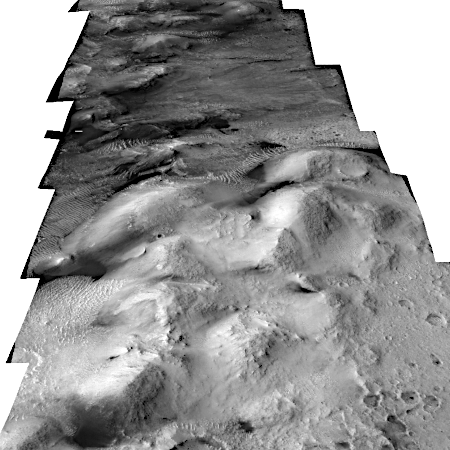
Cool image time! On October 7, 2025, the science team that operates HiRISE, the high resolution camera on Mars Reconnaissance Orbiter (MRO), took its 100,000th picture since entering Mars orbit in March 2006.
The objective of this observation is to better resolve sand dunes and the rocky material underneath them. These dark, eroded rocks may be the source for some of these Syrtis Major sand dunes. Our image was suggested by a high school student enrolled in the Jefferson County Executive Internship program in Colorado in 2023, one of many public outreach programs the HiRISE Team engages in.
To celebrate this accomplishment and the fantastic geology of the scene, students and staff in the HiRISE Photogrammetry lab constructed this digital terrain model. This oblique image highlights the hummocky mounds of the plains that border Jezero Crater, which are among the oldest on Mars.
That oblique image, cropped, reduced, and sharpened to post here, is to the right. The location is about 50 miles to the southwest of Jezero Crater where the rover Perseverance landed.
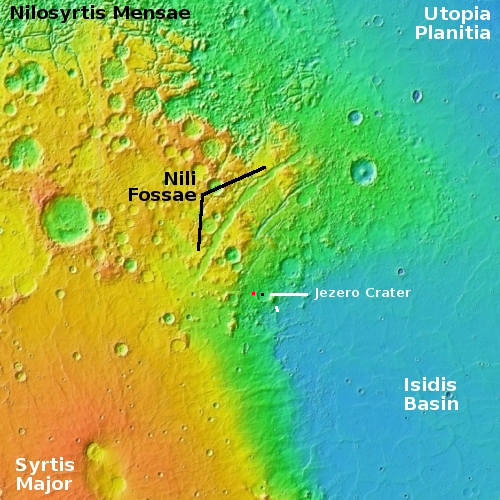
The white dot on the overview map to the right marks the location of this image, on the periphery of the cratered mountains that line the giant ancient impact Isidis basin. The black dot marks Perseverance’s landing site inside Jezero Crater, while the red dot the rover’s present position outside the crater to the west.
The fissures of Nili Fossae are believed to have been caused by the impact that created Isidis as well as subsequent geological events. This region is also considered one of the best potential mining regions on Mars, with orbital data suggesting it contains a lot of very intriguing mineralogy. As noted in research published in 2022:
On Earth, clays form when water interacts with rocks, with different conditions giving rise to different types of clays. For example, clay minerals such as smectite and vermiculite form when relatively small amounts of water interact with the rock and so retain mostly the same chemical elements as the original volcanic rocks. In the case of smectite and vermiculite those elements are iron and magnesium. When the amount of water is relatively high, the rocks can be altered more. Soluble elements tend to be carried away leaving behind aluminium-rich clays such as kaolin.
Thus, future colonists will probably find valuable ores of iron, magnesium, and aluminum in this region, with other ores also likely.

On Christmas Eve 1968 three Americans became the first humans to visit another world. What they did to celebrate was unexpected and profound, and will be remembered throughout all human history. Genesis: the Story of Apollo 8, Robert Zimmerman's classic history of humanity's first journey to another world, tells that story, and it is now available as both an ebook and an audiobook, both with a foreword by Valerie Anders and a new introduction by Robert Zimmerman.
The print edition can be purchased at Amazon or from any other book seller. If you want an autographed copy the price is $60 for the hardback and $45 for the paperback, plus $8 shipping for each. Go here for purchasing details. The ebook is available everywhere for $5.99 (before discount) at amazon, or direct from my ebook publisher, ebookit. If you buy it from ebookit you don't support the big tech companies and the author gets a bigger cut much sooner.
The audiobook is also available at all these vendors, and is also free with a 30-day trial membership to Audible.
"Not simply about one mission, [Genesis] is also the history of America's quest for the moon... Zimmerman has done a masterful job of tying disparate events together into a solid account of one of America's greatest human triumphs."--San Antonio Express-News
Click for original image.
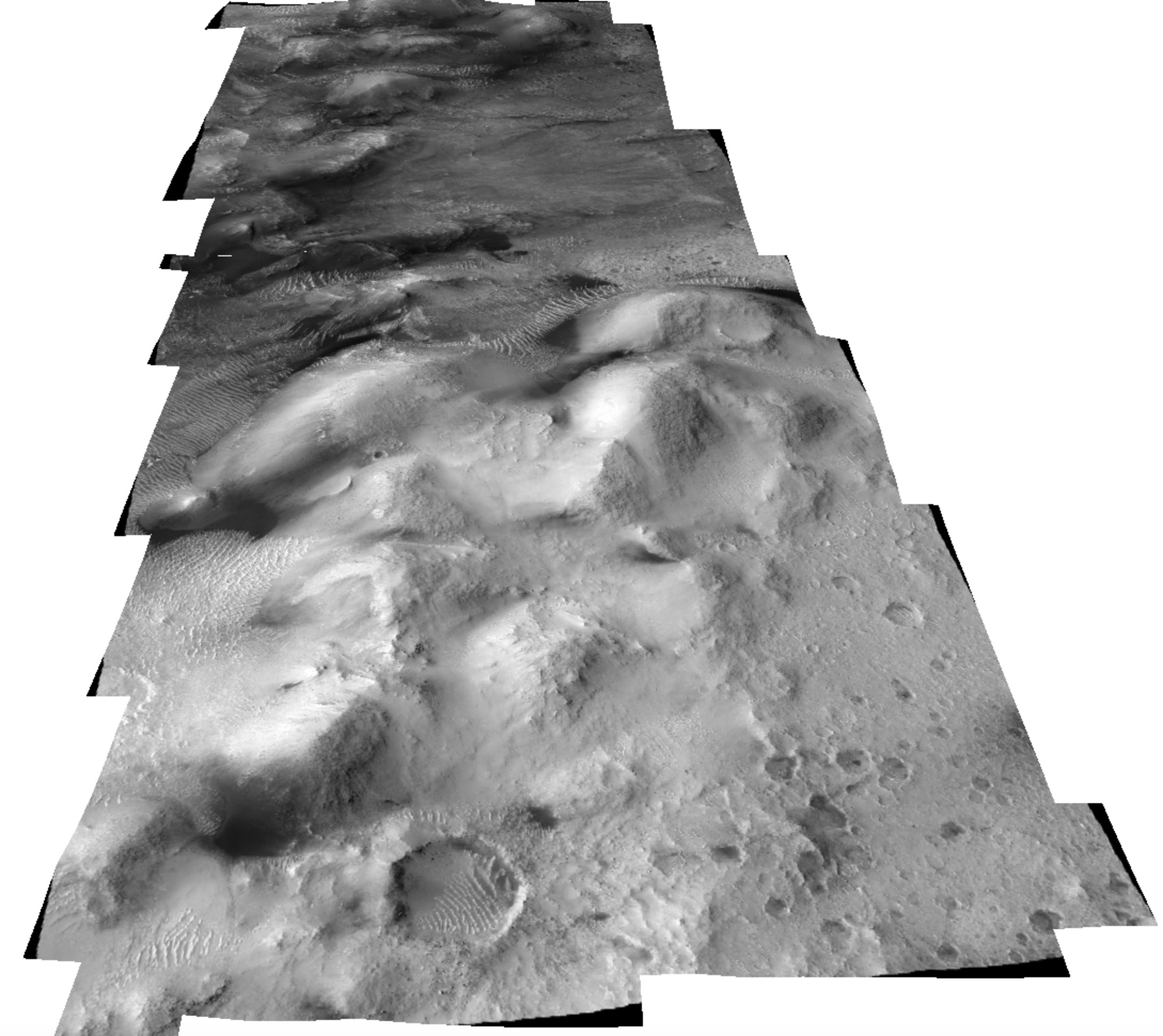
Cool image time! On October 7, 2025, the science team that operates HiRISE, the high resolution camera on Mars Reconnaissance Orbiter (MRO), took its 100,000th picture since entering Mars orbit in March 2006.
The objective of this observation is to better resolve sand dunes and the rocky material underneath them. These dark, eroded rocks may be the source for some of these Syrtis Major sand dunes. Our image was suggested by a high school student enrolled in the Jefferson County Executive Internship program in Colorado in 2023, one of many public outreach programs the HiRISE Team engages in.
To celebrate this accomplishment and the fantastic geology of the scene, students and staff in the HiRISE Photogrammetry lab constructed this digital terrain model. This oblique image highlights the hummocky mounds of the plains that border Jezero Crater, which are among the oldest on Mars.
That oblique image, cropped, reduced, and sharpened to post here, is to the right. The location is about 50 miles to the southwest of Jezero Crater where the rover Perseverance landed.
The white dot on the overview map to the right marks the location of this image, on the periphery of the cratered mountains that line the giant ancient impact Isidis basin. The black dot marks Perseverance’s landing site inside Jezero Crater, while the red dot the rover’s present position outside the crater to the west.
The fissures of Nili Fossae are believed to have been caused by the impact that created Isidis as well as subsequent geological events. This region is also considered one of the best potential mining regions on Mars, with orbital data suggesting it contains a lot of very intriguing mineralogy. As noted in research published in 2022:
On Earth, clays form when water interacts with rocks, with different conditions giving rise to different types of clays. For example, clay minerals such as smectite and vermiculite form when relatively small amounts of water interact with the rock and so retain mostly the same chemical elements as the original volcanic rocks. In the case of smectite and vermiculite those elements are iron and magnesium. When the amount of water is relatively high, the rocks can be altered more. Soluble elements tend to be carried away leaving behind aluminium-rich clays such as kaolin.
Thus, future colonists will probably find valuable ores of iron, magnesium, and aluminum in this region, with other ores also likely.
On Christmas Eve 1968 three Americans became the first humans to visit another world. What they did to celebrate was unexpected and profound, and will be remembered throughout all human history. Genesis: the Story of Apollo 8, Robert Zimmerman's classic history of humanity's first journey to another world, tells that story, and it is now available as both an ebook and an audiobook, both with a foreword by Valerie Anders and a new introduction by Robert Zimmerman.
The print edition can be purchased at Amazon or from any other book seller. If you want an autographed copy the price is $60 for the hardback and $45 for the paperback, plus $8 shipping for each. Go here for purchasing details. The ebook is available everywhere for $5.99 (before discount) at amazon, or direct from my ebook publisher, ebookit. If you buy it from ebookit you don't support the big tech companies and the author gets a bigger cut much sooner.
The audiobook is also available at all these vendors, and is also free with a 30-day trial membership to Audible.
"Not simply about one mission, [Genesis] is also the history of America's quest for the moon... Zimmerman has done a masterful job of tying disparate events together into a solid account of one of America's greatest human triumphs."--San Antonio Express-News
I am imagining using all this high quality imagery and computer aided manufacturing to produce a realistic , 3d surface, globe of Mars. Is this feasible?
Blobfish: Using the lower resolution context camera on MRO this global surface globe of Mars already exists, and is available online for anyone to use:
https://murray-lab.caltech.edu/CTX/V01/SceneView/MurrayLabCTXmosaic.html
I use it all the time in preparing my cool images.
The description of clays formation was informative. Thanks!
Thank you Robert. Will do.
Most of us give NASA a rough time around here — with good reason — but we have here a reminder of the good science it has been able to deliver in the past. I think it’s fair to say that the science mission directorate hit a home run with Mars Reconnaissance Orbiter. The imagery it has delivered of the Red Planet will be serving us well for a long time to come.
Richard M,
MRO was a home run. But MRO really should have had at least two progressively more capable descendants join it in orbit by now. MRO is not immortal any more than MAVEN proved to be.