More delays expected in India’s first manned Gaganyaan orbital mission
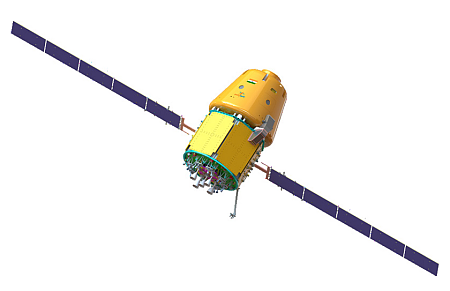
Artist rendering of India’s Gaganyaan capsule
It appears that India’s space agency ISRO is now hinting that the first manned orbital flight of India’s Gaganyaan capsule will not occur in 2027 as planned, but could be delayed until 2028.
ISRO had hoped to fly the first unmanned orbital test flight, Gaganyaan G1, before the end of this year, followed by several more unmanned flights in 2026, with the manned flight in 2027. G1 however has slipped to early 2026, though it appears the mission is finally coming together.
In a response to a question posed at the Lok Sabha, the State Minister for Space, Jitendra Singh noted that the first Gaganyaan mission is nearly ready to fly, “Major infrastructure such as the Orbital Module Preparation Facility, Gaganyaan Control Centre, Crew training facility have been established. Second launch pad modifications have been incorporated. Precursor missions such as TV-D1 and IADT-01 have been successfully accomplished. Ground tracking networks, terrestrial links and IDRSS-1 feeder stations have been established. Crew Module Recovery plan as well as assets to be deployed have been finalized. For the first uncrewed mission (G1), all HLVM3 stages and CES motors are ready. Crew and Service Module systems have been realized. Assembly and integration activities are nearing completion.”
…The Gaganyaan G1 flight is the first of eight planned missions as part of an expanded programme cleared by the Union Cabinet last year with a total budget of Rs 20,193 crore. Initially, the programme was envisioned with two developmental flights followed by a crewed flight, with a budget of Rs 9,023 crore. There are now two crewed flights in the revised campaign, with ISRO aiming for the first crewed flight in 2027-28. [emphasis mine]
The highlighted dates are the first time ISRO has suggested the first manned flight might slip to 2028.
When the Gaganyaan program was first announced in 2018, the first manned flight was scheduled for 2022. Since then that schedule has been repeatedly delayed. I suspect ISRO’s schedule will only become more reliable after it finally completes that first G1 orbital test flight.
The endless incremental delays however are reminiscent of NASA’s Artemis program, designed to hide a sluggish program with problems.

On Christmas Eve 1968 three Americans became the first humans to visit another world. What they did to celebrate was unexpected and profound, and will be remembered throughout all human history. Genesis: the Story of Apollo 8, Robert Zimmerman's classic history of humanity's first journey to another world, tells that story, and it is now available as both an ebook and an audiobook, both with a foreword by Valerie Anders and a new introduction by Robert Zimmerman.
The print edition can be purchased at Amazon or from any other book seller. If you want an autographed copy the price is $60 for the hardback and $45 for the paperback, plus $8 shipping for each. Go here for purchasing details. The ebook is available everywhere for $5.99 (before discount) at amazon, or direct from my ebook publisher, ebookit. If you buy it from ebookit you don't support the big tech companies and the author gets a bigger cut much sooner.
The audiobook is also available at all these vendors, and is also free with a 30-day trial membership to Audible.
"Not simply about one mission, [Genesis] is also the history of America's quest for the moon... Zimmerman has done a masterful job of tying disparate events together into a solid account of one of America's greatest human triumphs."--San Antonio Express-News
Artist rendering of India’s Gaganyaan capsule
It appears that India’s space agency ISRO is now hinting that the first manned orbital flight of India’s Gaganyaan capsule will not occur in 2027 as planned, but could be delayed until 2028.
ISRO had hoped to fly the first unmanned orbital test flight, Gaganyaan G1, before the end of this year, followed by several more unmanned flights in 2026, with the manned flight in 2027. G1 however has slipped to early 2026, though it appears the mission is finally coming together.
In a response to a question posed at the Lok Sabha, the State Minister for Space, Jitendra Singh noted that the first Gaganyaan mission is nearly ready to fly, “Major infrastructure such as the Orbital Module Preparation Facility, Gaganyaan Control Centre, Crew training facility have been established. Second launch pad modifications have been incorporated. Precursor missions such as TV-D1 and IADT-01 have been successfully accomplished. Ground tracking networks, terrestrial links and IDRSS-1 feeder stations have been established. Crew Module Recovery plan as well as assets to be deployed have been finalized. For the first uncrewed mission (G1), all HLVM3 stages and CES motors are ready. Crew and Service Module systems have been realized. Assembly and integration activities are nearing completion.”
…The Gaganyaan G1 flight is the first of eight planned missions as part of an expanded programme cleared by the Union Cabinet last year with a total budget of Rs 20,193 crore. Initially, the programme was envisioned with two developmental flights followed by a crewed flight, with a budget of Rs 9,023 crore. There are now two crewed flights in the revised campaign, with ISRO aiming for the first crewed flight in 2027-28. [emphasis mine]
The highlighted dates are the first time ISRO has suggested the first manned flight might slip to 2028.
When the Gaganyaan program was first announced in 2018, the first manned flight was scheduled for 2022. Since then that schedule has been repeatedly delayed. I suspect ISRO’s schedule will only become more reliable after it finally completes that first G1 orbital test flight.
The endless incremental delays however are reminiscent of NASA’s Artemis program, designed to hide a sluggish program with problems.
On Christmas Eve 1968 three Americans became the first humans to visit another world. What they did to celebrate was unexpected and profound, and will be remembered throughout all human history. Genesis: the Story of Apollo 8, Robert Zimmerman's classic history of humanity's first journey to another world, tells that story, and it is now available as both an ebook and an audiobook, both with a foreword by Valerie Anders and a new introduction by Robert Zimmerman.
The print edition can be purchased at Amazon or from any other book seller. If you want an autographed copy the price is $60 for the hardback and $45 for the paperback, plus $8 shipping for each. Go here for purchasing details. The ebook is available everywhere for $5.99 (before discount) at amazon, or direct from my ebook publisher, ebookit. If you buy it from ebookit you don't support the big tech companies and the author gets a bigger cut much sooner.
The audiobook is also available at all these vendors, and is also free with a 30-day trial membership to Audible.
"Not simply about one mission, [Genesis] is also the history of America's quest for the moon... Zimmerman has done a masterful job of tying disparate events together into a solid account of one of America's greatest human triumphs."--San Antonio Express-News
After working with people from India for years they aren’t that sharp. I think replacing American coders with them has slowed our technological advances.
And they lack American chutzpah.
I live in an area with a relatively high percentage of Indians (Hillsboro, Ore, home of Intel), and while acknowledging that I am seeing the best India has to offer (high percentage of hard science PhD’s), I have great respect for Indians. They were an advanced society prior to The Raj, and took lessons learned, and opportunities offered, to build a modern, soon-to-be-spacefaring nation. The culture is more communal; family is important, and many people, even some Americans, aren’t get-it-done-right-now. Live in Hawai’i for a while. Maybe tomorrow, maybe next week. My experience is that Indians are an asset to the Country. Some folks have decided to stay, become naturalized, and run for local office. Welcome.