New data from VLT uncovers numerous debris disks around stars
Click for original
Using a new instrument on the Very Large Telescope (VLT) in Chile, astronomers have compiled a catalog of 51 potential exoplanet solar systems, all with intriguing debris disks surround the stars with features suggesting the existence of asteroids and comets.
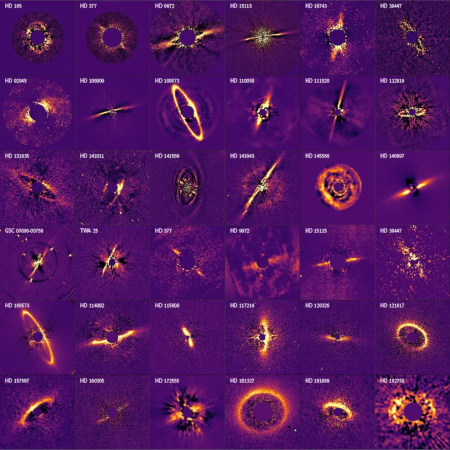
The image to the right shows a sampling of those systems. From the press release:
“To obtain this collection, we processed data from observations of 161 nearby young stars whose infrared emission strongly indicates the presence of a debris disk,” says Natalia Engler (ETH Zurich), the lead author of the study. “The resulting images show 51 debris disks with a variety of properties — some smaller, some larger, some seen from the side and some nearly face-on – and a considerable diversity of disk structures. Four of the disks had never been imaged before.”
Comparisons within a larger sample are crucial for discovering the systematics behind object properties. In this case, an analysis of the 51 debris disks and their stars confirmed several systematic trends: When a young star is more massive, its debris disk tends to have more mass as well. The same is true for debris disks where the majority of the material is located at a greater distance from the central star.
Arguably the most interesting feature of the SPHERE debris disks are the structures within the disks themselves. In many of the images, disks have a concentric ring- or band-like structure, with disk material predominantly found at specific distances from the central star. The distribution of small bodies in our own solar system has a similar structure, with small bodies concentrated in the asteroid belt (asteroids) and the Kuiper belt (comets).
The data from various telescopes both on the ground and in space is increasingly telling us that our solar system is not unique, and that the galaxy is filled with millions of similar systems, all in different states of formation. This hypothesis is further strengthened by the appearance of interstellar comet 3I/Atlas, which despite coming from outside our solar system is remarkably similar to the comets formed here.

On Christmas Eve 1968 three Americans became the first humans to visit another world. What they did to celebrate was unexpected and profound, and will be remembered throughout all human history. Genesis: the Story of Apollo 8, Robert Zimmerman's classic history of humanity's first journey to another world, tells that story, and it is now available as both an ebook and an audiobook, both with a foreword by Valerie Anders and a new introduction by Robert Zimmerman.
The print edition can be purchased at Amazon or from any other book seller. If you want an autographed copy the price is $60 for the hardback and $45 for the paperback, plus $8 shipping for each. Go here for purchasing details. The ebook is available everywhere for $5.99 (before discount) at amazon, or direct from my ebook publisher, ebookit. If you buy it from ebookit you don't support the big tech companies and the author gets a bigger cut much sooner.
The audiobook is also available at all these vendors, and is also free with a 30-day trial membership to Audible.
"Not simply about one mission, [Genesis] is also the history of America's quest for the moon... Zimmerman has done a masterful job of tying disparate events together into a solid account of one of America's greatest human triumphs."--San Antonio Express-News

Click for original
Using a new instrument on the Very Large Telescope (VLT) in Chile, astronomers have compiled a catalog of 51 potential exoplanet solar systems, all with intriguing debris disks surround the stars with features suggesting the existence of asteroids and comets.
The image to the right shows a sampling of those systems. From the press release:
“To obtain this collection, we processed data from observations of 161 nearby young stars whose infrared emission strongly indicates the presence of a debris disk,” says Natalia Engler (ETH Zurich), the lead author of the study. “The resulting images show 51 debris disks with a variety of properties — some smaller, some larger, some seen from the side and some nearly face-on – and a considerable diversity of disk structures. Four of the disks had never been imaged before.”
Comparisons within a larger sample are crucial for discovering the systematics behind object properties. In this case, an analysis of the 51 debris disks and their stars confirmed several systematic trends: When a young star is more massive, its debris disk tends to have more mass as well. The same is true for debris disks where the majority of the material is located at a greater distance from the central star.
Arguably the most interesting feature of the SPHERE debris disks are the structures within the disks themselves. In many of the images, disks have a concentric ring- or band-like structure, with disk material predominantly found at specific distances from the central star. The distribution of small bodies in our own solar system has a similar structure, with small bodies concentrated in the asteroid belt (asteroids) and the Kuiper belt (comets).
The data from various telescopes both on the ground and in space is increasingly telling us that our solar system is not unique, and that the galaxy is filled with millions of similar systems, all in different states of formation. This hypothesis is further strengthened by the appearance of interstellar comet 3I/Atlas, which despite coming from outside our solar system is remarkably similar to the comets formed here.
On Christmas Eve 1968 three Americans became the first humans to visit another world. What they did to celebrate was unexpected and profound, and will be remembered throughout all human history. Genesis: the Story of Apollo 8, Robert Zimmerman's classic history of humanity's first journey to another world, tells that story, and it is now available as both an ebook and an audiobook, both with a foreword by Valerie Anders and a new introduction by Robert Zimmerman.
The print edition can be purchased at Amazon or from any other book seller. If you want an autographed copy the price is $60 for the hardback and $45 for the paperback, plus $8 shipping for each. Go here for purchasing details. The ebook is available everywhere for $5.99 (before discount) at amazon, or direct from my ebook publisher, ebookit. If you buy it from ebookit you don't support the big tech companies and the author gets a bigger cut much sooner.
The audiobook is also available at all these vendors, and is also free with a 30-day trial membership to Audible.
"Not simply about one mission, [Genesis] is also the history of America's quest for the moon... Zimmerman has done a masterful job of tying disparate events together into a solid account of one of America's greatest human triumphs."--San Antonio Express-News
I believe that one of those rings of debris used to be Alderaan, once renowned for its natural beauty, sophisticated arts and culture, and peaceful traditions. Looks like the Death Star has been busy.