New data strengthens the conflict in the observed value for the universe’s expansion rate
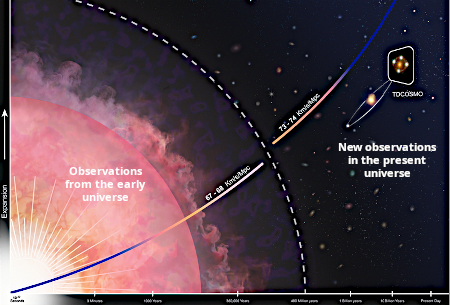
Click for original.
The uncertainty of science: New research using a combination of ground- and space-based telescopes has not only failed to resolve the difference between the two values observed for the Hubble constant (the expansion rate of the universe), it actually confirms that conflict.
The graphic to the right nicely illustrates the conflict. Observations from the early universe come up with a value of 67-68 kiloparsecs per second per megaparsec for the Hubble constant. Observations from the present universe, including these new more precise measurements, come up with a value of 73-74. From the press release:
A team of astronomers using a variety of ground and space-based telescopes including the W. M. Keck Observatory on Maunakea, Hawaiʻi Island, have made one of the most precise independent measurements yet of how fast the universe is expanding, further deepening the divide on one of the biggest mysteries in modern cosmology.
Using data gathered from Keck Observatory’s Cosmic Web Imager (KCWI) as well as NASA’s James Webb Space Telescope (JWST), the Hubble Space Telescope (HST) the Very Large Telescope (VLT), and European Organisation for Astronomical Research in the Southern Hemisphere (ESO) researchers have independently confirmed that the universe’s current rate of expansion, known as the Hubble constant (H₀), does not match values predicted from measurements from the universe when it was much younger.
Cosmologists call this conflict “the Hubble Tension”, a absurd fake term expressly designed to hide the fact that they have no idea what’s going on. It isn’t “tension”, it is a perfect example of good observations coming up with contradictory data that no theory can explain.

On Christmas Eve 1968 three Americans became the first humans to visit another world. What they did to celebrate was unexpected and profound, and will be remembered throughout all human history. Genesis: the Story of Apollo 8, Robert Zimmerman's classic history of humanity's first journey to another world, tells that story, and it is now available as both an ebook and an audiobook, both with a foreword by Valerie Anders and a new introduction by Robert Zimmerman.
The print edition can be purchased at Amazon or from any other book seller. If you want an autographed copy the price is $60 for the hardback and $45 for the paperback, plus $8 shipping for each. Go here for purchasing details. The ebook is available everywhere for $5.99 (before discount) at amazon, or direct from my ebook publisher, ebookit. If you buy it from ebookit you don't support the big tech companies and the author gets a bigger cut much sooner.
The audiobook is also available at all these vendors, and is also free with a 30-day trial membership to Audible.
"Not simply about one mission, [Genesis] is also the history of America's quest for the moon... Zimmerman has done a masterful job of tying disparate events together into a solid account of one of America's greatest human triumphs."--San Antonio Express-News

Click for original.
The uncertainty of science: New research using a combination of ground- and space-based telescopes has not only failed to resolve the difference between the two values observed for the Hubble constant (the expansion rate of the universe), it actually confirms that conflict.
The graphic to the right nicely illustrates the conflict. Observations from the early universe come up with a value of 67-68 kiloparsecs per second per megaparsec for the Hubble constant. Observations from the present universe, including these new more precise measurements, come up with a value of 73-74. From the press release:
A team of astronomers using a variety of ground and space-based telescopes including the W. M. Keck Observatory on Maunakea, Hawaiʻi Island, have made one of the most precise independent measurements yet of how fast the universe is expanding, further deepening the divide on one of the biggest mysteries in modern cosmology.
Using data gathered from Keck Observatory’s Cosmic Web Imager (KCWI) as well as NASA’s James Webb Space Telescope (JWST), the Hubble Space Telescope (HST) the Very Large Telescope (VLT), and European Organisation for Astronomical Research in the Southern Hemisphere (ESO) researchers have independently confirmed that the universe’s current rate of expansion, known as the Hubble constant (H₀), does not match values predicted from measurements from the universe when it was much younger.
Cosmologists call this conflict “the Hubble Tension”, a absurd fake term expressly designed to hide the fact that they have no idea what’s going on. It isn’t “tension”, it is a perfect example of good observations coming up with contradictory data that no theory can explain.
On Christmas Eve 1968 three Americans became the first humans to visit another world. What they did to celebrate was unexpected and profound, and will be remembered throughout all human history. Genesis: the Story of Apollo 8, Robert Zimmerman's classic history of humanity's first journey to another world, tells that story, and it is now available as both an ebook and an audiobook, both with a foreword by Valerie Anders and a new introduction by Robert Zimmerman.
The print edition can be purchased at Amazon or from any other book seller. If you want an autographed copy the price is $60 for the hardback and $45 for the paperback, plus $8 shipping for each. Go here for purchasing details. The ebook is available everywhere for $5.99 (before discount) at amazon, or direct from my ebook publisher, ebookit. If you buy it from ebookit you don't support the big tech companies and the author gets a bigger cut much sooner.
The audiobook is also available at all these vendors, and is also free with a 30-day trial membership to Audible.
"Not simply about one mission, [Genesis] is also the history of America's quest for the moon... Zimmerman has done a masterful job of tying disparate events together into a solid account of one of America's greatest human triumphs."--San Antonio Express-News
Shouldn’t that value be per megaparsec. not milliparsec?
M: You are correct. Now fixed.
This is a great Topic!
To simplify it more, if you “measure” backwards from now, you get the 73-74 rate, if you measure from the microwave background forward to now, you get the 67-68 rate.
It has been assumed, with “better” data on both sides, these numbers would merge, but they don’t.
One or more of our theories, on both sides of this, isn’t correct. That has massive implications for how old stuff actually is, and how far away it actually is.
Contra Einstein, perhaps God not only plays dice with the Universe, He plays the wee joke with it sometimes as well.
As in the latter part of the 19th century, when departures from Newtonian orthodoxy began piling up, the same seems to be happening again. The crypto-physics of that day turned out to be Relativity and Quantum Mechanics. I think we’re about due for a new round of crypto-physics theory, lacking only another Newton or Einstein to figure it out.
Newton and Einstein were separated, temporally, by a bit over three centuries. If that interval is normative between the appearance of such geniuses, we, sadly, may have a couple of more centuries to wait before the current basket of contradictions is sorted out. Or perhaps the AI folks will, much sooner, achieve the long-speculated-about superhuman AI that can suss out the next wave of crypto-physics for us.
I hope so. I want me my FTL drives, tractor beams, grav plating and anti-grav skimmers.
We just need observations from future universe to know for sure.
In this age when the Church is MIA at best and supporting the wrong team at worst, theoretical physicists have become our theologians and bloggers our prophets.
Jordan Peterson interviewed a physicist a while ago and it was fascinating when their discussion took them into the spiritual.
I believe the base value projected is kilometers per second per megaparse , not kiloparsecs per second which is immensely larger.
On the topic of the uncertainty in all this you will find this recent development interesting too I think.
https://m.youtube.com/watch?v=2VpP-qXuJMc
Fascinating. The Hubble expanding universe model (and it’s derivatives and variants) has been king since I was in High School in the late 70’s. As noted the last time we had anomalies in the form of the Ultraviolet Catastrophe and the Michelson-Morely experiments we got Quantum Physics and Relativity. Add in fun with radioactivity and it resulted in a whole new physical model of the universe. It will be interesting to see where this goes…
My understanding is that the Constant is different, depending on from which end of the process you measure. This seems like there should be a simple explanation. Maybe we just need better imagination.
It varies based on which direction you measure it? Almost sounds like there’s some sort of red/blueshift effect going on at a fundamental level that we don’t understand.
Blair / A. —
They are measuring different stuff depending on which direction they start. They assumed with better data this would eventually overlap to yield a number that would match both directions of measurement.
Going backwards from now, they use the distance-ladder, cepheid variables, and supernovae stuff. That doesn’t get you out very far before you have to start making huge assumptions. Going forward from the cosmic microwave background yields a lower number.
—————–
“The Timescape Illusion”–David Wiltshire
Brian Keating; Into the Impossible Podcast (June, 2025)
https://youtu.be/F2lUB1dFeMI
1:10:17
“…a radical perspective on cosmic acceleration and dark energy, proposing that both might be illusions created by the varying passage of time in different regions of the universe.”
Mach’s Principle is a concept in physics that suggests that the inertia of an object is determined by the distribution of matter in the universe. In simpler terms, it proposes that the motion of an object is influenced by the presence of all other matter in the universe.
Motion Vs. Expansion: “If you cannot tell the difference between being at rest in an expanding space or moving in a non-expanding space, those two things should be equivalent.”
Adam Riess
Runaway Universe: Tensions Between Measurements & Predictions of the Hubble Constant
Brian Keating: Into the Impossible (July 2023)
https://youtu.be/b3Tx1g8gKmY
57:04
Sturgill Simpson
“Turtles All the Way Down” (April 2014)
https://youtu.be/6gBV-Nzq7Pg
(3:02)
How many planets are there in the universe? (very short)
https://www.youtube.com/shorts/ErT2Dren6Qg
It is difficult to determine the microwave background noise… When you live inside the microwave. (I learned this as a child listening to two old-timers debating the “ether” and whether it was a “push” that was creating the illusion of gravity, or is it the mass of the planet pulling ether down?) they were debating how a local short wave radio experimenter could electrify his entire house and part of the neighborhood with his equipment. In a world full of energy… How do you tap that energy when you live inside the battery? (all atoms vibrate endlessly proving entropy has no hold on the subatomic level… Zero point energy)
I never understood the Hubble constant… When the universe we are measuring it against is constantly changing.
That’s funny on stellar candles, with better instruments we are finding no two candles are alike.
If everything we see in the universe came from the big bang… Then everything we see was the center of the universe at one time.
If a tiny fraction of the big bang resulted in physical matter… It would’ve been enough gravity to create an event horizon stopping the expansion/time. That would have resulted in an instant collapse… unless the overwhelming heat of the big bang forced it to overcome gravity and it’s explosion outward… But then that same billions of degrees of heat would’ve prevented any matter from existing because it would’ve vibrated itself into energy. (That’s assuming that gravity and time even existed yet in a newly formed universe.)
Actually as I sit here and think about it, the model of “energy only” racing out from the big bang is a better one? because magnetism is a byproduct of current… Like the event horizon, it would have created a magnetic bottle around the universe and kept it from expanding because magnetism is far stronger than gravity. So picture all this current creating individual packets that repel each other as they push outward from the big bang… (just as giant cells of magnetic polarity cover the surface of the sun) magnetic bottles of swirling contained energy repelling from the big bang unrestrained by the laws of mass, cooling down eventually into swirling clouds of gas and then matter from which galaxies emerged?
When the repelling magnetism of the energy subsided as matter cooled and congealed, gravity became more dominant force holding galaxies together while pulling galaxies toward each other, even as their initial inertia propels them in whatever direction their prior magnetic push gave them in a chaotic universe.
Of course I’m only talking about 1/2 of the matter of the big bang… The other half called antimatter may not of been constrained by magnetism or gravity, and have found itself out pacing the rest of the universe un hindered by the yet set laws of physics.
But then I don’t think I believe that, more likely antimatter produced anti-time which resulted in all of the antimatter being propelled “before the Big Bang” in the opposite time direction of the flow of normal time and matter. (yep, if you had a time machine and went back before the big bang you would find the antimatter universe being created flowing in the opposite direction of negative time)
The red shift of light being proof that empty space is expanding and therefore elongating the wavelength of light into the red seems suspect to me. After all, what force is empty nothingness producing against a photon of light other than making it travel further? A photon is affected by gravity (bending space) Time (Slowing the photon down), magnetism (as resistance pushing, pulling, realigning, changing the frequency…)
Does empty space have any of these qualities to cause an affect? Far more likely that interstellar medium has enough gas and dust to filter out all of the shorter frequencies of light not long enough to go around these objects. The further away the galaxy, the more filtering of the light so only the longer wave length of energy make it to our eyes. The infrared telescope is Taylor made for only these frequencies and is finding red spots everywhere throughout our galaxy and universe. Every object that is emitting heat shines brilliantly. Every preconceived notion is suspect now. So the Internet will come up with more Clickbait.
Heat death, the big crunch, now the “big rip”?
Quote;
“And as Space.com explains, not only is the universe expanding, but it’s expanding at a rate faster than the speed of light. This means that most of the universe will be forever out of reach unless we can somehow bypass the light-speed barrier. Some unknown phenomenon dubbed “dark energy” is fueling the universe’s expansion. And if dark energy wins the battle against the phenomena holding the universe together — gravity and dark matter — then the whole universe might shred itself apart at the sub-atomic level”
A. Nonymous wrote: “It varies based on which direction you measure it? Almost sounds like there’s some sort of red/blueshift effect going on at a fundamental level that we don’t understand.”
Sounds like a form of hysteresis.