
New study: AI is corrupting the minds of children
Click for source.
A new study has found that the unsupervised use of AI by young children increasingly has them involved in bad things that are violent and emotionally harmful.
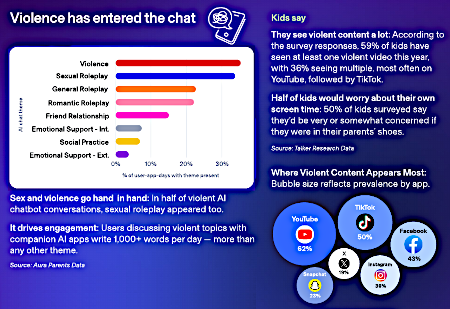
A new report conducted by the digital security company Aura found that a significant percentage of kids who turn to AI for companionship are engaging in violent roleplays — and that violence, which can include sexual violence, drove more engagement than any other topic kids engaged with.
Drawing from anonymized data gathered from the online activity of roughly 3,000 children aged five to 17 whose parents use Aura’s parental control tool, as well as additional survey data from Aura and Talker Research, the security firm found that 42 percent of minors turned to AI specifically for companionship, or conversations designed to mimic lifelike social interactions or roleplay scenarios. Conversations across nearly 90 different chatbot services, from prominent companies like Character.AI to more obscure companion platforms, were included in the analysis.
Of that 42 percent of kids turning to chatbots for companionship, 37 percent engaged in conversations that depicted violence, which the researchers defined as interactions involving “themes of physical violence, aggression, harm, or coercion” — that includes sexual or non-sexual coercion, the researchers clarified — as well as “descriptions of fighting, killing, torture, or non-consensual acts.”
Half of these violent conversations, the research found, included themes of sexual violence. The report added that minors engaging with AI companions in conversations about violence wrote over a thousand words per day, signaling that violence appears to be a powerful driver of engagement, the researchers argue. [emphasis mine]
You can read the study here. As bad as this data above is, the most frightening aspect of the report is this quote:
Click for source.
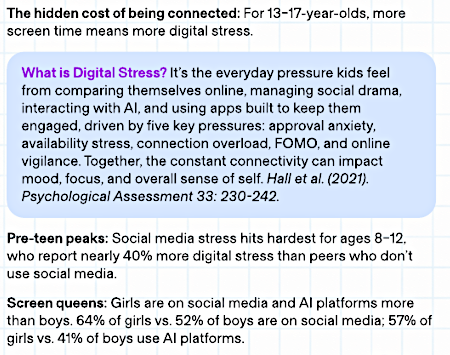
Across the device data, teens 13–17 who spend more time on social media show higher levels of digital stress. The idea comes from the Digital Stress Scale (Hall et al., 2021), which Aura also used in its earlier report on kids’ digital stress. The scale defines five pressures: approval anxiety, availability stress, connection overload, fear of missing out (FOMO), and online vigilance.
Among preteens (8–12), those on social media report nearly 40% more digital stress than peers who stay off. Girls are more active on the platforms where stress is most often reported: 64% use social media, compared with 52% of boys; 57% use AI tools, compared with 41% of boys.
Families are feeling the strain, according to Talker Research. Nearly half believe technology is harming their child’s emotional well-being — 51% cite concerns for girls, compared with 36% for boys. Many are tightening rules at home: 50% set screen-time limits, 64% require approval for online purchases, and 49% withhold devices until chores or homework are done. [emphasis mine]
We should not be surprised by this. This uncontrolled use of AI and its clear negative consequences is merely an extension of the accumulating evidence that unsupervised use of smart phones by young children has a negative impact on their development.
The frightening part to me, however, is the weak response by parents. Only half are convinced this technology is harming their kids, and even those who do believe so are not taking it away from their children, only limiting its use in a variety of superficial and generally ineffective ways.
Humans are tool-makers. We create tools to enhance our abilities. Until recently, those tools always worked to our benefit, making us smarter or stronger or more capable. Even when these enhanced abilities allowed us to destroy ourselves in war with greater efficiency, overall the benefits of the tools clearly outweighed the negatives.
There is increasing evidence that this is not the case with our new digital tools. While they provide us instant access to information, their design is directing us to shallow knowledge that is also increasingly destructive to our ability to think critically. The information is also often confusing, incorrect, superficial, or purely emotional. And these digital tools are numbingly addictive, driving out all other thought processes.
In other words, these digital tools are not making us smarter or better informed. They are making us less thoughtful using a database that is less nuanced or robust.
That’s the negatives we see as adults. The negative influences on children is now found to be even more profound. And yet, we are taking almost no action to fix the problem.
It seems to me that the dark age of foolish emotional madness that seems to be engulfing civilization at this time is only going to get worse.

On Christmas Eve 1968 three Americans became the first humans to visit another world. What they did to celebrate was unexpected and profound, and will be remembered throughout all human history. Genesis: the Story of Apollo 8, Robert Zimmerman's classic history of humanity's first journey to another world, tells that story, and it is now available as both an ebook and an audiobook, both with a foreword by Valerie Anders and a new introduction by Robert Zimmerman.
The print edition can be purchased at Amazon or from any other book seller. If you want an autographed copy the price is $60 for the hardback and $45 for the paperback, plus $8 shipping for each. Go here for purchasing details. The ebook is available everywhere for $5.99 (before discount) at amazon, or direct from my ebook publisher, ebookit. If you buy it from ebookit you don't support the big tech companies and the author gets a bigger cut much sooner.
The audiobook is also available at all these vendors, and is also free with a 30-day trial membership to Audible.
"Not simply about one mission, [Genesis] is also the history of America's quest for the moon... Zimmerman has done a masterful job of tying disparate events together into a solid account of one of America's greatest human triumphs."--San Antonio Express-News
Click for source.
A new study has found that the unsupervised use of AI by young children increasingly has them involved in bad things that are violent and emotionally harmful.
A new report conducted by the digital security company Aura found that a significant percentage of kids who turn to AI for companionship are engaging in violent roleplays — and that violence, which can include sexual violence, drove more engagement than any other topic kids engaged with.
Drawing from anonymized data gathered from the online activity of roughly 3,000 children aged five to 17 whose parents use Aura’s parental control tool, as well as additional survey data from Aura and Talker Research, the security firm found that 42 percent of minors turned to AI specifically for companionship, or conversations designed to mimic lifelike social interactions or roleplay scenarios. Conversations across nearly 90 different chatbot services, from prominent companies like Character.AI to more obscure companion platforms, were included in the analysis.
Of that 42 percent of kids turning to chatbots for companionship, 37 percent engaged in conversations that depicted violence, which the researchers defined as interactions involving “themes of physical violence, aggression, harm, or coercion” — that includes sexual or non-sexual coercion, the researchers clarified — as well as “descriptions of fighting, killing, torture, or non-consensual acts.”
Half of these violent conversations, the research found, included themes of sexual violence. The report added that minors engaging with AI companions in conversations about violence wrote over a thousand words per day, signaling that violence appears to be a powerful driver of engagement, the researchers argue. [emphasis mine]
You can read the study here. As bad as this data above is, the most frightening aspect of the report is this quote:
Click for source.
Across the device data, teens 13–17 who spend more time on social media show higher levels of digital stress. The idea comes from the Digital Stress Scale (Hall et al., 2021), which Aura also used in its earlier report on kids’ digital stress. The scale defines five pressures: approval anxiety, availability stress, connection overload, fear of missing out (FOMO), and online vigilance.
Among preteens (8–12), those on social media report nearly 40% more digital stress than peers who stay off. Girls are more active on the platforms where stress is most often reported: 64% use social media, compared with 52% of boys; 57% use AI tools, compared with 41% of boys.
Families are feeling the strain, according to Talker Research. Nearly half believe technology is harming their child’s emotional well-being — 51% cite concerns for girls, compared with 36% for boys. Many are tightening rules at home: 50% set screen-time limits, 64% require approval for online purchases, and 49% withhold devices until chores or homework are done. [emphasis mine]
We should not be surprised by this. This uncontrolled use of AI and its clear negative consequences is merely an extension of the accumulating evidence that unsupervised use of smart phones by young children has a negative impact on their development.
The frightening part to me, however, is the weak response by parents. Only half are convinced this technology is harming their kids, and even those who do believe so are not taking it away from their children, only limiting its use in a variety of superficial and generally ineffective ways.
Humans are tool-makers. We create tools to enhance our abilities. Until recently, those tools always worked to our benefit, making us smarter or stronger or more capable. Even when these enhanced abilities allowed us to destroy ourselves in war with greater efficiency, overall the benefits of the tools clearly outweighed the negatives.
There is increasing evidence that this is not the case with our new digital tools. While they provide us instant access to information, their design is directing us to shallow knowledge that is also increasingly destructive to our ability to think critically. The information is also often confusing, incorrect, superficial, or purely emotional. And these digital tools are numbingly addictive, driving out all other thought processes.
In other words, these digital tools are not making us smarter or better informed. They are making us less thoughtful using a database that is less nuanced or robust.
That’s the negatives we see as adults. The negative influences on children is now found to be even more profound. And yet, we are taking almost no action to fix the problem.
It seems to me that the dark age of foolish emotional madness that seems to be engulfing civilization at this time is only going to get worse.
On Christmas Eve 1968 three Americans became the first humans to visit another world. What they did to celebrate was unexpected and profound, and will be remembered throughout all human history. Genesis: the Story of Apollo 8, Robert Zimmerman's classic history of humanity's first journey to another world, tells that story, and it is now available as both an ebook and an audiobook, both with a foreword by Valerie Anders and a new introduction by Robert Zimmerman.
The print edition can be purchased at Amazon or from any other book seller. If you want an autographed copy the price is $60 for the hardback and $45 for the paperback, plus $8 shipping for each. Go here for purchasing details. The ebook is available everywhere for $5.99 (before discount) at amazon, or direct from my ebook publisher, ebookit. If you buy it from ebookit you don't support the big tech companies and the author gets a bigger cut much sooner.
The audiobook is also available at all these vendors, and is also free with a 30-day trial membership to Audible.
"Not simply about one mission, [Genesis] is also the history of America's quest for the moon... Zimmerman has done a masterful job of tying disparate events together into a solid account of one of America's greatest human triumphs."--San Antonio Express-News
I am starting to warm up to A.I. myself
https://www.msn.com/en-us/money/other/we-let-ai-run-our-office-vending-machine-it-lost-hundreds-of-dollars/ar-AA1SAlNa
I guess it was programmed by Mr. Robot or someone from Lisa Dodson’s Moral Underground ;)
Note that the problem isn’t really the digital platform. It’s the same thing that has plagued teens for generations: acceptance and validation.
What the digital stuff does is take that audience 24 hours and global. Yes, an American teen could be crushed by some girl in India calling him names.
Sad, it was so much better when TV raised feral children. I watched some old sitcoms via TV antenna, they weren’t crude, deviant, or sexualized and usually had the protagonist learn some moral lesson or do something right or good.
Heard from a relative that the stereotype of young white liberal woman being on antidepressants is true, most of her circle are.
Between phone addiction, social media ‘influencers’, modern TV, corporate propaganda media, government schools, university indoctrination, hateful destruction of western values, soros prosecutors, demographic replacement, etcetera etcetera – there is no hope for western society not to collapse.
Hey Brown University- simple question: What happened? They can’t even.
To GWB
You hit the nail on the head.
Peer pressure was bad enough with jocks, before the Mean Girls used social media and brought the 24/7 news cycle where everyone is a nightcrawler/paparazzi:
https://en.wikipedia.org/wiki/Nightcrawler_(film)
That film should replace The Great Gatsby in terms of school subject matter. If you like the 1920’s, there’s always Chaosium RPG Cthulhu supplements for games–or Absolute Joker.
The red light is always on, and the mic is always hot.
Still, there are talented youths with the presence of mind to mock, say, toxic internet (and otaku) culture :)
https://m.youtube.com/watch?v=c0p7jBcVZfU
She needs to replace everyone at SNL
John wrote: “Between phone addiction, social media ‘influencers’, modern TV, corporate propaganda media, government schools, university indoctrination, hateful destruction of western values, soros prosecutors, demographic replacement, etcetera etcetera – there is no hope for western society not to collapse.”
Well, let’s hope not! Western society is heavily based upon the premise that We the People can govern ourselves. The U.S. (Un)Civil War was an early test, and we passed. After WWI (the war to end all wars) much of Europe also tried the self-government route. We will have to see if we can, once again, make the self corrections that are needed to keep our civilization civilized.
Otherwise, there are plenty of dictators who will gladly rule us in place of our own governance.
I still say that it should be legal for property owners to set and use cell phone blockers.
Even if it is restricted and needs a permit.
Such as in movie theaters and schools. at least in schools to cut down on cheating and to increase their concentration.
Make it a little harder for children to post on line. A timed delay with AI monitoring for content and or a parents approval.
Its not an answer to everything possible but you have to start someplace.
It isn’t just kids–lonely elders fall victim to these things:
https://www.kaspersky.com/blog/avoid-traps-when-seeking-love-online/1198/
Trump struck some ISIS camps in Nigeria.
I’d rather he’d just EMP fry that whole country’s computers, then bomb every port in Somalia.
There’s some blatant fearmongering here. “Violent roleplay”– does this extend to Cops & Robbers? Their definition doesn’t exclude it, but primes you to think of fetishistic sexual roleplay. I actually agree with the conclusion (supervise your kids, parents!) but they are using the worst sort of fearmongering tactics to get there.