Nova explosions appear to have multiple slow and fast explosive outflows
Click for original.
According to new observations of two different recent nova events have shown that the star’s eruption is complex, with multiple outflows moving at both fast and slow speeds.
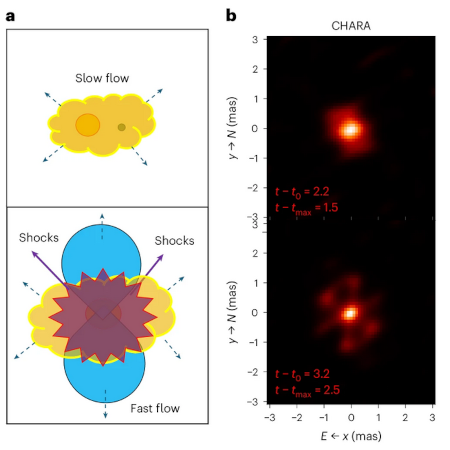
The graphic and images to the right come from figure 1 of the paper, and show the evolution of one of these novae, Nova V1674 Herculis. The initial slow flow along the star’s equator, indicated at the top, acts to force the later fast flow to move out along the star’s poles, as shown at the bottom. From the paper’s abstract:
The images of the very fast 2021 nova V1674 Her, taken just 2–3 days after discovery, reveal the presence of two perpendicular outflows. The interaction between these outflows probably drives the observed γ-ray emission. Conversely, the images of the very slow 2021 nova V1405 Cas suggest that the bulk of the accreted envelope was ejected more than 50 days after the eruption began, as the nova slowly rose to its visible peak, during which the envelope engulfed the system in a common-envelope phase. These images offer direct observational evidence that the mechanisms driving mass ejection from the surfaces of accreting white dwarfs are not as simple as previously thought, revealing multiple outflows and delayed ejections.
Novae are stellar explosions of a much smaller scale than supernovae, and occur when a white dwarf star gathers enough material on its surface stolen from a binary star companion for that material to go critical. Because the stars are binaries, with some systems this process is periodic.
That these better observations, including good high resolution visuals, reveal the explosions are more complicated than “previously thought” should not be a surprise to anyone. In fact, to even suggest that anyone expected the process to be simply is absurd. Whenever we get a better view we discover new details that increase the complexity of any phenomenon.

On Christmas Eve 1968 three Americans became the first humans to visit another world. What they did to celebrate was unexpected and profound, and will be remembered throughout all human history. Genesis: the Story of Apollo 8, Robert Zimmerman's classic history of humanity's first journey to another world, tells that story, and it is now available as both an ebook and an audiobook, both with a foreword by Valerie Anders and a new introduction by Robert Zimmerman.
The print edition can be purchased at Amazon or from any other book seller. If you want an autographed copy the price is $60 for the hardback and $45 for the paperback, plus $8 shipping for each. Go here for purchasing details. The ebook is available everywhere for $5.99 (before discount) at amazon, or direct from my ebook publisher, ebookit. If you buy it from ebookit you don't support the big tech companies and the author gets a bigger cut much sooner.
The audiobook is also available at all these vendors, and is also free with a 30-day trial membership to Audible.
"Not simply about one mission, [Genesis] is also the history of America's quest for the moon... Zimmerman has done a masterful job of tying disparate events together into a solid account of one of America's greatest human triumphs."--San Antonio Express-News
Click for original.
According to new observations of two different recent nova events have shown that the star’s eruption is complex, with multiple outflows moving at both fast and slow speeds.
The graphic and images to the right come from figure 1 of the paper, and show the evolution of one of these novae, Nova V1674 Herculis. The initial slow flow along the star’s equator, indicated at the top, acts to force the later fast flow to move out along the star’s poles, as shown at the bottom. From the paper’s abstract:
The images of the very fast 2021 nova V1674 Her, taken just 2–3 days after discovery, reveal the presence of two perpendicular outflows. The interaction between these outflows probably drives the observed γ-ray emission. Conversely, the images of the very slow 2021 nova V1405 Cas suggest that the bulk of the accreted envelope was ejected more than 50 days after the eruption began, as the nova slowly rose to its visible peak, during which the envelope engulfed the system in a common-envelope phase. These images offer direct observational evidence that the mechanisms driving mass ejection from the surfaces of accreting white dwarfs are not as simple as previously thought, revealing multiple outflows and delayed ejections.
Novae are stellar explosions of a much smaller scale than supernovae, and occur when a white dwarf star gathers enough material on its surface stolen from a binary star companion for that material to go critical. Because the stars are binaries, with some systems this process is periodic.
That these better observations, including good high resolution visuals, reveal the explosions are more complicated than “previously thought” should not be a surprise to anyone. In fact, to even suggest that anyone expected the process to be simply is absurd. Whenever we get a better view we discover new details that increase the complexity of any phenomenon.
On Christmas Eve 1968 three Americans became the first humans to visit another world. What they did to celebrate was unexpected and profound, and will be remembered throughout all human history. Genesis: the Story of Apollo 8, Robert Zimmerman's classic history of humanity's first journey to another world, tells that story, and it is now available as both an ebook and an audiobook, both with a foreword by Valerie Anders and a new introduction by Robert Zimmerman.
The print edition can be purchased at Amazon or from any other book seller. If you want an autographed copy the price is $60 for the hardback and $45 for the paperback, plus $8 shipping for each. Go here for purchasing details. The ebook is available everywhere for $5.99 (before discount) at amazon, or direct from my ebook publisher, ebookit. If you buy it from ebookit you don't support the big tech companies and the author gets a bigger cut much sooner.
The audiobook is also available at all these vendors, and is also free with a 30-day trial membership to Audible.
"Not simply about one mission, [Genesis] is also the history of America's quest for the moon... Zimmerman has done a masterful job of tying disparate events together into a solid account of one of America's greatest human triumphs."--San Antonio Express-News