One of Saturn’s many weird moons
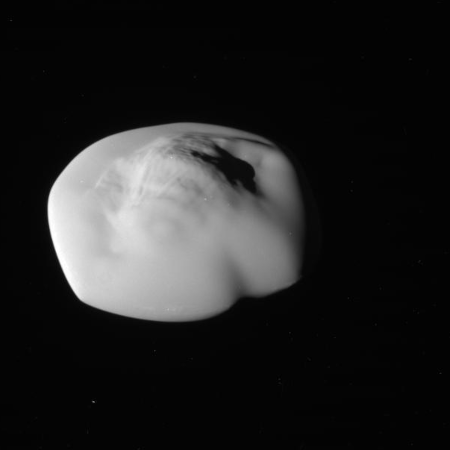
Click for original image.
Cool image time! The picture to the right, cropped and reduced to post here, was taken on April 13, 2017 by the orbiter Cassini as it began it last close loops around Saturn before diving into its atmosphere to burn up.
Those close loops allowed it to get good close-up images of a few of the tiny moons that orbit in or close to the gas giant’s rings. On the right is one of those pictures, of the moon Atlas, taken from a distance of about 10,000 miles.
The moon’s weird ravioli shape is thought to be caused by the accretion of dust and ice from the nearby rings along Atlas’s equator.
Scientists also found the moon surfaces to be highly porous, further confirming that they were formed in multiple stages as ring material settled onto denser cores that might be remnants of a larger object that broke apart. The porosity also helps explain their shape: Rather than being spherical, they are blobby and ravioli-like, with material stuck around their equators. “We found these moons are scooping up particles of ice and dust from the rings to form the little skirts around their equators,” Buratti said. “A denser body would be more ball-shaped because gravity would pull the material in.”
Atlas itself is about 25 miles wide and about 11.5 miles thick, at its thickest point. I suspect if you tried to walk on it you would sink into the accumulated dust and ice, as it is likely no more dense as newly fallen snow.

On Christmas Eve 1968 three Americans became the first humans to visit another world. What they did to celebrate was unexpected and profound, and will be remembered throughout all human history. Genesis: the Story of Apollo 8, Robert Zimmerman's classic history of humanity's first journey to another world, tells that story, and it is now available as both an ebook and an audiobook, both with a foreword by Valerie Anders and a new introduction by Robert Zimmerman.
The print edition can be purchased at Amazon or from any other book seller. If you want an autographed copy the price is $60 for the hardback and $45 for the paperback, plus $8 shipping for each. Go here for purchasing details. The ebook is available everywhere for $5.99 (before discount) at amazon, or direct from my ebook publisher, ebookit. If you buy it from ebookit you don't support the big tech companies and the author gets a bigger cut much sooner.
The audiobook is also available at all these vendors, and is also free with a 30-day trial membership to Audible.
"Not simply about one mission, [Genesis] is also the history of America's quest for the moon... Zimmerman has done a masterful job of tying disparate events together into a solid account of one of America's greatest human triumphs."--San Antonio Express-News
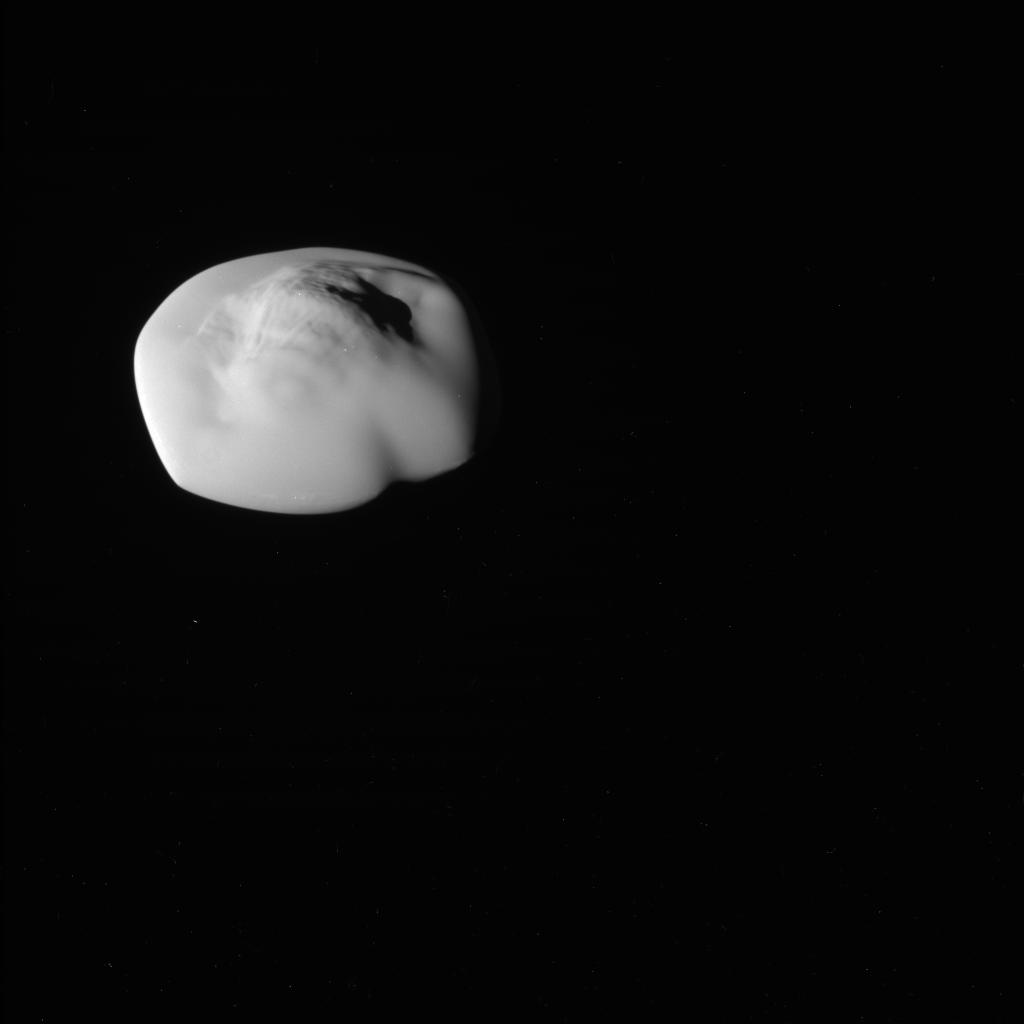
Click for original image.
Cool image time! The picture to the right, cropped and reduced to post here, was taken on April 13, 2017 by the orbiter Cassini as it began it last close loops around Saturn before diving into its atmosphere to burn up.
Those close loops allowed it to get good close-up images of a few of the tiny moons that orbit in or close to the gas giant’s rings. On the right is one of those pictures, of the moon Atlas, taken from a distance of about 10,000 miles.

The moon’s weird ravioli shape is thought to be caused by the accretion of dust and ice from the nearby rings along Atlas’s equator.
Scientists also found the moon surfaces to be highly porous, further confirming that they were formed in multiple stages as ring material settled onto denser cores that might be remnants of a larger object that broke apart. The porosity also helps explain their shape: Rather than being spherical, they are blobby and ravioli-like, with material stuck around their equators. “We found these moons are scooping up particles of ice and dust from the rings to form the little skirts around their equators,” Buratti said. “A denser body would be more ball-shaped because gravity would pull the material in.”
Atlas itself is about 25 miles wide and about 11.5 miles thick, at its thickest point. I suspect if you tried to walk on it you would sink into the accumulated dust and ice, as it is likely no more dense as newly fallen snow.
On Christmas Eve 1968 three Americans became the first humans to visit another world. What they did to celebrate was unexpected and profound, and will be remembered throughout all human history. Genesis: the Story of Apollo 8, Robert Zimmerman's classic history of humanity's first journey to another world, tells that story, and it is now available as both an ebook and an audiobook, both with a foreword by Valerie Anders and a new introduction by Robert Zimmerman.
The print edition can be purchased at Amazon or from any other book seller. If you want an autographed copy the price is $60 for the hardback and $45 for the paperback, plus $8 shipping for each. Go here for purchasing details. The ebook is available everywhere for $5.99 (before discount) at amazon, or direct from my ebook publisher, ebookit. If you buy it from ebookit you don't support the big tech companies and the author gets a bigger cut much sooner.
The audiobook is also available at all these vendors, and is also free with a 30-day trial membership to Audible.
"Not simply about one mission, [Genesis] is also the history of America's quest for the moon... Zimmerman has done a masterful job of tying disparate events together into a solid account of one of America's greatest human triumphs."--San Antonio Express-News
We all know that while OUR moon is made of green cheese, all these tiny Saturnian moons are actually giant cereal marshmallows.
Right?
I suspect you have to have some weight to either walk or sink. On Atlas you would weigh less than a feather so you would not sink or walk.
On the matter of pasta shape analogies, my 16 months working in Milan in the late 1970s causes me to think Atlas looks a lot more tortellini-ish than ravioli-ish, but maybe that’s just me.
That really is a fascinating object. A small rock with a tenuous girdle of dust and ice. I suspect it wouldn’t take much at all to blow the dust and ice clear. The constituents are likely barely in contact; and the ‘skirt’ may be as much as the moon’s feeble gravity can bound.
It’s ravioli.
This really is a fascinating object. A small rock with a tenuous girdle of dust and ice. I suspect it wouldn’t take much at all to blow the dust and ice clear. The constituents are likely barely in contact; and the ‘skirt’ may be as much as the moon’s feeble gravity can bound.
It’s ravioli.