
Pluto and Charon come out of the dark
Click for original image.
Cool image time! I have decided to start delving into the archives of some of the older planetary missions, because there is value there that is often forgotten now years later, that should not be forgotten.
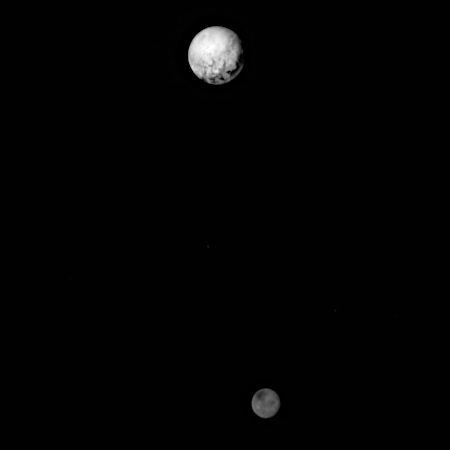
In looking through the archive of images from the main camera on New Horizons as it sped past Pluto in July 2015, I found the picture to the right, taken on July 10, 2015 when New Horizons was still about three million miles away.
This is the raw image from that camera, cropped, reduced, and sharpened to post here. It is also the first time in human history we had a sharp look at these two planets that sit at the outer fringes of the solar system. The science team that day released a version that they enhanced to bring out the details, which I immediately posted. They then noted the following:
A high-contrast array of bright and dark features covers Pluto’s surface, while on Charon, only a dark polar region interrupts a generally more uniform light gray terrain. The reddish materials that color Pluto are absent on Charon. Pluto has a significant atmosphere; Charon does not. On Pluto, exotic ices like frozen nitrogen, methane, and carbon monoxide have been found, while Charon’s surface is made of frozen water and ammonia compounds. The interior of Pluto is mostly rock, while Charon contains equal measures of rock and water ice. “These two objects have been together for billions of years, in the same orbit, but they are totally different,” said Principal Investigator Alan Stern of the Southwest Research Institute (SwRI), Boulder, Colorado.
This difference is quite clear in the raw image, with Charon markedly dimmer than Pluto even though they are getting the same amount of light from the Sun.
More than any other objects in the solar system, the double planet system of Pluto-Charon demonstrates how uniquely different every object in the solar system is from every other object. Even when formed together, as these two planets were, they formed in a manner that made them drastically different.

On Christmas Eve 1968 three Americans became the first humans to visit another world. What they did to celebrate was unexpected and profound, and will be remembered throughout all human history. Genesis: the Story of Apollo 8, Robert Zimmerman's classic history of humanity's first journey to another world, tells that story, and it is now available as both an ebook and an audiobook, both with a foreword by Valerie Anders and a new introduction by Robert Zimmerman.
The print edition can be purchased at Amazon or from any other book seller. If you want an autographed copy the price is $60 for the hardback and $45 for the paperback, plus $8 shipping for each. Go here for purchasing details. The ebook is available everywhere for $5.99 (before discount) at amazon, or direct from my ebook publisher, ebookit. If you buy it from ebookit you don't support the big tech companies and the author gets a bigger cut much sooner.
The audiobook is also available at all these vendors, and is also free with a 30-day trial membership to Audible.
"Not simply about one mission, [Genesis] is also the history of America's quest for the moon... Zimmerman has done a masterful job of tying disparate events together into a solid account of one of America's greatest human triumphs."--San Antonio Express-News

Click for original image.
Cool image time! I have decided to start delving into the archives of some of the older planetary missions, because there is value there that is often forgotten now years later, that should not be forgotten.
In looking through the archive of images from the main camera on New Horizons as it sped past Pluto in July 2015, I found the picture to the right, taken on July 10, 2015 when New Horizons was still about three million miles away.

This is the raw image from that camera, cropped, reduced, and sharpened to post here. It is also the first time in human history we had a sharp look at these two planets that sit at the outer fringes of the solar system. The science team that day released a version that they enhanced to bring out the details, which I immediately posted. They then noted the following:
A high-contrast array of bright and dark features covers Pluto’s surface, while on Charon, only a dark polar region interrupts a generally more uniform light gray terrain. The reddish materials that color Pluto are absent on Charon. Pluto has a significant atmosphere; Charon does not. On Pluto, exotic ices like frozen nitrogen, methane, and carbon monoxide have been found, while Charon’s surface is made of frozen water and ammonia compounds. The interior of Pluto is mostly rock, while Charon contains equal measures of rock and water ice. “These two objects have been together for billions of years, in the same orbit, but they are totally different,” said Principal Investigator Alan Stern of the Southwest Research Institute (SwRI), Boulder, Colorado.
This difference is quite clear in the raw image, with Charon markedly dimmer than Pluto even though they are getting the same amount of light from the Sun.
More than any other objects in the solar system, the double planet system of Pluto-Charon demonstrates how uniquely different every object in the solar system is from every other object. Even when formed together, as these two planets were, they formed in a manner that made them drastically different.
On Christmas Eve 1968 three Americans became the first humans to visit another world. What they did to celebrate was unexpected and profound, and will be remembered throughout all human history. Genesis: the Story of Apollo 8, Robert Zimmerman's classic history of humanity's first journey to another world, tells that story, and it is now available as both an ebook and an audiobook, both with a foreword by Valerie Anders and a new introduction by Robert Zimmerman.
The print edition can be purchased at Amazon or from any other book seller. If you want an autographed copy the price is $60 for the hardback and $45 for the paperback, plus $8 shipping for each. Go here for purchasing details. The ebook is available everywhere for $5.99 (before discount) at amazon, or direct from my ebook publisher, ebookit. If you buy it from ebookit you don't support the big tech companies and the author gets a bigger cut much sooner.
The audiobook is also available at all these vendors, and is also free with a 30-day trial membership to Audible.
"Not simply about one mission, [Genesis] is also the history of America's quest for the moon... Zimmerman has done a masterful job of tying disparate events together into a solid account of one of America's greatest human triumphs."--San Antonio Express-News
I just took a look at the original image Bob has provided, and contemplated how far from Earth they are, the cold empty space around them, and the billions of years this has been so.
Chilling, literally and figuratively.
“These two objects have been together for billions of years, in the same orbit, but they are totally different.”
The Kuiper Belt appears to a *very* fascinating part of the Solar System, one whose existence we did not even suspect only a generation ago. It’s a puty that we’ve really only had one spacecraft to investigate it so far.
It’s not easy or fast or cheap to get out there, either, so it’s gonna be a while before our next closeup look at it.
“””I have decided to start delving into the archives of some of the older planetary missions””
Robert, what I am about to say has a heavy dose of tongue-in-cheek, while at the same time some seriousness. New Horizons in the Older Planetary Missions category?? New Horizons seems like yesterday for those of us who remember the Mercury Seven. The books and podcasts from the main people involved in New Horizons are amazing!
Richard M: “”It’s a pity that we’ve really only had one spacecraft to investigate it so far.””
Yes, and that makes New Horizons all the more amazing.
Yeah, it really is.
We all are frequently critical of NASA and how it does some of its science, but New Horizons really is an achievement that the science mission directorate can take real pride in pulling off. It had to go visit a world (actually, a set of worlds, since it wasn’t just Pluto but all of its moons, with Arrakoth later thrown in for good measure) farther away than humans and their robots had ever visited before, and do it with a less than flagship budget; and yet Alan Stern’s team and APL did it, on budget and on schedule. A lot of great science packed into that little probe. Worth every dollar and then some, I think.
New Horizons should have been a model, both scientifically and managerially, for every other NASA deep space mission that followed. Unfortunately, that has not been the case. Another item on Jared’s ‘to-do’ list.
A tiny glitch: ” … I found the picture to the right, taken on July 10, 2025…”
I’m sure you meant 2015, as in the previous sentence. Great work anyway, Bob!
Ray Van Dune: Typo fixed. Thank you.
“… and yet Alan Stern’s team and APL did it, on budget and on schedule.”
The schedule was all important. In the mid or late 1990s, planetary scientists realized that if we were to investigate Pluto’s atmosphere, we had to get a probe out there before that atmosphere condensed out onto the surface. Thus, timing was all important. If we didn’t get a probe there now, then it would be a couple of centuries before the atmosphere again vaporized into existence.