
Pluto’s mountains of ice surrounded by a sea of frozen nitrogen
Click for original image.
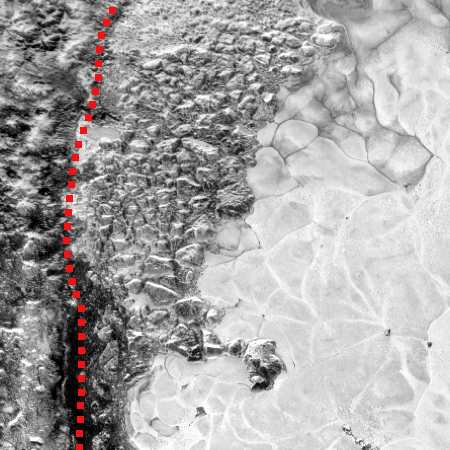
Cool image time! Though we only have a limited archive of high resolution pictures of Pluto that were taken when New Horizons did its close fly-by of the planet in July 2015, it is worthwhile sometimes to take a second look at some of those images. The picture to the right, cropped and annotated to post here, was taken during that July 14, 2015 fly-by, and shows a mountainous region dubbed Al-Idrisi Montes on the shore of a white frozen ocean. The red dotted line indicates a large trench that separates the Al-Idrisi mountains from the mountainous region to the west.
Sounds similar to an arctic shoreline here on Earth, doesn’t it? Not in the least. Those mountains, ranging from 600 to 9,000 feet high, are made of frozen ice, which on Pluto are as hard as granite due to the endless cold. And the white frozen ocean is frozen nitrogen, broken into polygon shaped blocks. Even stranger: those ice mountains might even be floating in that nitrogen sea! A paper from 2019 [pdf] looked at the New Horizons data and concluded as follows:
Evidence suggests that the Al-Idrisi mountains may have been uplifted by the formation of
the western trench feature. Solid state convection appears to be our best supposition as to how the Al-Idrisi Montes reached their heights.
In other words, as that large trench/depression formed, convection (the bubbles you see when you simmer tomato sauce) pushed these mountains of ice upward to float above the “sea level” of that nitrogen sea.
At least, that’s one hypothesis. The scientists who wrote this paper admit their “our hypothesis still remains in need of study and this trench-mountain system warrants serious further research.” In other words, we simply don’t know enough to have a definitive understanding of the geology of this extremely alien planet.

On Christmas Eve 1968 three Americans became the first humans to visit another world. What they did to celebrate was unexpected and profound, and will be remembered throughout all human history. Genesis: the Story of Apollo 8, Robert Zimmerman's classic history of humanity's first journey to another world, tells that story, and it is now available as both an ebook and an audiobook, both with a foreword by Valerie Anders and a new introduction by Robert Zimmerman.
The print edition can be purchased at Amazon or from any other book seller. If you want an autographed copy the price is $60 for the hardback and $45 for the paperback, plus $8 shipping for each. Go here for purchasing details. The ebook is available everywhere for $5.99 (before discount) at amazon, or direct from my ebook publisher, ebookit. If you buy it from ebookit you don't support the big tech companies and the author gets a bigger cut much sooner.
The audiobook is also available at all these vendors, and is also free with a 30-day trial membership to Audible.
"Not simply about one mission, [Genesis] is also the history of America's quest for the moon... Zimmerman has done a masterful job of tying disparate events together into a solid account of one of America's greatest human triumphs."--San Antonio Express-News

Click for original image.
Cool image time! Though we only have a limited archive of high resolution pictures of Pluto that were taken when New Horizons did its close fly-by of the planet in July 2015, it is worthwhile sometimes to take a second look at some of those images. The picture to the right, cropped and annotated to post here, was taken during that July 14, 2015 fly-by, and shows a mountainous region dubbed Al-Idrisi Montes on the shore of a white frozen ocean. The red dotted line indicates a large trench that separates the Al-Idrisi mountains from the mountainous region to the west.
Sounds similar to an arctic shoreline here on Earth, doesn’t it? Not in the least. Those mountains, ranging from 600 to 9,000 feet high, are made of frozen ice, which on Pluto are as hard as granite due to the endless cold. And the white frozen ocean is frozen nitrogen, broken into polygon shaped blocks. Even stranger: those ice mountains might even be floating in that nitrogen sea! A paper from 2019 [pdf] looked at the New Horizons data and concluded as follows:
Evidence suggests that the Al-Idrisi mountains may have been uplifted by the formation of
the western trench feature. Solid state convection appears to be our best supposition as to how the Al-Idrisi Montes reached their heights.
In other words, as that large trench/depression formed, convection (the bubbles you see when you simmer tomato sauce) pushed these mountains of ice upward to float above the “sea level” of that nitrogen sea.
At least, that’s one hypothesis. The scientists who wrote this paper admit their “our hypothesis still remains in need of study and this trench-mountain system warrants serious further research.” In other words, we simply don’t know enough to have a definitive understanding of the geology of this extremely alien planet.
On Christmas Eve 1968 three Americans became the first humans to visit another world. What they did to celebrate was unexpected and profound, and will be remembered throughout all human history. Genesis: the Story of Apollo 8, Robert Zimmerman's classic history of humanity's first journey to another world, tells that story, and it is now available as both an ebook and an audiobook, both with a foreword by Valerie Anders and a new introduction by Robert Zimmerman.
The print edition can be purchased at Amazon or from any other book seller. If you want an autographed copy the price is $60 for the hardback and $45 for the paperback, plus $8 shipping for each. Go here for purchasing details. The ebook is available everywhere for $5.99 (before discount) at amazon, or direct from my ebook publisher, ebookit. If you buy it from ebookit you don't support the big tech companies and the author gets a bigger cut much sooner.
The audiobook is also available at all these vendors, and is also free with a 30-day trial membership to Audible.
"Not simply about one mission, [Genesis] is also the history of America's quest for the moon... Zimmerman has done a masterful job of tying disparate events together into a solid account of one of America's greatest human triumphs."--San Antonio Express-News
Edit Suggestion:
” . . . Though we only have a limited archive of high resolution pictures of Pluto that were taken when New Horizons did its close fly-by of the PLANET!!!!!! in July 2015 . . .”
F: Heh. I see no need to shout. Simply using the word “planet” in describing Pluto makes the point quite well.
So Alien!
This is what I see when I look at this landscape.
There are dozens of craters on the left side of the dotted line but not much ejecta. Older terrain where impacts don’t throw material but turn into gas which snows back down to the surface. Leaving holes that looks like it was melted into a crater shape.
On the right side of the line are very few impacts. This tells me the the rough mountains here are not as old, formed from an impact? in the sea that caused a wave of ice to be deposited on higher terrain.
Impacts at the top right of the picture “melted it’s surroundings” and refilled the crater and caused discoloration as it flowed into the sea, a different substance then the left side of the redline, that did not vaporize that became liquefied for a time.
An Eskimo village at the top left of Alaska is built upon a gravel bar pushed there by pack ice. By tradition, Eskimos fish to survive… But they know to head for higher ground if the wind starts blowing to the east because the ice from the Bering Sea will flow towards them and it doesn’t stop when it hits land. People are killed every year from ice that land, breaks and flips over crushing them as the ice flow piles up sometimes stories high against the shoreline. (they also have a large well-built fence around the village to keep out the polar bears… a bear that does not hibernate)