Rubin Observatory’s first observations detects more than 2,000 asteroids
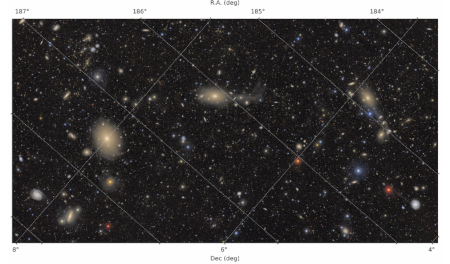
The first look patch, in which 2,103 asteroids
were detected. Figure 1 of the paper.
Scientists have now published the first results from the Rubin Observatory in Chile during its on-going commissioning phase, during which they detected more than 2,000 asteroids in just one patch in the sky, most of which had been unknown previously and many rotating at record-breaking speeds.
You can read the paper here [pdf]. From the press release:
The study presents 76 asteroids with reliable rotation periods. This includes 16 super-fast rotators with rotation periods between roughly 13 minutes and 2.2 hours, and three ultra-fast rotators that complete a full spin in less than five minutes.
All 19 newly identified fast-rotators are longer than the length of an American football field (100 yards or about 90 meters). The fastest-spinning main-belt asteroid identified, named 2025 MN45, is 710 meters (0.4 miles) in diameter and it completes a full rotation every 1.88 minutes. This combination makes it the fastest-spinning asteroid with a diameter over 500 meters that astronomers have found.
All but one of these fast-rotators are in the main asteroid belt, with the exception a near-Earth asteroid.
This work essentially completes Rubin’s commissioning. It will begin full observations in 2026. From the paper:
Toward the start of 2026, the observatory will begin conducting the Legacy Survey of Space and Time (LSST), a decade-long campaign to repeatedly image the southern sky in multiple bands. The main LSST survey will use six filters spanning near-ultraviolet to near-infrared wavelengths, revisiting the same pointing twice each night, returning to take additional pairs every few nights. … The cadence is designed to result in a dataset capable of answering numerous and varied science cases, from understanding the nature of dark energy to discovering and characterizing millions of asteroids, comets, interstellar objects, and transneptunian objects (TNOs) in the solar system.
In building Rubin the astronomers have always thought their biggest problem was archiving and accessing this large dataset, and much work was spent developing a usable and accessible archive system. Even so, it will take thousands of scientists many decades to mine the discoveries that will be hidden there.

On Christmas Eve 1968 three Americans became the first humans to visit another world. What they did to celebrate was unexpected and profound, and will be remembered throughout all human history. Genesis: the Story of Apollo 8, Robert Zimmerman's classic history of humanity's first journey to another world, tells that story, and it is now available as both an ebook and an audiobook, both with a foreword by Valerie Anders and a new introduction by Robert Zimmerman.
The print edition can be purchased at Amazon or from any other book seller. If you want an autographed copy the price is $60 for the hardback and $45 for the paperback, plus $8 shipping for each. Go here for purchasing details. The ebook is available everywhere for $5.99 (before discount) at amazon, or direct from my ebook publisher, ebookit. If you buy it from ebookit you don't support the big tech companies and the author gets a bigger cut much sooner.
The audiobook is also available at all these vendors, and is also free with a 30-day trial membership to Audible.
"Not simply about one mission, [Genesis] is also the history of America's quest for the moon... Zimmerman has done a masterful job of tying disparate events together into a solid account of one of America's greatest human triumphs."--San Antonio Express-News
The first look patch, in which 2,103 asteroids
were detected. Figure 1 of the paper.
Scientists have now published the first results from the Rubin Observatory in Chile during its on-going commissioning phase, during which they detected more than 2,000 asteroids in just one patch in the sky, most of which had been unknown previously and many rotating at record-breaking speeds.
You can read the paper here [pdf]. From the press release:
The study presents 76 asteroids with reliable rotation periods. This includes 16 super-fast rotators with rotation periods between roughly 13 minutes and 2.2 hours, and three ultra-fast rotators that complete a full spin in less than five minutes.
All 19 newly identified fast-rotators are longer than the length of an American football field (100 yards or about 90 meters). The fastest-spinning main-belt asteroid identified, named 2025 MN45, is 710 meters (0.4 miles) in diameter and it completes a full rotation every 1.88 minutes. This combination makes it the fastest-spinning asteroid with a diameter over 500 meters that astronomers have found.
All but one of these fast-rotators are in the main asteroid belt, with the exception a near-Earth asteroid.
This work essentially completes Rubin’s commissioning. It will begin full observations in 2026. From the paper:
Toward the start of 2026, the observatory will begin conducting the Legacy Survey of Space and Time (LSST), a decade-long campaign to repeatedly image the southern sky in multiple bands. The main LSST survey will use six filters spanning near-ultraviolet to near-infrared wavelengths, revisiting the same pointing twice each night, returning to take additional pairs every few nights. … The cadence is designed to result in a dataset capable of answering numerous and varied science cases, from understanding the nature of dark energy to discovering and characterizing millions of asteroids, comets, interstellar objects, and transneptunian objects (TNOs) in the solar system.
In building Rubin the astronomers have always thought their biggest problem was archiving and accessing this large dataset, and much work was spent developing a usable and accessible archive system. Even so, it will take thousands of scientists many decades to mine the discoveries that will be hidden there.
On Christmas Eve 1968 three Americans became the first humans to visit another world. What they did to celebrate was unexpected and profound, and will be remembered throughout all human history. Genesis: the Story of Apollo 8, Robert Zimmerman's classic history of humanity's first journey to another world, tells that story, and it is now available as both an ebook and an audiobook, both with a foreword by Valerie Anders and a new introduction by Robert Zimmerman.
The print edition can be purchased at Amazon or from any other book seller. If you want an autographed copy the price is $60 for the hardback and $45 for the paperback, plus $8 shipping for each. Go here for purchasing details. The ebook is available everywhere for $5.99 (before discount) at amazon, or direct from my ebook publisher, ebookit. If you buy it from ebookit you don't support the big tech companies and the author gets a bigger cut much sooner.
The audiobook is also available at all these vendors, and is also free with a 30-day trial membership to Audible.
"Not simply about one mission, [Genesis] is also the history of America's quest for the moon... Zimmerman has done a masterful job of tying disparate events together into a solid account of one of America's greatest human triumphs."--San Antonio Express-News
https://selenianboondocks.com/2015/04/asteroids-as-transportation-hubs/
10 years ago I suggested rotation as the mechanism for sending samples or even large quantities of ore home.. A beanstalk on a rotating asteroid is feasible. On a rapidly rotating one even more so.
A good idea.
Cables were used to cut Kursk in half…I could see an asteroid turned into a bolt this way… maybe a flyby rotorvator that would need to be only a few hundred miles long.
I know you take a dim view of SLS, but seeing it has an 1,800 km apogee… perhaps in lieu of a typical payload…it could fire a cable for a Nantucket sleigh ride if Starship won’t be ready.
Time to dust off those scifi asteroid mining stories, so we can see how others thought it might be done. Maybe some thoughts that will lead to practical ideas.
Someone suggested looking for fast spinning asteroids because they might house either micro black holes or magnetic monopoles (I can’t remember which). Do any of you remember?
More on asteroids
https://phys.org/news/2026-01-asteroid-impact-simulation-reveals-hidden.html
I forgot noted: “Someone suggested looking for fast spinning asteroids because they might house either micro black holes or magnetic monopoles (I can’t remember which).”
I don’t remember the exact source, but that has Niven and/or Pournelle written all over it.