Russia and India agree to orbit their space stations in the same inclination, the same as ISS
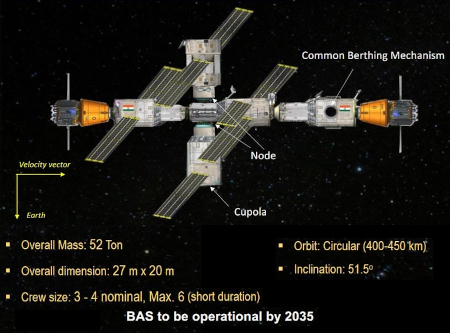
India’s Bharatiya Antariksh Station as outlined in 2024.
Click for original image.
According to statements made by Roscosmos head Dmitry Bakanov at a conference in New Delhi this week, Russia and India have agreed to orbit their planned new space stations in the same inclination as ISS, 51.6 degrees, and coordinate their operations at both stations.
By choosing the same orbital geometry for ROS [Russian Orbital Station] and BAS [Bharatiya Antariksh Station], Moscow and New Delhi are effectively planning a continuous “replacement belt” in low Earth orbit. After the ISS is retired, crewed spacecraft launched from Russia and India would still be able to reach a major laboratory complex without radically changing launch trajectories or infrastructure, and—crucially—could, in principle, travel between the two stations with relatively modest maneuvers compared with a full plane-change.
Bakanov’s New Delhi comments build on a broader Roscosmos–ISRO understanding that the two stations should be able to support cross-visits, resource sharing and coordinated operations once both are flying.
This high inclination is required because spacecraft launching from Russia’s high latitudes can’t reach lower inclinations practically. India could put its station at a lower inclination (being at a lower latitude), but if this story is true, it apparently has decided there are advantages using an orbit that will allow cross-missions with Russia, including launches from Russia.
India plans to launch the first module of its station in 2028, and have the entire station operational by 2035. Russia says it will launch is station’s first module by 2027, with full operations beginning by 2030. While both schedules are likely to see delays, we should expect India to get its station built, while Russia will likely struggle to launch even one module.
In fact, I suspect this deal is Russia’s effort to find some partner that can carry it in the future, when its own station gets delayed.
Instead of a picture of the proposed Russian
station, I give you the Roscosmos logo, which
is about as real as any of Russia’s station
proposals.
Since the fall of the Soviet Union, Russia’s space program has not been able to accomplish much on its own. First it partnered with the U.S. to save Mir in the 1990s (with the U.S. providing the funding to keep the station afloat(. Next in the late 1990s to the present it partnered with the U.S. and the international partnership building ISS, because without further U.S. funding (we paid for one of their modules and provided other aid), they couldn’t have built their own station.
Then in 2021 Russia signed a partnership deal with China to do work together to build a manned Moon base, except that Russia’s contribution appears so far to be nil (as I predicted at that time), so that China is essentially going it alone.
The new commercial stations being built by four different American companies/consortiums have no interest in partnering with Russia. Neither is China with its Tiangong-3 station. Thus, Russia’s eagerness to work out a partnership of some kind with India.
I predict however that India will end up carrying most of the load of this partnership. At best, India’s station might possibly get some Russian components, in exchange with providing Roscosmos a place to send its astronauts, since its own station will not likely ever get launched. And if it does, it will be one to two decades late.

On Christmas Eve 1968 three Americans became the first humans to visit another world. What they did to celebrate was unexpected and profound, and will be remembered throughout all human history. Genesis: the Story of Apollo 8, Robert Zimmerman's classic history of humanity's first journey to another world, tells that story, and it is now available as both an ebook and an audiobook, both with a foreword by Valerie Anders and a new introduction by Robert Zimmerman.
The print edition can be purchased at Amazon or from any other book seller. If you want an autographed copy the price is $60 for the hardback and $45 for the paperback, plus $8 shipping for each. Go here for purchasing details. The ebook is available everywhere for $5.99 (before discount) at amazon, or direct from my ebook publisher, ebookit. If you buy it from ebookit you don't support the big tech companies and the author gets a bigger cut much sooner.
The audiobook is also available at all these vendors, and is also free with a 30-day trial membership to Audible.
"Not simply about one mission, [Genesis] is also the history of America's quest for the moon... Zimmerman has done a masterful job of tying disparate events together into a solid account of one of America's greatest human triumphs."--San Antonio Express-News

India’s Bharatiya Antariksh Station as outlined in 2024.
Click for original image.
According to statements made by Roscosmos head Dmitry Bakanov at a conference in New Delhi this week, Russia and India have agreed to orbit their planned new space stations in the same inclination as ISS, 51.6 degrees, and coordinate their operations at both stations.
By choosing the same orbital geometry for ROS [Russian Orbital Station] and BAS [Bharatiya Antariksh Station], Moscow and New Delhi are effectively planning a continuous “replacement belt” in low Earth orbit. After the ISS is retired, crewed spacecraft launched from Russia and India would still be able to reach a major laboratory complex without radically changing launch trajectories or infrastructure, and—crucially—could, in principle, travel between the two stations with relatively modest maneuvers compared with a full plane-change.
Bakanov’s New Delhi comments build on a broader Roscosmos–ISRO understanding that the two stations should be able to support cross-visits, resource sharing and coordinated operations once both are flying.
This high inclination is required because spacecraft launching from Russia’s high latitudes can’t reach lower inclinations practically. India could put its station at a lower inclination (being at a lower latitude), but if this story is true, it apparently has decided there are advantages using an orbit that will allow cross-missions with Russia, including launches from Russia.
India plans to launch the first module of its station in 2028, and have the entire station operational by 2035. Russia says it will launch is station’s first module by 2027, with full operations beginning by 2030. While both schedules are likely to see delays, we should expect India to get its station built, while Russia will likely struggle to launch even one module.
In fact, I suspect this deal is Russia’s effort to find some partner that can carry it in the future, when its own station gets delayed.
Instead of a picture of the proposed Russian
station, I give you the Roscosmos logo, which
is about as real as any of Russia’s station
proposals.
Since the fall of the Soviet Union, Russia’s space program has not been able to accomplish much on its own. First it partnered with the U.S. to save Mir in the 1990s (with the U.S. providing the funding to keep the station afloat(. Next in the late 1990s to the present it partnered with the U.S. and the international partnership building ISS, because without further U.S. funding (we paid for one of their modules and provided other aid), they couldn’t have built their own station.
Then in 2021 Russia signed a partnership deal with China to do work together to build a manned Moon base, except that Russia’s contribution appears so far to be nil (as I predicted at that time), so that China is essentially going it alone.
The new commercial stations being built by four different American companies/consortiums have no interest in partnering with Russia. Neither is China with its Tiangong-3 station. Thus, Russia’s eagerness to work out a partnership of some kind with India.
I predict however that India will end up carrying most of the load of this partnership. At best, India’s station might possibly get some Russian components, in exchange with providing Roscosmos a place to send its astronauts, since its own station will not likely ever get launched. And if it does, it will be one to two decades late.
On Christmas Eve 1968 three Americans became the first humans to visit another world. What they did to celebrate was unexpected and profound, and will be remembered throughout all human history. Genesis: the Story of Apollo 8, Robert Zimmerman's classic history of humanity's first journey to another world, tells that story, and it is now available as both an ebook and an audiobook, both with a foreword by Valerie Anders and a new introduction by Robert Zimmerman.
The print edition can be purchased at Amazon or from any other book seller. If you want an autographed copy the price is $60 for the hardback and $45 for the paperback, plus $8 shipping for each. Go here for purchasing details. The ebook is available everywhere for $5.99 (before discount) at amazon, or direct from my ebook publisher, ebookit. If you buy it from ebookit you don't support the big tech companies and the author gets a bigger cut much sooner.
The audiobook is also available at all these vendors, and is also free with a 30-day trial membership to Audible.
"Not simply about one mission, [Genesis] is also the history of America's quest for the moon... Zimmerman has done a masterful job of tying disparate events together into a solid account of one of America's greatest human triumphs."--San Antonio Express-News
According to Anatoly Zak at RussianSpaceWeb, the current plan is to use the existing Russian side ISS modules as a starting point, adding just enough capability via new modules that they can separate from the ISS before it’s de-orbited and become their own independent station, similar to Axiom’s plan.
I’m not sure whether that’s in fact a more realistic plan than starting from scratch. It means they have less to do, but it also puts a very short timer on the startup phase. With the way they’ve been operating, I don’t see how Russia can get the necessary modules built and launched before ISS has to be abandoned.
On the other hand, using the ISS inclination does mean that they can use the remaining Proton parts. Which again could be good or bad. In theory it’s great, you have parts ready to build the proven rocket. On the other hand, what’s the condition of those parts?
David Eastman: The Russian plan to use ISS modules in its new station in order to save money while speeding development reminds me of Congress’s plan to use shuttle engines and its solid rocket boosters to save money while speeding the development of SLS.
That sure worked out as planned, didn’t it?
The ISS orbital inclination seems likely to become a standard for the rest of the world – save, of course, the PRC. With the Indians and the Russians now agreed on the ISS inclination, and Axiom as well due to the way it plans to initiate its orbital presence, it would not surprise me if Vast, Starlab and even Orbital Reef, if that ever gets to be a thing, will do likewise to allow for maximum ease of sharing crew and cargo service vessels. That inclination is also good for future purely tourism-oriented stations as it allows people from pretty much anywhere to see their native land from overhead.
It would also allow SpaceX to straightforwardly run a Starship-based “metro bus”-type service that could provide quite inexpensive crew rotation and cargo resupply to multiple stations on a single trip. It could even be a hybrid of cruise ship and metro bus with short stops of a day or two or three at each station to allow face-to-face crew handover, containerized cargo drop-off/pick-up and for at least some of the “cruise ship” passengers to stretch their legs a bit and see the orbital sights. The entire circuit could take perhaps two or three weeks and the strictly tourist passengers could return at the end of it along with returning crews while the dropped-off crews would remain for longer tours on their respective stations. This would allow the tourists to rub elbows with “real astronauts” too, something that I suspect would be a considerable inducement.
David Eastman & Robert Zimmerman,
I’m also quite dubious the Russian ROS plans will ever amount to anything. The Russians might be able to salvage Nauka from ISS, but the rest of their stuff there is leaky junk. Completing and launching any additional station modules looks like an increasing long shot as the Russo-Ukraine War results in destruction of more and more Russian industry and Russia’s finances grow ever more parlous. If Russia flat-out loses the Russo-Ukraine War – an increasingly likely possibility – then the nation, itself, will crumble into ethnicity-based chunks with a rump Russia having far more pressing concerns than another dinky space station in an orbit it will barely be able to reach from Vostochny – assuming Vostochny is even still in Russian-controlled territory by then.
The Indians, on the other hand, are going to build BAS and are likely already bending metal toward that end. They’ll be good neighbors in the ISS orbit. Perhaps, for old time’s sake, they will occasionally launch and host a Russian cosmonaut or two if – as may well prove to be the case – the Russians lose the ability to do so themselves.