Scientists map the outside edge of the Sun’s atmosphere
Using multiple solar observatories in space, scientists have now been able to map the approximate location of the outside edge of the Sun’s atmosphere, the point “where the speed of the outward solar wind becomes faster than the speed of magnetic waves.”
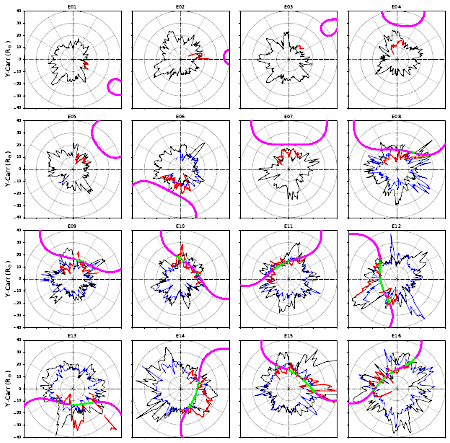
The panels to the right are a sampling of that mapping, and is figure 3 of the peer-reviewed paper [pdf]. The bulk of the data (black) comes from five spacecraft observing the Sun from the L1 point a million miles from Earth. The blue line is data from Solar Orbiter, while the red line is data from the Parker Solar Probe. From the press release:
Astronomers have produced the first continuous, two-dimensional maps of the outer edge of the Sun’s atmosphere, a shifting, frothy boundary that marks where solar winds escape the Sun’s magnetic grasp. By combining the maps and close-up measurements, scientists from the Center for Astrophysics | Harvard & Smithsonian (CfA) showed that the boundary grows larger, rougher and spikier as the Sun becomes more active.
…The boundary in the Sun’s atmosphere where the solar wind’s outward speed becomes faster than the speed of magnetic waves, known as the Alfvén surface, is the “point of no return” for material that escapes the Sun and enters interplanetary space; once material travels beyond this point, it cannot travel back to the Sun. This surface is the effective “edge” of the Sun’s atmosphere, and provides scientists with an active laboratory for studying and understanding how solar activity impacts the rest of the solar system, including life and technology on and around Earth.
This new data further refines the nature of the boundary, as earlier probes had already given scientists a rough idea of its size and nature.

On Christmas Eve 1968 three Americans became the first humans to visit another world. What they did to celebrate was unexpected and profound, and will be remembered throughout all human history. Genesis: the Story of Apollo 8, Robert Zimmerman's classic history of humanity's first journey to another world, tells that story, and it is now available as both an ebook and an audiobook, both with a foreword by Valerie Anders and a new introduction by Robert Zimmerman.
The print edition can be purchased at Amazon or from any other book seller. If you want an autographed copy the price is $60 for the hardback and $45 for the paperback, plus $8 shipping for each. Go here for purchasing details. The ebook is available everywhere for $5.99 (before discount) at amazon, or direct from my ebook publisher, ebookit. If you buy it from ebookit you don't support the big tech companies and the author gets a bigger cut much sooner.
The audiobook is also available at all these vendors, and is also free with a 30-day trial membership to Audible.
"Not simply about one mission, [Genesis] is also the history of America's quest for the moon... Zimmerman has done a masterful job of tying disparate events together into a solid account of one of America's greatest human triumphs."--San Antonio Express-News
Using multiple solar observatories in space, scientists have now been able to map the approximate location of the outside edge of the Sun’s atmosphere, the point “where the speed of the outward solar wind becomes faster than the speed of magnetic waves.”
The panels to the right are a sampling of that mapping, and is figure 3 of the peer-reviewed paper [pdf]. The bulk of the data (black) comes from five spacecraft observing the Sun from the L1 point a million miles from Earth. The blue line is data from Solar Orbiter, while the red line is data from the Parker Solar Probe. From the press release:
Astronomers have produced the first continuous, two-dimensional maps of the outer edge of the Sun’s atmosphere, a shifting, frothy boundary that marks where solar winds escape the Sun’s magnetic grasp. By combining the maps and close-up measurements, scientists from the Center for Astrophysics | Harvard & Smithsonian (CfA) showed that the boundary grows larger, rougher and spikier as the Sun becomes more active.
…The boundary in the Sun’s atmosphere where the solar wind’s outward speed becomes faster than the speed of magnetic waves, known as the Alfvén surface, is the “point of no return” for material that escapes the Sun and enters interplanetary space; once material travels beyond this point, it cannot travel back to the Sun. This surface is the effective “edge” of the Sun’s atmosphere, and provides scientists with an active laboratory for studying and understanding how solar activity impacts the rest of the solar system, including life and technology on and around Earth.
This new data further refines the nature of the boundary, as earlier probes had already given scientists a rough idea of its size and nature.
On Christmas Eve 1968 three Americans became the first humans to visit another world. What they did to celebrate was unexpected and profound, and will be remembered throughout all human history. Genesis: the Story of Apollo 8, Robert Zimmerman's classic history of humanity's first journey to another world, tells that story, and it is now available as both an ebook and an audiobook, both with a foreword by Valerie Anders and a new introduction by Robert Zimmerman.
The print edition can be purchased at Amazon or from any other book seller. If you want an autographed copy the price is $60 for the hardback and $45 for the paperback, plus $8 shipping for each. Go here for purchasing details. The ebook is available everywhere for $5.99 (before discount) at amazon, or direct from my ebook publisher, ebookit. If you buy it from ebookit you don't support the big tech companies and the author gets a bigger cut much sooner.
The audiobook is also available at all these vendors, and is also free with a 30-day trial membership to Audible.
"Not simply about one mission, [Genesis] is also the history of America's quest for the moon... Zimmerman has done a masterful job of tying disparate events together into a solid account of one of America's greatest human triumphs."--San Antonio Express-News
(have not read the original)
“where the speed of the outward solar wind becomes faster than the speed of magnetic waves”
I was under the assumption magnetic waves travel at the speed of light. How would solar wind exceed that speed?
The intensity of magnetic waves however does drop off as you square the distance.
(having a problem conceptualizing this…)
Magnetism is a force created by an electrical flow.(instantaneous) The Soho satellite will detect a magnetic event nearly 8 minutes before they see the eruption on the sun. It appears their choice of words is unfortunate or ignorance.
“The Solar wind plasma” is the source of the “magnetic fields” created by a ionized electrical current.
As a flow of plasma expands beyond the stronger field lines of the sun causing/inducing a current in the plasma generating more magnetic fields “internally separate” from the chromosphere plasma where most of the Sun’s magnetic field, all the solar wind, light, and heat of the sun originate.
The magnetic field settles down when the plasma is beyond the boundary of the suns more dense atmosphere… it expands and goes quiet… Until it hits an object like the earth and suddenly you have the Carrington event generating so much magnetic flux that the induced current in wires electrocute the people running the telegraph machines.
This is the biggest fear for space travel, some believe they can collect this energy and use it for propulsion. Science needs to be performed “outside” earths magnetic field to find out if degaussing fields like used on battleships and submarines will protect the people and cargo.
“Solar Physics: The solar wind is the extension of the Sun’s hot and ionized corona, and it exists in a state of continuous expansion into interplanetary space. The radial distance at which the wind’s outflow speed exceeds the phase speed of Alfvénic and fast-mode magnetohydrodynamic (MHD) waves is called the Alfvén radius. In one-dimensional models, this is a singular point beyond which most fluctuations in the plasma and magnetic field cannot propagate back down to the Sun“
(The difference between a closed loop event and a open loop where the material exceeds the gravitational and the magnetic force of the sun)
“Combined with recent perihelia of Parker Solar Probe, these studies seem to indicate that the Alfvén surface spends most of its time at heliocentric distances between about 10 and 20 solar radii.”
Gravity is also a force, instantaneous, but gets weaker at the square of the distance just like magnetism. Easy to prove with gravity detectors common on satellites now… But if knowledge was widely known, billions of dollars of science funding would dry up. (Ignorant congressmen…A fool and his money are quickly departed, A fool with somebody else’s money…)