
Scientists produce new estimate of the thickness of Europa’s icy crust
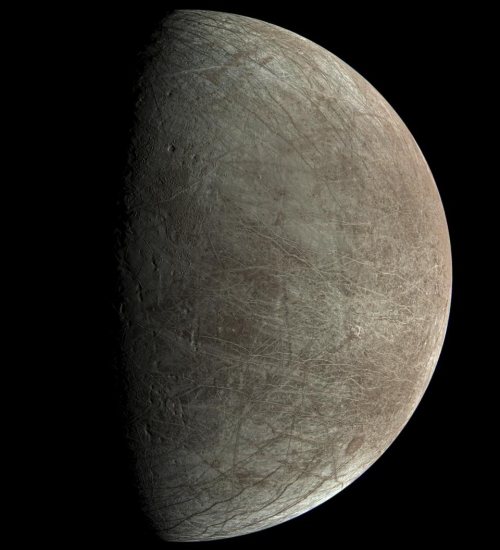
Europa in true color, taken by Juno during that
September 2022 fly-by. Click for full image.
Using data produced by Juno during a 2022 close-fly of Jupiter’s moon Europa, scientists have made a new estimate of the thickness of Europa’s icy crust, approximately 18 miles thick with a 6-mile margin of error.
In other words, their estimate could be as small as 12 miles thick, or as large as 24 miles thick.
You can read their paper here. From their abstract:
For the idealized case of pure water ice, the data are consistent with the existence of a thermally conductive ice shell with a thickness of 29 ± 10 km [18 ± 6 miles] and with the presence of cracks, pores or other scatterers extending to depths of hundreds of metres below the surface with a characteristic size smaller than a few centimetres in radius. An ice-shell salinity of 15 mg kg−1, as indicated by models based on terrestrial marine ice, would reduce our estimate of the thickness of the ice shell by about 5 km, substantially less than our 10 km uncertainty. The low volume fraction, small size and shallow depth of the scatterers indicate that the fracture interfaces observed at Europa’s surface are alone unlikely to be capable of carrying nutrients between the surface and the ocean. [emphasi mine]
The highlighted sentence is the important one. If this new estimate is right, than the unidentified reddish material that appears to leak out of the long ridgelike cracks on Europa’s surface, clearly visible in the picture to the right, are not coming from any underground ocean. The distances are too large.
Other estimates have suggested that ice crust could be as thin as 2 miles, but like this research the uncertainties are very large.
Meanwhile, the Juno mission is still alive, though essentially winding down operations. The mission was expected to officially end at the end of September 2025, when its budget ran out, but the just passed budget included enough money to keep it going, albeit at a relatively low level. According to the orbiter’s webpage, it will continue to orbit Jupiter, its orbit degrading naturally until it falls into Jupiter to burn up. As it does so data will continue to be collected, though at a much lower rate.

On Christmas Eve 1968 three Americans became the first humans to visit another world. What they did to celebrate was unexpected and profound, and will be remembered throughout all human history. Genesis: the Story of Apollo 8, Robert Zimmerman's classic history of humanity's first journey to another world, tells that story, and it is now available as both an ebook and an audiobook, both with a foreword by Valerie Anders and a new introduction by Robert Zimmerman.
The print edition can be purchased at Amazon or from any other book seller. If you want an autographed copy the price is $60 for the hardback and $45 for the paperback, plus $8 shipping for each. Go here for purchasing details. The ebook is available everywhere for $5.99 (before discount) at amazon, or direct from my ebook publisher, ebookit. If you buy it from ebookit you don't support the big tech companies and the author gets a bigger cut much sooner.
The audiobook is also available at all these vendors, and is also free with a 30-day trial membership to Audible.
"Not simply about one mission, [Genesis] is also the history of America's quest for the moon... Zimmerman has done a masterful job of tying disparate events together into a solid account of one of America's greatest human triumphs."--San Antonio Express-News
Europa in true color, taken by Juno during that
September 2022 fly-by. Click for full image.
Using data produced by Juno during a 2022 close-fly of Jupiter’s moon Europa, scientists have made a new estimate of the thickness of Europa’s icy crust, approximately 18 miles thick with a 6-mile margin of error.
In other words, their estimate could be as small as 12 miles thick, or as large as 24 miles thick.
You can read their paper here. From their abstract:
For the idealized case of pure water ice, the data are consistent with the existence of a thermally conductive ice shell with a thickness of 29 ± 10 km [18 ± 6 miles] and with the presence of cracks, pores or other scatterers extending to depths of hundreds of metres below the surface with a characteristic size smaller than a few centimetres in radius. An ice-shell salinity of 15 mg kg−1, as indicated by models based on terrestrial marine ice, would reduce our estimate of the thickness of the ice shell by about 5 km, substantially less than our 10 km uncertainty. The low volume fraction, small size and shallow depth of the scatterers indicate that the fracture interfaces observed at Europa’s surface are alone unlikely to be capable of carrying nutrients between the surface and the ocean. [emphasi mine]
The highlighted sentence is the important one. If this new estimate is right, than the unidentified reddish material that appears to leak out of the long ridgelike cracks on Europa’s surface, clearly visible in the picture to the right, are not coming from any underground ocean. The distances are too large.
Other estimates have suggested that ice crust could be as thin as 2 miles, but like this research the uncertainties are very large.
Meanwhile, the Juno mission is still alive, though essentially winding down operations. The mission was expected to officially end at the end of September 2025, when its budget ran out, but the just passed budget included enough money to keep it going, albeit at a relatively low level. According to the orbiter’s webpage, it will continue to orbit Jupiter, its orbit degrading naturally until it falls into Jupiter to burn up. As it does so data will continue to be collected, though at a much lower rate.
On Christmas Eve 1968 three Americans became the first humans to visit another world. What they did to celebrate was unexpected and profound, and will be remembered throughout all human history. Genesis: the Story of Apollo 8, Robert Zimmerman's classic history of humanity's first journey to another world, tells that story, and it is now available as both an ebook and an audiobook, both with a foreword by Valerie Anders and a new introduction by Robert Zimmerman.
The print edition can be purchased at Amazon or from any other book seller. If you want an autographed copy the price is $60 for the hardback and $45 for the paperback, plus $8 shipping for each. Go here for purchasing details. The ebook is available everywhere for $5.99 (before discount) at amazon, or direct from my ebook publisher, ebookit. If you buy it from ebookit you don't support the big tech companies and the author gets a bigger cut much sooner.
The audiobook is also available at all these vendors, and is also free with a 30-day trial membership to Audible.
"Not simply about one mission, [Genesis] is also the history of America's quest for the moon... Zimmerman has done a masterful job of tying disparate events together into a solid account of one of America's greatest human triumphs."--San Antonio Express-News
”…scientists have made a new estimate of the thickness of Europa’s icy crust, approximately 18 miles thick with a 6-mile margin of error.”
Fortunately Europa Clipper is on its way to Jupiter* to answer this very question. It’s due to enter orbit about Jupiter in April of 2030.
*Actually, it’s on its way back to Earth for a gravity assist this December after which it will head to Jupiter. Details.
“All these worlds are yours except Europa. Attempt no landing there”
At full size and with some simple enhancement, the Juno image shows quite a bit more cratering on Europa than I recall seeing before on lower resolution images. What, if anything, do these impacts tell us about the nature of its ice crust? As mkent suggests, we will just have to wait until 2030 to find out.
Richard M: Other than scientific reasons, there is absolutely no reason to access liquid water on Europa. For future colonies, there is plenty of ice there, readily available on the surface. There is also ice available on Ganymede and Callisto. And of course, on Mars itself.
I could see a probe following an impactor on the way down, making use of the hole left behind as an entry point.
I am surprised that solar panels worked that far out
Hello Bob,
“Richard M: Other than scientific reasons, there is absolutely no reason to access liquid water on Europa. For future colonies, there is plenty of ice there, readily available on the surface. There is also ice available on Ganymede and Callisto. And of course, on Mars itself.”
Oh, sure, science is all I was thinking of. And of course there have been serious proposals for how NASA might get some sort of robotic probe down into that ocean (like this one by JPL: https://www.jpl.nasa.gov/images/pia25314-cryobot-for-ocean-worlds-exploration-illustration/ ), though it’s obvious that the cost and resources needed for such a thing would be, well, staggering…. I have my doubts that there *is* any sort of life in Europa’s ocean, but sure, it would be wonderful if one day we could actually explore it first-hand, even if presumably long after every one on this site has gone to meet his maker…
One of the obstacles to doing anything around or on the surface of Europa is, of course, the intense radiation of Jupiter’s electromagnetic field, which is why Europa Clipper’s mission has it doing a series of flybys rather than going into orbit around the Moon — it is enough (540 REM or more!) to kill any humans who might go there within a day, at least without some seriously massive shielding. Even a fully robotic surface mission would need hefty shielding for its electronics as well… In this regard, Callisto is the only Galilean moon with radiation levels sufficiently low for any safe human presence, and one day, I don’t doubt, that *is* going to happen. Perhaps even by a Starship!
In the meantime, I am afraid we are going to have to make do with whatever data Europa Clipper and JUICE returns to us from a greater distance in 2030-33.