
Startup focused on mining helium-3 on the Moon teams up with JPL for private rover mission
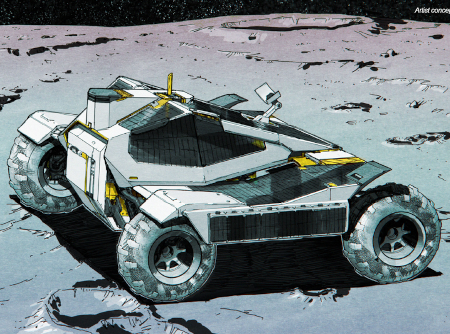
Artist rendering of Black Moon’s Fusion-1 rover
The helium-3 lunar mining startup Black Moon Energy (BMEC) has now signed a partnership deal with JPL to build and send a private rover to the Moon, dubbed Fusion-1, to search for helium-3.
BMEC will lead mission management, resource-assessment strategy, and large-scale operations planning. As global leaders in robotic space exploration, the Jet Propulsion Laboratory (JPL) and Caltech, which manages JPL, have been engaged to oversee the mission’s robotic systems, scientific instrumentation, data acquisition, and mission operations.
…BMEC’s initial year-long lunar expedition will provide the first decision-quality dataset for Helium-3 production operations. Information from the mission will support potential applications in fusion power generation, national security systems, quantum computing, radiation detection, medical imaging, and cryogenic technologies. Insights from the mission will guide BMEC’s long-term strategy for establishing a sustainable cost-effective Helium-3 supply chain from the lunar surface.
A review of Black Moon’s website as well as a search on the web reveals no information about the company’s available capital, so this proposed private mission could be real, or it could be pie-in-the-sky.
Its existence at all however proves the impact that lower launch costs is having. Proposing a private mission such as this before SpaceX would have been met with outright laughter. Now it draws serious interest. It is wholly conceivable to build a low-cost small robotic rover and find affordable launch providers and lunar lander companies that can get it to the Moon.

On Christmas Eve 1968 three Americans became the first humans to visit another world. What they did to celebrate was unexpected and profound, and will be remembered throughout all human history. Genesis: the Story of Apollo 8, Robert Zimmerman's classic history of humanity's first journey to another world, tells that story, and it is now available as both an ebook and an audiobook, both with a foreword by Valerie Anders and a new introduction by Robert Zimmerman.
The print edition can be purchased at Amazon or from any other book seller. If you want an autographed copy the price is $60 for the hardback and $45 for the paperback, plus $8 shipping for each. Go here for purchasing details. The ebook is available everywhere for $5.99 (before discount) at amazon, or direct from my ebook publisher, ebookit. If you buy it from ebookit you don't support the big tech companies and the author gets a bigger cut much sooner.
The audiobook is also available at all these vendors, and is also free with a 30-day trial membership to Audible.
"Not simply about one mission, [Genesis] is also the history of America's quest for the moon... Zimmerman has done a masterful job of tying disparate events together into a solid account of one of America's greatest human triumphs."--San Antonio Express-News
Artist rendering of Black Moon’s Fusion-1 rover
The helium-3 lunar mining startup Black Moon Energy (BMEC) has now signed a partnership deal with JPL to build and send a private rover to the Moon, dubbed Fusion-1, to search for helium-3.
BMEC will lead mission management, resource-assessment strategy, and large-scale operations planning. As global leaders in robotic space exploration, the Jet Propulsion Laboratory (JPL) and Caltech, which manages JPL, have been engaged to oversee the mission’s robotic systems, scientific instrumentation, data acquisition, and mission operations.
…BMEC’s initial year-long lunar expedition will provide the first decision-quality dataset for Helium-3 production operations. Information from the mission will support potential applications in fusion power generation, national security systems, quantum computing, radiation detection, medical imaging, and cryogenic technologies. Insights from the mission will guide BMEC’s long-term strategy for establishing a sustainable cost-effective Helium-3 supply chain from the lunar surface.
A review of Black Moon’s website as well as a search on the web reveals no information about the company’s available capital, so this proposed private mission could be real, or it could be pie-in-the-sky.
Its existence at all however proves the impact that lower launch costs is having. Proposing a private mission such as this before SpaceX would have been met with outright laughter. Now it draws serious interest. It is wholly conceivable to build a low-cost small robotic rover and find affordable launch providers and lunar lander companies that can get it to the Moon.
On Christmas Eve 1968 three Americans became the first humans to visit another world. What they did to celebrate was unexpected and profound, and will be remembered throughout all human history. Genesis: the Story of Apollo 8, Robert Zimmerman's classic history of humanity's first journey to another world, tells that story, and it is now available as both an ebook and an audiobook, both with a foreword by Valerie Anders and a new introduction by Robert Zimmerman.
The print edition can be purchased at Amazon or from any other book seller. If you want an autographed copy the price is $60 for the hardback and $45 for the paperback, plus $8 shipping for each. Go here for purchasing details. The ebook is available everywhere for $5.99 (before discount) at amazon, or direct from my ebook publisher, ebookit. If you buy it from ebookit you don't support the big tech companies and the author gets a bigger cut much sooner.
The audiobook is also available at all these vendors, and is also free with a 30-day trial membership to Audible.
"Not simply about one mission, [Genesis] is also the history of America's quest for the moon... Zimmerman has done a masterful job of tying disparate events together into a solid account of one of America's greatest human triumphs."--San Antonio Express-News
it’s far cheaper to make it with a D-D reactor as Helion is currently doing
https://www.helionenergy.com/articles/how-to-engineer-a-renewable-deuterium-helium-3-fusion-fuel-cycle/
but in the end most likely someone will just invest the billion or so to add a fractional cryogenic distillation step to the current He4 processing (it’s only a few more degrees to separate out He3) and then prices will likely drop from $10M/kg back to near the $100/kg of the 1990s, when no one was yet using the excess we harvested from maintaining the T in nuclear weapons
the only reason it hasn’t already been done is that the market is tiny, only a few kgs per year
but Helion might require around 10kg/year per 50MWe reactor, they have a dozen on order for delivery over the next five years
still, mining it on the Moon is frankly pretty silly :)
It’s only silly if no one can find a way to make it profitable. Sometimes there’s sufficient demand for a good that seemingly silly ideas can still end up worth it, and use in fusion reactors isn’t the only arena where helium-3 will be valuable. Perhaps Helion will be able to scale up production for national security, quantum computing, and so on, but perhaps not, too.
Whether or not mining it on the Moon will ever make sense means answering the questions on the cost to manufacture the necessary hardware, ship it to the lunar surface, and get mined 3He to customers; where the end users are (Musk IIRC has postulated a quantum computing facility on the Moon); is demand elastic or inelastic; are there economies of scale available-and this is not an exhaustive list.